

Wednesday, 10 September 2025, 10:02
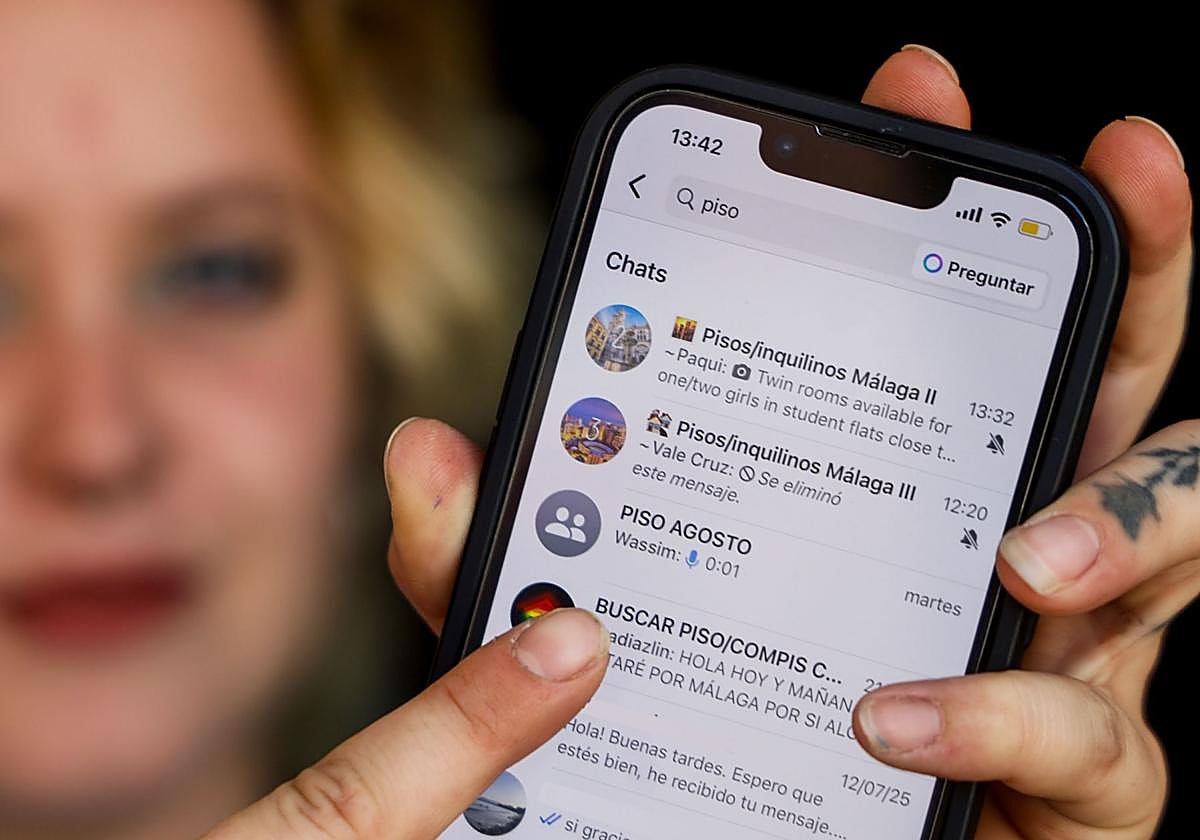
“I don’t even turn to property websites any more. Now I use WhatsApp groups, X, I look at Instagram stories… they’re even offering rooms on TikTok. There are even people who, when they’re looking for flatmates, use social media to show what they’re like, what their hobbies are… because as well as finding someone for the room that’s now free, they also want to make friends”, says María Fuentes. In fact, she has just found an apartment in Malaga via WhatsApp: she will live in La Paz with two other young women and each will pay 290 euros for her own room. “The process of looking for a room is very tedious, you have to talk to a lot of people, but now, through social media, I talk more with tenants than with landlords,” she says.
Flat hunting is a ritual in Spain that has been practised by each generation, especially at this time of the year, when the academic year begins. However, the profile of those who rent a room is no longer only that of students moving to a new city to pursue their dream studies, as there is an increasing number of workers, including those from overseas, who cannot afford to rent a whole apartment.
Nowadays, the search for a place to live is no longer just a matter of reading adverts posted on university bulletin boards, in local shops or plastered on traffic light poles. Classified ads in newspapers and trade publications have been taken over by real estate portals, but even these may be heading towards obsolescence, replaced by WhatsApp, Instagram and TikTok, which have proven to be useful places to look for an apartment or just a room within a shared flat. Sometimes links to property websites are posted on these social media channels and apps but, more often than not, they’re just photos, property details and the type of tenant required. That, or what the person looking for a room needs. The fact is that these groups are packed full of people. Some have already reached the maximum number of members.
Sequence of rising prices
María Fuentes has been renting ever since she arrived in Malaga city from Antequera to study graphic design back in 2021. For her first year, she paid 250 euros monthly in Parque Sur. For her second year she was located in Cristo de la Epidemia, paying around 270 euros, an amount that later rose to 300 euros per month. Then she returned to the same apartment in Parque Sur and was charged the same, 300 euros. In the room where she has temporarily lived this summer, in Carranque, the price has already risen to 350 euros, so she has certainly witnessed the rise in housing prices in Malaga. However, the bill for her new apartment has dropped to 290 euros and she is very happy as it is also only ten minutes from the sea.
A recent report by real estate website Idealista ranked Malaga as the fourth most expensive city in Spain for flatshares, tying with Palma de Mallorca. According to this study, the average price of a room in the Costa del Sol capital is 425 euros, a 6% increase on last year. Ahead of the ranking are Barcelona with an average of 570 euros per room, Madrid (527 euros) and San Sebastian (475 euros). The cheapest provincial capital, meanwhile, is Jaen (240 euros, on average). That same report, while showing a 45% increase in room availability in Malaga, reflected a 19% fall in demand (measured by how many views of listings). This latter figure might be explained by the fact that those looking for accommodation have now turned to social media.
Another real estate portal, Fotocasa, puts the average price of a room in Malaga at over 500 euros and that of Barcelona, the most expensive capital in all of Spain, above 600 euros.
Alfonso del Río Vázquez, head of Planetacasa’s downtown office, is very in touch with prices on the ground and states that room prices in Malaga are around 400 euros, although some can be found at 320 or 350 euros. With additional bills, renting a room can very well reach 500 euros per month.
September to June
In her long experience as a tenant renting different rooms in Malaga city – despite being only 22 years old – María Fuentes has observed something that is confirmed when you pay a little attention to the ads that proliferate in WhatsApp groups these days: rentals are often for the months that coincide with the academic year, from September to June. Then, for the summer, the owners can dedicate the properties to holiday rentals, which are more profitable. In the real estate world, it is said that tourist rentals can even start earlier, coinciding with Easter. It also sometimes happens that landlords abandon the idea of tourist rentals and allow their tenants to stay on over the summer, provided they agree to pay a higher price.
Samantha Bontempi, 26, now lives in a short-term rental apartment in Teatinos.
Marilú Báez
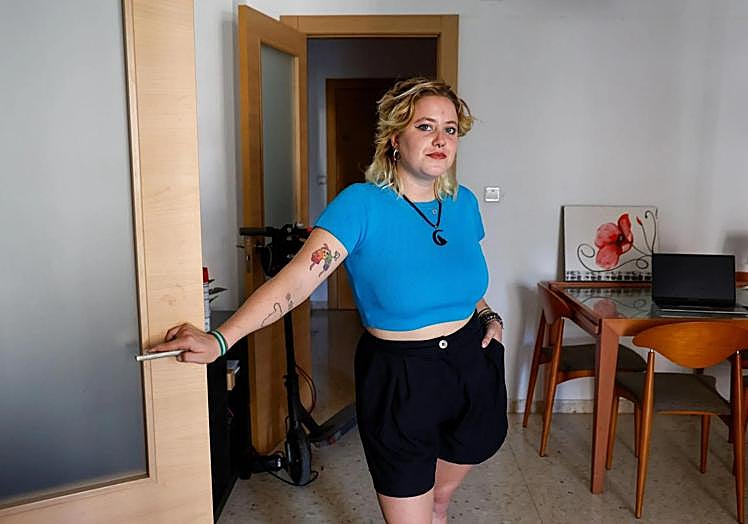
Samantha Bontempi, 26, an Italian resident in Malaga for three years, has been one of those affected by this situation: she needed accommodation for the summer months and is paying 500 euros a month in Teatinos. She is now looking to move in October: “It’s difficult to find accommodation because most of the rentals are from September to June and I want to stay in summer too.” Some tenants say that staying in the same room is so difficult that, in Samantha Bontempi’s case, she has now lived in five apartments that have lasted her less than three years.
She is still looking for a room using the most popular real estate portals, but says that, if these websites are decreasing in popularity, it is because she suspects that most of the listings are from estate agents, and compliance with the law prohibiting charging fees to tenants is not yet fully implemented. Furthermore, she feels that contact with private individuals, with landlords, without intermediaries, is preferred, also including those who are going to be flatmates. However, José Antonio Jiménez, 21, who has been renting a room for the last three years, comments: “I’m the one in charge of finding flatmates, so I use Twitter and WhatsApp, but there are also landlords and estate agents in the groups”, he says.
“It’s difficult to find a room because most of the rentals are from September to June and I want to stay in the summer too.”
In Bontempi’s case, she follows Telegram groups and has also created a Facebook account. Nevertheless, she says that apartments are flying off the shelves and, within minutes of posting the ads, the rooms are no longer available because they’ve been taken. According to data from Idealista, for each listing on its platform for available rooms in Malaga city, there are 38 interested parties. The Spanish average is 22 applicants per room. There again, in Palma and San Sebastián, each listing has over 60 contacts and, in Tarragona, close to 50. The queues no longer form at the doors of the apartments up for rent as they are no longer physical, now the queues are in the ether.
38
interested parties per room
in Malaga, according to Idealista. The Spanish average is 22. In Palma and San Sebastian the figure rises to more than 60 applicants per room.
As for María Fuentes, she perceives that there is a lot of supply, plenty of apartments, lots of rooms, but with problems in three main areas: price, the condition of the apartment and location. Despite the price being high, some apartments, especially in the city centre, are not well-equipped, while the location, especially those most sought by students, needs to be well-connected by public transport, which is not always the case.
José Antonio Jiménez, 21, who has been living in the same apartment for three years, during which time the rent has risen by 100 euros, comments that, as he is in charge of looking for roommates when someone vacates the place, it is difficult for him to find someone. All this despite his belief that demand for rooms is high. Still, from his surroundings, he knows that it is also increasingly difficult to find a room, not just because of the high prices. It is also due to the increasing requirements laid down by landlords: sometimes they ask for up to two or three months’ deposit. María Fuentes adds that the difficulty in finding a room also has to do with the landlords’ preferred tenant profile: a female student with guarantors. The rest have it tougher.
Choice: landlord or tenant?
Victoria Guerrero, 25, provides another example: she found the apartment she lives in by searching on Idealista. It is located in Capuchinos and she pays 367 euros per month plus bills. The total price of the apartment is 1,100 euros and they divide it between the three flatmates, because the contract is a single one, the whole apartment is rented. Since she moved into the property in April 2023, when a roommate leaves, they have their landlord’s permission to look for a new tenant on their own. They usually post stories on Instagram or advertise in WhatsApp groups and also use real estate websites. In the event that they are unable to find anyone on their own, the landlord then delegates the search to an estate agent. Once a suitable candidate is found, whoever leaves the apartment signs their departure and whoever moves in is added to the contract, which stays frozen at 1,100 euros for at least the two years that Victoria has been a tenant.
A landlord’s point of view: “We provide a social benefit, we provide housing when it’s scarce”
Miguel Báez has been renting out two apartments by room for over 20 years. “This is almost a sociological study, because I’ve seen how the profiles have evolved: at first, they were all students, then workers and now increasingly more international. And I attribute this mainly to the fact that Malaga generates a lot of economic activity and many workers come from outside,” explains Báez.
He himself manages the two apartments he owns, which he rents by room in Parque Sur and in Trinidad. He ensures that each apartment is well-equipped and that the tenants have profiles that guarantee tranquility, order, cleanliness, schedules and so on. “The owner has to set the dynamics of the apartment. If you leave the selection in the hands of the tenants, you risk a harmonious coexistence. And the same thing happens if you delegate the task to a real estate agency”, he argues.
He also supports establishing a bond between landlord and tenant: “I want people to stay for a long time, for it to be as stable as possible, so that mutual trust is built. It also helps people feel like the apartment is their home and so they are interested in keeping it in good condition.”
“Demand is high and tenants are easy to find”, he says. He admits that he searches for them via websites like Idealista, but he has recently started using WhatsApp groups too. Long gone are the days when he used to stick up posters in university buildings. He only did that at the very start, some 20 years ago. Now he knows there is a lot of property market activity on TikTok – in fact, his own daughter is looking for an apartment to buy via that app.
The rooms he rents out cost between 425 and 450 euros monthly, bills included and services such as cleaning and property repairs insurance. “A landlord has to be prepared to respond to whatever arises. Some people wash their hands of it.” He adds: “This is a profitable business activity, but you have to work hard at it. It’s not just a matter of hiring anyone. Also, you have to take care of the maintenance and management so that people have peace of mind.” He then takes the opportunity to flag one request: more lenient taxation. “We provide a social benefit: we provide stable housing when it’s scarce, because sometimes it’s easier to find work than finding somewhere to live.”