
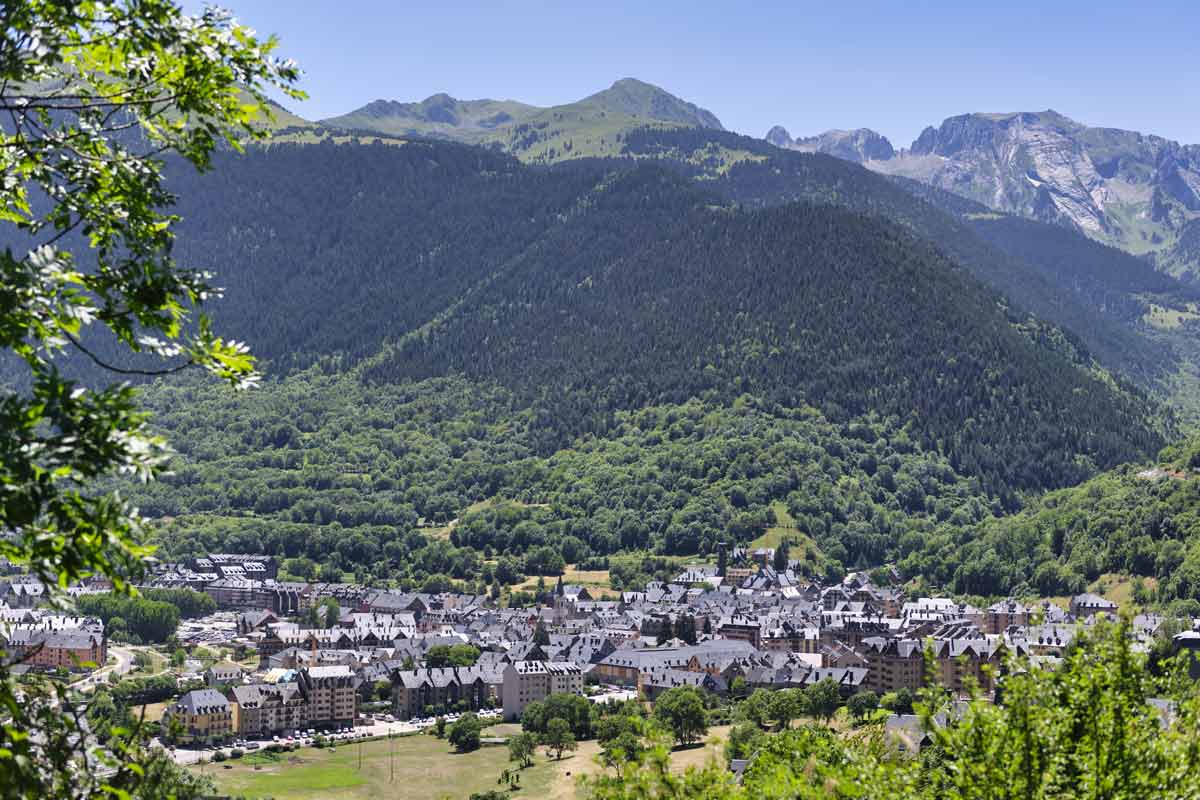
Few towns in the Pyrenees have as much living history as Viella. From its medieval origins as a strategic pass between the Kingdom of Aragon and the south of France, to its prominence during wars, exiles and smuggling, this small high mountain capital has witnessed events that have marked the destiny of the Aran Valley. Defences ordered by Ferdinand the Catholic were erected here to stop French incursions, works of art were hidden here during the Civil War and the longest tunnel in Spain was built under Franco’s regime to bring a whole valley out of isolation.
Although Viella as a municipality has ancient origins (with references already in medieval documents from the 11th century), the current administrative configuration under the name “Vielha e Mijaran” was constituted in 1970 from the merger of six former local entities: Viella, Betren, Escuñau, Casau, Gausac and Vilac. In 1974 Aubèrt was added, thus completing the current municipality. This union made it possible to create a single municipal nucleus that today concentrates a significant part of the population, infrastructures and services of the valley.
It has the particularity of being a valley with an Atlantic orientation, with a great mixture of cultures such as the Roman and Gothic ones, which rises at an altitude of 974 metres between peaks of over 3000 metres. Located at an altitude of 974 metres, at the confluence of the Nere and Garonne rivers, Viella is the main urban centre of the Aran Valley and the natural access point from Spain through the Vielha Tunnel – formerly known as the Alfonso XIII Vielha Tunnel – a key work inaugurated in 1948 that connected the valley, historically isolated, with the rest of Catalonia throughout the year.
The construction of the Vielha Tunnel was promoted under the regime of Francisco Franco, in the context of the historical isolation of the Val d’Aran. For decades it was the longest road tunnel in Spain at 5,240 metres long. It was built for both strategic and socio-economic reasons, given the difficult winter communications between the Val d’Aran and the rest of Catalonia and Spain, as the Port de la Bonaigua was closed for many months of the year due to snow. Given its age and inadequacy in terms of safety standards, a second tunnel was planned in the 1990s. The new “Juan Carlos I” Vielha Tunnel was opened in 2007, with improved safety, lighting and ventilation conditions. The original tunnel was maintained as an evacuation gallery and maintenance passage.
With 3,628 inhabitants in 2023 (according to IDESCAT data), the municipality of Vielha e Mijaran concentrates approximately 40% of the total population of the valley, making it the administrative, economic, educational and health centre of the valley. It is home to the main institutions of Aranese self-government, such as the headquarters of the Conselh Generau d’Aran, the Vielha Hospital, educational and cultural centres and a large part of the valley’s commercial and tourist fabric.

Located in the Catalan Pyrenees, this small town fills up in winter with tourists and local people to practice all kinds of winter sports in the famous resort of Baqueira Beret.
Viella can be visited in a very short time, although due to all the things to see, we recommend that you dedicate at least two days to get to know its spectacular natural environment, visit the small mountain villages and if you like walking, do some hiking.
Here is a list of the best things to see and do in Viella that will help you make the most of the town and its surroundings, so you can have a unique experience.
Historic centre of Viella: witness to the Aranese soul
The town of Viella, situated on the banks of the Garonne and divided in two by the river Nere, is remarkable for its Aranese architecture, characterised by its exposed stone façades, slate roofs and wooden doors and windows.
The old quarter of Viella is laid out around cobbled streets that still preserve their medieval appearance. These narrow streets, which are often pedestrianised, are organised around several historical axes:
-
The Carrer Major, a traditional commercial artery, follows the route of the old Royal Road that crossed the valley.
-
The Passeig de la Llibertat, a tree-lined, panoramic avenue, ideal for enjoying the urban landscape and the surrounding mountains.
-
Bridges over the Nere and Garonne rivers, such as the historic medieval bridge (now disappeared due to a flood in 1937), which formed part of the ancient communication routes between the Pyrenean valleys.
If you take a stroll through the streets of the historic centre, a visit to the church of San Miguel (Sant Miquèu de Viella in Aranese Occitan), in Gothic style with Romanesque and Renaissance elements, is a must. It was begun in the 12th century and extended until the 16th century. Its bell tower, with a fortified appearance, was ordered to be built by Ferdinand the Catholic in 1506 as a defensive symbol in the context of the wars with France.
Inside, visitors will find the unfinished carving of the Christ of Mijaran . This 11th century Romanesque carving is considered one of the jewels of Catalan sacred art and is comparable in importance to the Christ Majesty of Sant Climent de Taüll. The Christ was originally in the Sanctuary of Mijaran, partially destroyed during the Civil War in 1936. The sculpture was plundered and smuggled to Switzerland, from where it was recovered and returned in 1940.
It is also worth visiting the Museum of the Val d’Aran, where you can immerse yourself in the history and way of life of the valley. This is an essential stop to contextualise the tangible and intangible heritage of Viella and its surroundings. Housed in the Torre del General Martinhon, a 17th century noble house, this museum is a continuation of the visit to the old town. Using modern museography, it provides an insight into the history of the Val d’Aran from prehistoric times to the present day, the evolution of the Aranese language (Occitan) and rural customs and traditions, social structures and pastoral and agricultural culture.
And finally, the old Woollen Mill. It was in operation until the middle of the 20th century. Today transformed into an ethnographic museum, this factory recalls the importance of the textile industry in the traditional economy of the valley, especially during the 19th and 20th centuries, when the natural isolation of the valley gave way to an incipient industrial activity linked to Aranese sheep wool.
The historic centre of Viella not only has cultural things to visit, it is also highly recommended that you can go for a drink in the beautiful Passeig dera Libertat, take a photo from the bridge over the river Nere and go shopping in the Avenida Castiero if you are looking for shops specialising in sports equipment, where you can equip yourself for winter sports and hiking.
Outdoor plans in Viella: waterfalls, lakes and viewpoints
In addition to its wealth of heritage and culture, Viella is a privileged gateway to some of the most captivating landscapes in the Catalan Pyrenees. The capital of the Val d’Aran seduces not only for its history, but also for its intimate connection with nature. From waterfalls cascading down among hundred-year-old fir trees to crystal-clear lakes surrounded by alpine forests, each natural spot invites you to stop, contemplate and breathe in the pure mountain air.
The area around Viella is a veritable sanctuary for lovers of active tourism and hiking. Spaces such as the Saut deth Pish waterfall, the Bassa d’Oles lake and the Ròca de Sèrra viewpoints allow visitors to immerse themselves in a landscape shaped by water, altitude and time. These natural gems, accessible both on foot and by vehicle, are ideal for families, hikers and photographers who wish to discover the wildest, quietest and most authentic side of the valley.
Saut Deth Pish waterfall: the most beautiful waterfall in the Aran Valley
One of the best things to do or see in this place is to drive to the Saut Deth Pish waterfall. It is located 17 kilometres northeast of Viella, on the road that leads to the Varradòs valley. Although access is by car, the last part of the route runs along a narrow, winding, mountain road, so driving with caution is recommended. During the winter, access may be closed due to snow or you may need to drive with chains or snow tyres. You can’t get lost getting there. From Viella, take the road to Gausac and continue along the forest track that climbs up to the Varicauba Forest. Car park: There you will find a parking area just 300 metres from the waterfall. From there, you can get there on foot in 5 minutes.
The Saut deth Pish is part of the Varradòs Protected Natural Area, an area of high biodiversity that is included in the Plan for Areas of Natural Interest in Catalonia (PEIN). Its altitude is around 1,500 metres above sea level, and it is surrounded by forests of fir, beech and red pine trees, as well as rich Pyrenean fauna (roe deer, foxes, golden eagles, etc.).
This waterfall has two waterfalls, the main one at a height of 20 metres and the lower one at about 5 metres. To get the best panoramic view, there are several accessible viewpoints located on the right flank of the river. Once you have taken the photos, you can take a hiking route to the Sieso forest and the small mountain lake of Varradós, a beautiful route, full of charm and with an end that has beautiful views and landscapes.
Moreover, this enclave is also the starting point of several hiking routes, ideal for mountain and nature lovers, such as the route to the Lac de Varradòs ( 2h round trip) of easy to moderate difficulty. It is a small glacial lake surrounded by alpine meadows. The panoramic views of the valley are breathtaking. We also recommend the Bosque de Sieso route as it is a perfect option for families. This circular route crosses shady areas, streams and offers multiple observation points for fauna and flora. Both routes are part of the GR 211, a network of long-distance paths in the Val d’Aran, perfectly signposted and maintained.
Bassa d’Oles Lake
Another of the most beautiful spots in Viella is this small lake located at the foot of Montcorbison. There you can take a beautiful walk along its shores, while you enter a forest of firs and spectacular red pines. The route is very simple, perfect for the whole family because of its comfort.
To visit this lake you can go to Gausac, a small village located less than 1 kilometre from Viella, from where there is a tarmac track that climbs for 8 kilometres and crosses the Varicauba forest.
Near the lake there is a free car park where you can leave your car, located in front of a refuge. Once there you will have to follow the signs to reach your destination, enjoying the variety of vegetation found in the area. Once you get there, you will be able to appreciate the surprising transparency of its waters and all the surrounding nature. By the way, just a short distance from the Bassa d’Oles is the Plan Batalhèr, a picnic area equipped with tables, barbecues and drinking water, perfect for enjoying an open-air meal in the middle of nature.
Viewpoints
There are several viewpoints in the town where you can see the town surrounded by imposing mountains and green meadows, such as the Viella Lake and the Ròca de Sèrra.
If there is a downside to these viewpoints, it is that they are only accessible by land, so you will need a suitable car, either a 4×4 or a walking route that takes 3 hours because you will cover 7 kilometres.
As a very useful recommendation, you can choose to go to the village of Cassau, located 5 minutes by car from Viella, on the mountainside and with privileged views of this town.
The medieval bridge of Viella
The medieval bridge of Viella is located next to the fountain and water trough in the main street, which disappeared in the floods of 1937.
This construction formed part of the route of the Royal Road, which ran along the whole of the Aran Valley following the Garonne at the same time as it joined the two banks of the river Nere, which today still form the south-north axis of the town of Viella.
Nowadays, a sign on the bridge over the river Nere reminds us of its history, a great place to have a look at this river that flows into the Garonne.

The banks of the Garonne
The River Garonne is the only river that rises in Spain and flows into France. It rises in the Val d’Aran, in the area of the ski slopes of Baqueira Beret. It is traditionally said that it rises at the source of the Garona in the Uaeh deth Garona, in the pla de Beret, although it seems more appropriate to consider the Saboreo course and the Ratera pass as its point of origin.
In Viella it is joined by the river Nere, which we have mentioned in the previous sections.
Betren
Betren is in the same municipality of Viella Mitg Aran, a small village of 526 inhabitants attached to Viella, so we can say that it is a neighbourhood of the capital of the Aran Valley and some say that it is actually the old town.
It is one of the essential visits in Viella, as everyone comes out of it enchanted. Strolling through its streets between stone houses and rustic courtyards is a real treat.
The 14th century church of San Esteban in this village stands out for its Romanesque art, which is architecturally and sculpturally a blend of Gothic and Gothic.
From Aranese pot to civet: a journey through the flavours of Viella
In Viella, gastronomy is not just a way of eating, but a genuine cultural expression and a window onto the identity of the Val d’Aran. Marked by the high mountain climate and enriched by the fusion of Catalan, Occitan and French influences, the traditional cuisine of this region offers hearty dishes, made with local ingredients and designed to comfort body and soul.
Aranese pot (òlha aranesa)
This is the most iconic dish in the Val d’Aran and a real institution in Viella. It is a thick stew made with meat (beef, chicken, pork), sausages, bacon, bones, noodles, white beans, rice, potatoes and vegetables. Traditionally, it was cooked for hours over a hot fire, which gave it an intense, deep flavour. It is a perfect warming dish and is often served as a starter on winter menus.
Wild boar civet
Traditional stew made with wild boar meat marinated in red wine with aromatic herbs and vegetables, simmered until it reaches a mellow texture. It is a dish of French origin, very common in hunting areas, and a favourite in traditional mountain restaurants.
Truhada
A humble but delicious recipe consisting of mashed potatoes with onion and garlic, to which bacon or lard is sometimes added. It is often served as an accompaniment to meat, but can also be eaten on its own, especially in traditional households.
Stuffed cabbage
Mountain cabbage is blanched and stuffed with a mixture of minced meat, rice and spices before being baked in the oven with a light sauce. It is a typical home-cooked dish for holidays or family gatherings.
Local pâtés and sausages
Homemade pâté, especially of wild boar, deer or liver, is a common part of the starters, accompanied by local bread and jams. In addition, many establishments serve traditional sausages from the valley: sausage, black and white sausage, secallona and cured mountain ham.
Where to eat in Viella: the restaurants we recommend for a taste of the Aran Valley
Viella has a wide range of restaurants, from traditional inns to signature cuisine venues that reinterpret Aranese gastronomy with creativity and elegance. Many restaurants combine seasonal cuisine with tasting menus featuring local produce, paired with wines from Somontano or Priorat.
ETH Bistro
This gastronomic space located in the heart of Viella has real charm and originality that can be appreciated from the very first moment. Its decoration is typical of the mountains, where wood predominates and together with striking handcrafted deer decorations, make it a distinctive feature of this establishment.
It is an ideal restaurant to come with the family thanks to its friendly and attentive atmosphere. The restaurant has a terrace which is open in summer. There is also a private room for 18 people where we find a large fireplace and a beautiful decoration faithful to its very special style. They have a gastronomic proposal that changes from summer to winter, and from winter to summer. Contrasts of flavours between sweet and savoury, sea and mountain mark the ETH seal with originality and personality.
Some recommendations are: trout roe, lobster gazpacho and caviar tasting.
El Racó Brasserie
It is located in the centre of Viella and has an atmosphere and decoration typical of the area. Its specialities include grilled meats, grilled octopus, old cow, churrasco and vegetables with melted cheese. All prepared in front of the diners’ eyes in its “open kitchen”.
Restaurant El Molí
It is a very well known restaurant due to its impressive views. It is a family-run place located in the historic centre of the town and is elegantly decorated but without losing the essence of its medieval stone walls and chill music. It has a glass ceiling and large windows through which you can enjoy views of the village and the river Nere.
It offers typical Pyrenean, Catalan and mountain cuisine, although it also combines traditional and modern cuisine. Among its most popular dishes are: grilled meats, old cow steak, duck leg confit with fig sauce and potato au gratin, etc.
Era Coquèla Restaurant
This is one of the best restaurants to eat in the city. Its fusion dishes of traditional and modern cuisine are highly recommended by its diners. This restaurant offers to book private rooms for events, as its decoration will make you feel at home.
Some of its specialities are: grilled monkfish with seaweed caviar, suckling lamb confit with garlic and orange puree and its white chocolate dessert with yoghurt.