
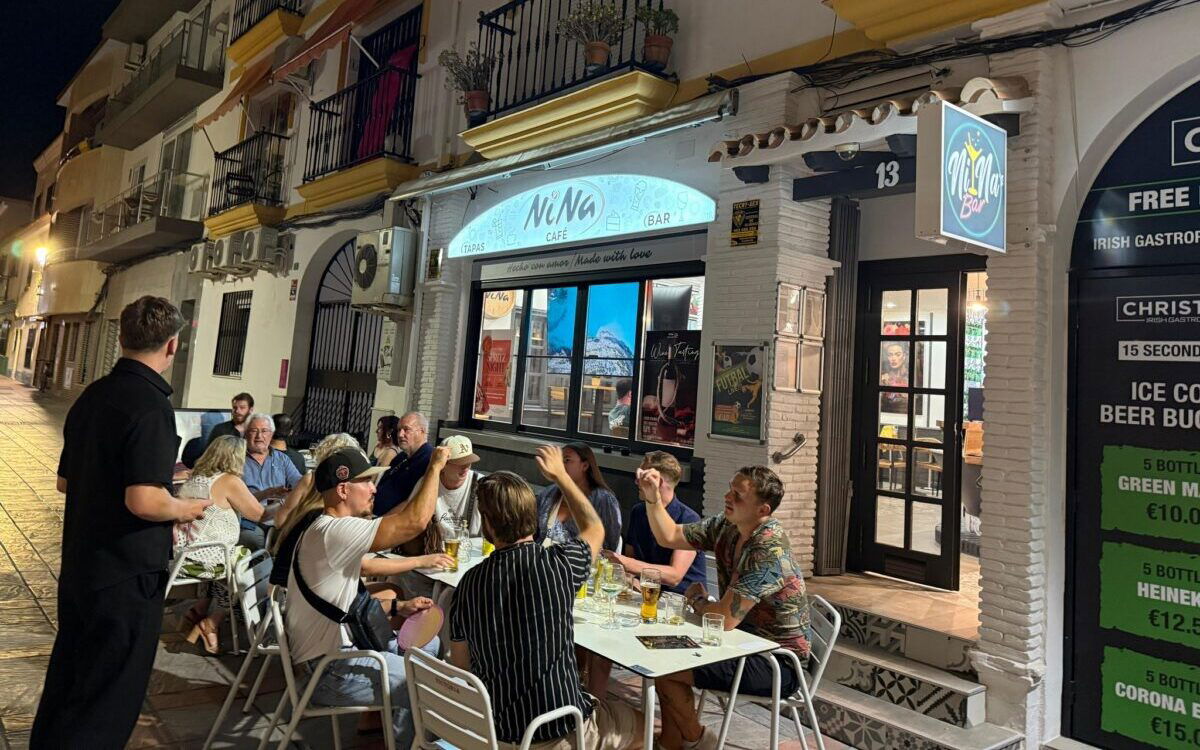
A new interactive map published by Accumin Intelligence reveals that three towns in the province of Malaga are among the top 10 Spanish districts with over 50,000 inhabitants that boast the highest number of bars relative to their population.
The discovery shows the huge benefit of tourism on the local hospitality sector’s density. The national average stands at one bar for every 207 inhabitants across Spain.
Spain likes bars and Costa del Sol towns are in the national spotlight
According to the stats, the three highest-ranking pub-crawlable Malaga Province towns are:
Fuengirola: Ranks 5th nationally with 11.5 establishments per thousand inhabitants. (Population: >85,600; Total Bars: 981)
Torremolinos: Ranks 8th with 10.3 establishments per thousand inhabitants. (Population: 70,920; Total Bars: 734)
Marbella: Ranks 9th with 9.9 establishments per thousand inhabitants. (Population: 159,000; Total Bars: 1,577)
The study’s authors attribute these high ratios directly to the “strong presence” of international and domestic tourism in the coastal hotspots.
National bar density ranking highlights tourism
The 2025 to 2026 map of bar locations across Spain is heavily led by tourist destinations.
The top four municipalities nationwide are:
- Calvia (Balearic Islands): 15.3 bars per 1,000 inhabitants
- Ibiza (Balearic Islands): 14.7
- San Bartolomé de Tirajana (Canary Islands): 14.5
- Benidorm (Alicante): 13.2
- Fuengirola (11.5) completes the top five.
Other touristy-centric capitals like Toledo (11.0), Santiago de Compostela (9.8), and Granada (8.4) also feature prominently in the top 20 list of most boozers. Taking a closer look at the top five, there is something unique about each with a single common factor among all: Their most common denominator is that they are all hugely popular with UK and Irish holidaymakers.
Major cities and Malaga capital
Interestingly, Spain’s largest cities show a lower density ratio. Accumin shows that the sheer volume of people in major urban centres “dilutes the density per population of the commercial activity.”
Barcelona is the only major capital to break into the top 20, and ranks with 7.7 bars per 1,000 inhabitants. Whereas, Madrid has only 6.3 establishments per 1,000 people. Malaga Capital registers a density of 4.3 establishments per 1,000 inhabitants (Population: 592,346; Total Bars: 2,541), placing it lower than its coastal neighbours.
Other Malaga towns found in the study include Benalmadena (7.0), Estepona (5.3), Velez-Malaga (4.5), Mijas (4.2), and Rincon de la Victoria (3.6).
Bar density as a sign of dynamism, or a drink problem?
Gerardo Raido, Marketing Director at Accumin Intelligence, explained the cultural significance of the data. “Where bars abound, there is dynamism, tourism, and community. Where they are lacking, depopulation leaves its mark,” he stated. Provinces like Soria, Palencia, Avila, and Burgos concentrate the highest number of municipalities with no operating bars, indicating areas affected by rural depopulation.
The comprehensive study confirms Malaga’s position as a premier Spanish tourist destination for those who like a tipple, a lively social atmosphere, and where the local economy thrives on a highly concentrated and accessible hospitality sector.