
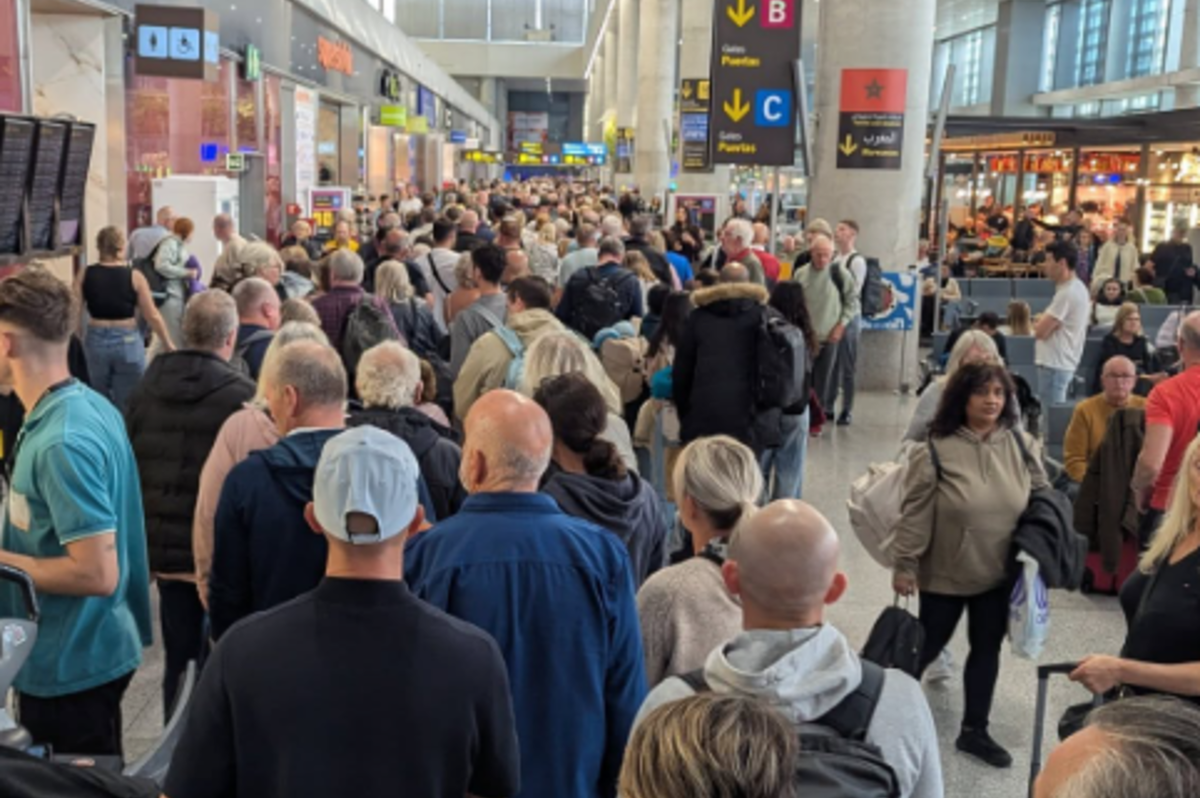
Travelling from Malaga airport – queues. Credit: Facebook, Trevor Tutt.
It’s that wonderful time of year again with the kids about to be off school, airports and train stations filling for families to get home for Christmas, and this year, due to the early onslaught of wintery weather, flu season is back with us. And this year is predicted to be a strong one.
The UK is currently struggling with a severe and early flu season, described by health and education officials as reminiscent of the “Covid times”, as a highly infectious “superflu” strain sweeps across the nation. The outbreak has led to school closures, a tripling of hospitalisations in London, and critical incidents declared in NHS trusts.
Superflu hospitalisations have reached crisis point
The escalating crisis is most visible in schools, where headteachers are reporting alarmingly high sickness rates. St Martin’s in Caerphilly, South Wales, was forced to implement a temporary closure, or ‘firebreak,’ after more than 250 pupils and staff succumbed to a ‘major outbreak of a flu-like illness.’ The affected individuals are reporting a range of symptoms including vomiting, diarrhoea, high temperatures, and fatigue, with an average recovery time of seven days. A deep clean is underway before the school attempts to reopen.
Similarly stark figures emerged from Ebrington Primary School in Northern Ireland, where Principal Brian Guthrie reported 170 pupils off sick on a single day, roughly one-third of the student body. Mr Guthrie said that attendance was worse than during the peak of the Covid-19 pandemic, severely impacting literacy and numeracy lessons. In Northern Ireland, confirmed flu cases among adults and children have more than tripled in the last two weeks, with some needing hospital admission.
Compounding the problem is the appearance of a mutated seasonal flu virus, strain H3, which is reportedly more infectious and seems to be impacting children more seriously. Experts warn this year’s outbreak could be the worst in a decade.
NHS Trust declares “critical incident’
In response to the mounting pressure, University Hospitals of North Midlands NHS Trust have declared a ‘critical incident’ as the Royal Stoke Hospital and Stafford County Hospital faced ‘extremely high demand’, urging patients to only use A&E for life-threatening conditions. In all the chaos, people are being advised to wear masks in public places, while a separate Norovirus outbreak has simultaneously struck down 100 cruise passengers, adding to the health service strain.
The NHS has issued a ‘flu jab SOS’, appealing for increased uptake. Despite the vaccine reducing a child’s likelihood of needing hospital treatment by about 70 per cent, uptake across all ages remains below 50 per cent in Northern Ireland. Data shows under-five-year-olds currently have the highest number of confirmed flu cases, a factor fuelling fears as the infection rate and hospital admissions continue to nearly double week-on-week.
Will compulsory face masks make a comeback?
Localised Requirements (High Likelihood): While a national mandate is unlikely at this stage, it is highly probable that we will see compulsory mask-wearing enforced in specific, high-risk settings, particularly due to the severe flu and other respiratory virus outbreaks.
NHS Settings: Several reports, even from early 2025, indicate that hospitals and NHS health centres in specific, highly affected areas (such as parts of London and other trusts) have already reintroduced mandatory masks for staff, visitors, and sometimes patients, to protect vulnerable individuals and curb the spread of respiratory infections, including the current severe flu.
Flu vs. COVID-19: The decision to reintroduce compulsory measures will be mostly driven by the pressure on NHS capacity from both the circulating flu virus (the H3 ‘superflu’ strain) and any concurrent COVID-19 surges. The highly transmissible nature of the current flu is a major contributing factor this winter.
Added layer of protection from superflu
For those in Spain travelling back for the Christmas holidays, the free flu vaccine in Spain is provided by the National Health System (Sistema Nacional de Salud) and is primarily aimed at at-risk groups during the annual vaccination campaign. These groups typically include people aged 60 years and older, children between 6 and 59 months (in some regions), individuals aged 5 to 59 with chronic risk conditions (such as cardiovascular or respiratory diseases), pregnant women, and essential service personnel (like healthcare and socio-sanitary workers, and police). If you belong to one of these eligible groups, you can easily get the free vaccine by requesting an appointment at your local health centre (centro de salud).