
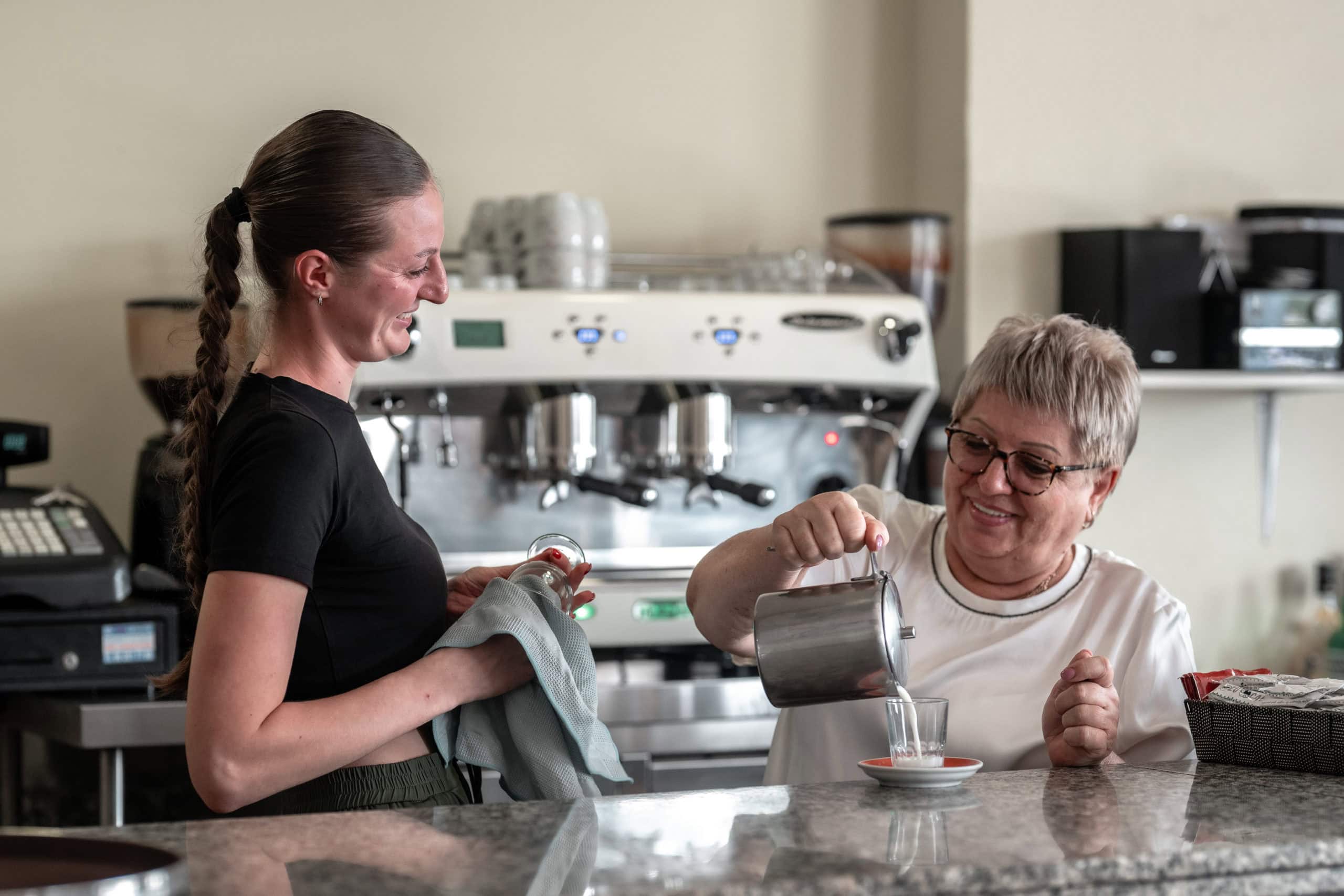
In a small Valencian town shaped by migration and memory, everyday places like lunch bars have become unexpected points of arrival for people displaced by war and economic upheaval. Alberic (Valencia, Spain) is one such place, where new lives quietly take root amid sandwiches, shared routines, and informal networks of support.

When Tamara Shpatar, 65, arrived in Alberic, she only had a backpack, some money, and a piece of paper with the phone number of the only Ukrainian woman living in this Valencian village, which now has 11,000 inhabitants. That woman took her in and gave her a job as a cleaner. More than 25 years later, it is Tamara who welcomes and employs several women who have fled the war in Ukraine in her lunch bar.
One of them is Ruslana. She arrived in 2021, a few months before the war broke out, when there was already talk of a possible conflict. She was 19 at the time. When she started working at Tamara’s bar, all she could say in Spanish was “hello,” “how are you,” “what would you like on your sandwich,” and “what would you like to drink.” She learned the language by working, with books and YouTube videos, before enrolling in adult school. “Then I met Enrique (her partner) and learned a lot more,” Ruslana jokes. Now they live together in a small house with a yard that reminds her of her home in Ukraine.
Tamara had also been forced to leave her country by circumstances: the 1998 Russian financial crisis, which had a spill-over effect on Ukraine. She worked as an accountant, but many factories closed and her children were starting university. She needed money to pay for their studies. She came to Spain with the idea of saving up for a couple of years and then returning, but she liked it so much that she stayed.
Since then, she has never been short of work: she has picked strawberries and oranges, cleaned houses, and served in bars. Until one day a decade ago, the opportunity to rent a bar arose. Since then, she has been running Bar Pastor, one of the best known in the area for doing what is most important in a Valencian village: making lunch sandwiches.
Over the years, the bar has not only become her livelihood, but also a kind of first safe haven for those Ukrainians who have arrived without the language and still feeling fearful. The latest to do so still does not speak Spanish and helps Tamara in the kitchen, while Ruslana is in charge of serving tables. Two other women passed through before finding work in their field. Tamara has not only given them jobs: she has also acted as a translator, accompanied them to the doctor, to school meetings, to whatever was needed.
One of them came from Kherson, one of the areas hardest hit by the war. Her house was destroyed after the Nova Kajovka dam was blown up. Tamara compares the disaster to the flooding in Tous, a town near Alberic, where torrential rains broke the dam in the 1980s and the water from the reservoir completely flooded dozens of municipalities.
“But this wasn’t because of the rain,” she says, “it was because of the war.” In the Valencian region of La Ribera, where the memory of that tragedy is still alive, the story of Kherson does not seem so distant. Alberic has not been immune to the suffering of Ukraine.
When the invasion began in 2022, informal support networks were set up to send aid and welcome those who were gradually arriving, or to help them find a flat to rent, which in recent years has doubled in price in the village.
“They didn’t all come at once, and they are still arriving,” she recalls. “But one year, when school started, there were quite a few new children.”
At the beginning of 2025, there are about 230 people with Ukrainian nationality registered in the town. Compared to the proportion of Ukrainian people in towns in the area, Alberic’s number is considerable. Tamara and Ruslana say that almost all of them are from the same region as them, Bucovina, and that they know about 12 or 13 families: «Half the town! And almost no one wants to go back to Ukraine.» Many have opened businesses—hair salons, nail salons, car repair shops, bars—and their presence has become a natural part of everyday life in the town.
It was a woman from Alberic, the owner of another bar, who taught Tamara the essentials of attracting customers at lunchtime, the most important time of day. Over time, she has perfected her skills.
“Those who come every day don’t say anything, but those who come from outside tell me, ‘What a delicious sandwich!’” She makes them with fresh bread from a local bakery, high-quality ingredients, finely chopped horse meat from the butcher’s, and always uses olive oil, “never sunflower oil,” she points out.
Tamara doesn’t keep her secret to herself. She likes to teach those who work in her kitchen, just as they once did with her. Among those who have passed through there, there is also a Russian woman who later opened her own establishment.
And Tamara is clear on this point: «She is very hard-working and a very good person. It doesn’t matter if she’s Russian or Ukrainian, there are good people and bad people everywhere. Although my little granddaughter, who lives in Ukraine, would disagree. She says that Russians are bad,» she jokes.
Like any grandmother with a smartphone, Tamara treasures hundreds of videos sent to her by her grandchildren. In one, the little girl is helping her father sort small parts for drones made with the 3D printer at his dental clinic. The girl, focused, says she makes the parts because she doesn’t want to be Russian. She says the war will end and they will live in peace, that she will go to school without fear of the alarm and that she won’t have to go down to the basement.
“She’s very afraid of the basement,” says Tamara.
She also has grandchildren who were born here. On Saturdays, they take them to the Ukrainian school in Valencia so they can learn to read and write the language. Sometimes she cooks them borsch, a beetroot soup typical of Ukraine. She only makes it for the family and, from time to time, a friend takes some, but she doesn’t serve it in the bar. “Who wants Ukrainian food? No one. I don’t like it anymore,” she says with a laugh. “There’s no such thing as bad food anywhere, but there’s the custom of eating.”
Every Sunday she goes with her husband to eat paella at a different place. Sometimes she cooks at home, but what she does best is baked rice. At 65, she is only a few months away from retirement, although she is in no hurry. She enjoys opening the bar every morning, seeing the tables full and the comings and goings of lunchtime. She has found her way to happiness in this routine and in preparing many people’s favorite sandwiches.

Funded by the European Union. Views and opinions expressed are however those
of the author(s) only and do not necessarily reflect those of the European Union or the European
Education and Culture Executive Agency (EACEA). Neither the European Union nor EACEA can be held
responsible for them.