
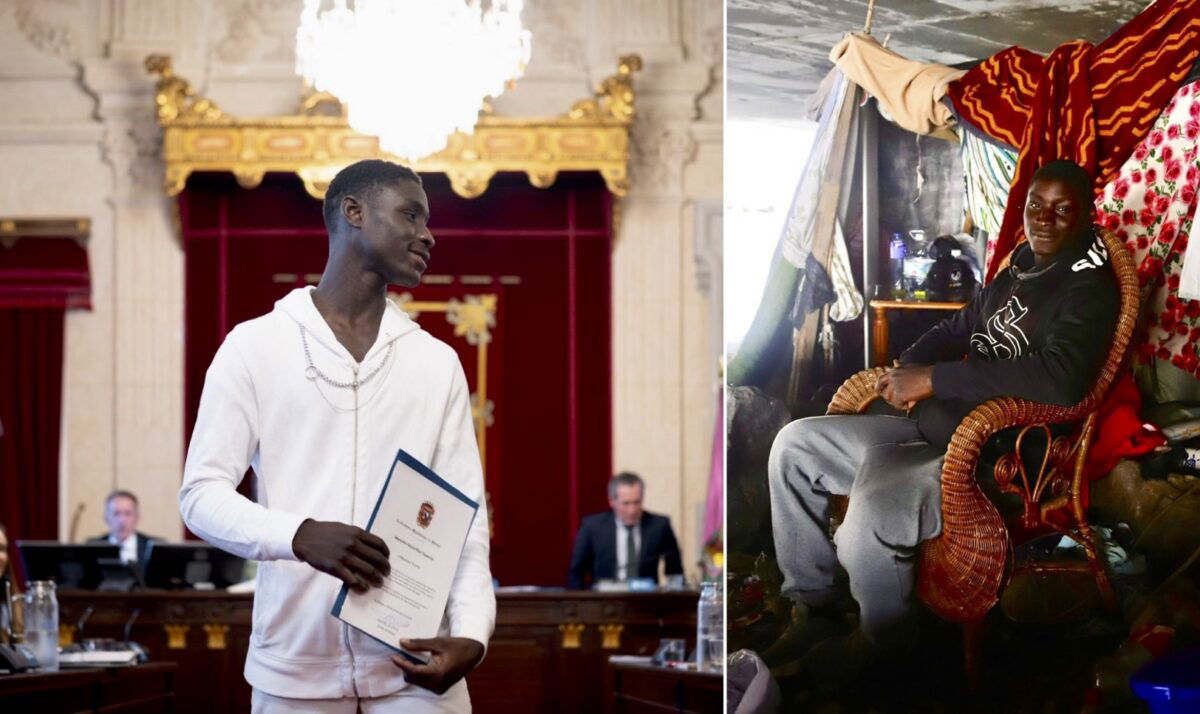
Mansour, from celebrity to living under a bridge.
Credit: Ayuntamiento de Malaga/
Fonsi Loaiza X
In a poignant twist of fate, Mansour Konte, the 20-year-old Guinean asylum seeker who became a celebrated hero in Malaga for rescuing a woman during the devastating 2024 DANA floods and later who portrayed King Balthazar in the city’s 2025 Three Kings Parade, has spent nearly a year living under a bridge in extreme hardship. His story is a reminder of the extreme situation many suffer in winter in Spain.
From perilous small boat crossing to hero of the city
Mansour arrived in Spain five years ago via the perilous Canary Route, fleeing Guinea Conakry at age 15. His life changed dramatically in 2024 when, during the torrential rains from the DANA storm, he spotted a woman paralysed with fear in the rising floodwaters in the street Heroe de Sostoa. Without hesitation, he approached the woman in the rising to find she was frozen with fear, and so he decided to pick her up in his arms and carry her to safety – a moment captured on video that went viral on social media. The act earned him widespread praise, including an honorary mention from the mayor for his heroism and kindness.
The accolades reached a peak when he was selected to play King Balthazar in Malaga’s January 2025 Cabalgata de Reyes Magos, a role chosen to honour his bravery and promote inclusivity, and making a shift away from controversial practices in the parade. Often, persons of note in a town are celebrated by making them one of the kings, leading in many cases to the highly controversial “blacking up” of a white person to play the role of King Balthazar. For the January 2025 parade, Mayor Paco de la Torre announced the end of this practice in Malaga and the choice this year of Mansour.
Mansour – Fleeting symbol of hope
For a brief moment, Mansour symbolised hope and integration for immigrants in Spain. Yet, fame proved fleeting. Seeking stability, Mansour moved to Madrid chasing a promising job offer as a solar panel installer, complete with housing and a €1,500 monthly salary. Reality shattered expectations: he received just €120 a month, forcing him to sleep on the streets in the capital. Destitute, he returned to Malaga with his last earnings, briefly renting a room in the Huelin neighbourhood—only to have his belongings and documents stolen, complicating job searches even further. For 11 months, he survived under the Puente del Carmen (also known as Muelle Heredia), enduring cold, dampness, and hunger, sometimes eating only every three days.
His plight came to light through local media, prompting rapid action. On Christmas Eve 2025, Ana Medina, moved by reports of the former “Rey Baltasar” living invisibly beneath a busy bridge, coordinated with Fundación La Merced Migraciones, the Dehonian congregation and San Antonio de Padua parish; they found Mansour, barefoot and carrying just a bag of clean clothes, and welcomed him into Casa San Juan, a temporary shelter supported by the foundation.
Small acts of kindness and failures of successive governments
Arriving in donated flip-flops, Mansour expressed humble gratitude: a hot shower and a bed were luxuries after months of exposure.
Mansour’s journey – from perilous migration crossing to heroic rescue to celebrity, exploitation, homelessness, and now temporary refuge – is a stark reminder revealing systemic gaps in migrant support. Yet, on Christmas Eve, acts of compassion from individuals and charitable organisations offered him warmth and community.
Article 47 of the Spanish Constitution states that everyone in the country has the inalienable right to decent and adequate housing. Yet successive governments have failed to uphold this right, and so it is down to charitable organisations to do what they can to put a roof over the head of thousands of people like Mansour whenever they can. Meanwhile another estimated 33,000+ sleep rough every night, a number that has doubled in the last two years.