
Congress and Exhibition Palace, Cáceres
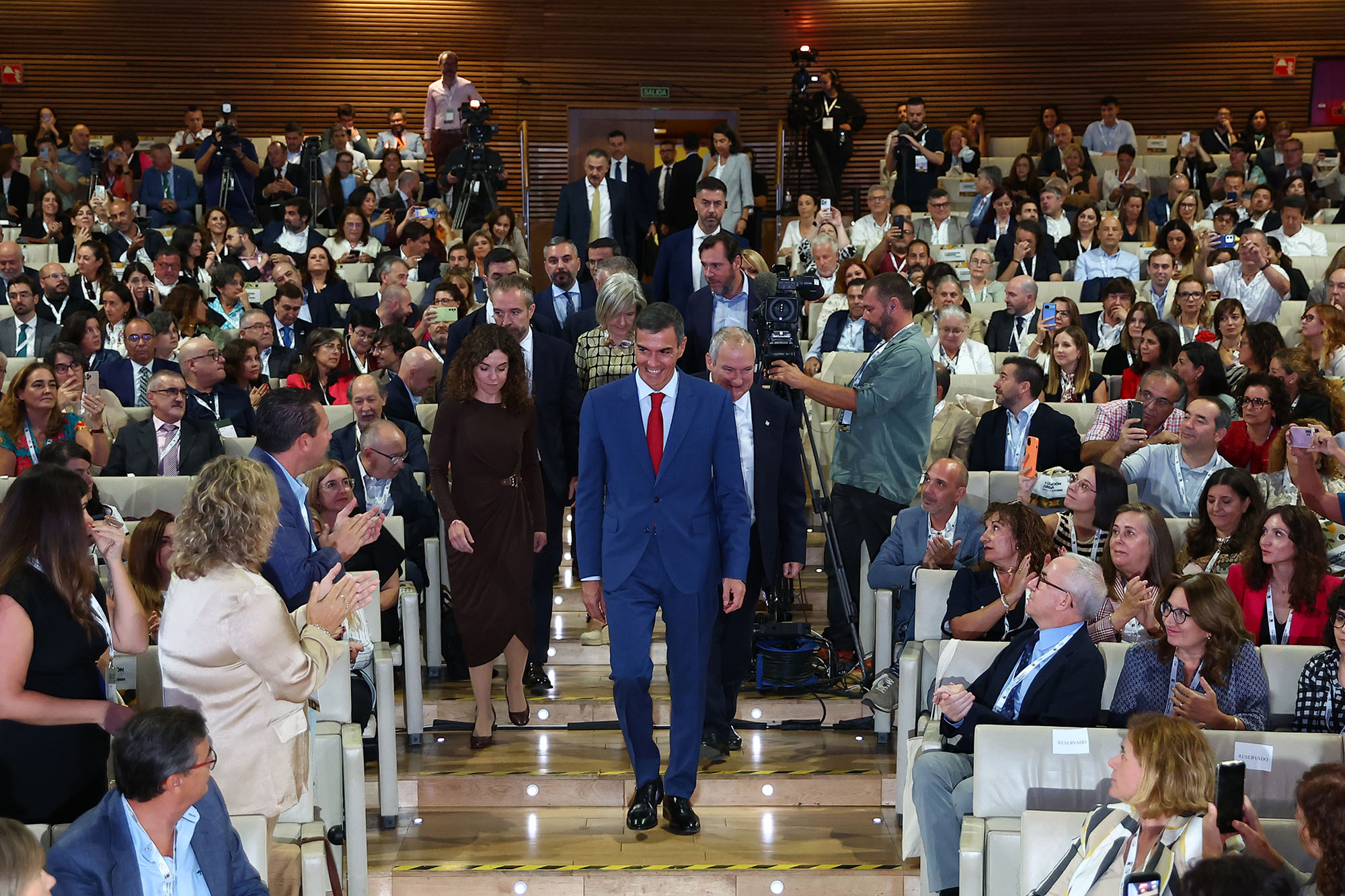
 The President of the Government of Spain, Pedro Sánchez, during the opening day of the 5th Turespaña Convention, held in Cáceres (Pool Moncloa/Fernando Calvo)
Ministers will next week adopt the Spain Tourism Strategy 2030 with “consensus, transversality and modernisation” and incorporating for the first time the climate emergency. This was stated during the presentation of the strategy, held as part of the 5th Turespaña Convention at the Conference and Exhibition Centre in Cáceres (Extremadura), which was also attended by the Minister for Industry and Tourism, Jordi Hereu, and the Minister for Transport and Sustainable Mobility, Óscar Puente.
Pedro Sánchez explained that almost 300 public and private entities have participated in its drafting, including experts in the field, business organisations, tourism companies, workers’ representatives and universities, with a “decisive role” for Conestur. The cross-cutting nature of the strategy is reflected in the 50 measures included from different ministries and organisations, and its modernisation in the commitment to artificial intelligence as a lever of innovation for the sector and to guarantee the well-being of citizens, he explained.
Furthermore, Pedro Sánchez stressed that the strategy represents a “real paradigm shift” because, for the first time, it incorporates the climate emergency as a central factor, with mitigation, adaptation and risk management measures. “We want Spain to be not only the most visited country in the world, but also a global reference for sustainable tourism”, said Pedro Sánchez, who stressed the urgency of a State Pact to combat the climate emergency, for which he asked institutions and political forces to be “up to the challenge”. “Climate change is not a matter of ideology. It is a matter of survival,” he argued.
He encourages everyone to work to ensure we do “not become a victim of our own success” after an “extraordinary” summer
 The President of the Government of Spain, Pedro Sánchez, during his speech at the opening day of the 5th Turespaña Convention, held in Cáceres | Pool Moncloa/Fernando Calvo
The President of the Government of Spain praised the “extraordinary summer for Spain as a destination” and pointed out that “everything points to the fact that 2025, as a whole, will also be extraordinary”, as “we are on the way to surpassing” the historic figures of 2024, with almost 94 million international tourists and an associated expenditure of 126 billion euros. Tourism and all related activities account for 13.2% of employment in Spain and generate 12.3% of GDP. “Behind these figures is the shared effort of the sector’s professionals and the support of all the administrations. But also of our fellow citizens”, said Pedro Sánchez, since “if Spain attracts and captivates, it is also because our way of being and living is captivating”. For this reason, he encouraged everyone to work to protect the human factor and the sector, as “we cannot afford to become a victim of our own success”.
Tourist apartments and job quality
“Together, we have turned Spain into the best destination on the planet. And together, we have to take care of it”, he remarked, urging everyone to work for the sustainability of tourism activity and to tackle challenges such as gentrification, which affects 27% of the residents of tourist cities, and tourist apartments, whose boom “has a direct impact on the right to access decent housing in many cities”. In this regard, he argued that “tourism fills our cities with life, but it cannot empty our neighbourhoods of their residents”, which is why the Government has launched a measure to put an end to holiday rental fraud and to remove 54,000 illegal holiday apartments from holiday rental portals and platforms.
“We all need to understand that the people who live in these areas, which are under enormous pressure, are not just part of the scenery. They are their soul and their essence”, he said, which is why he advocated “putting people at the centre of the model” and investing in sustainability. In this regard, he announced the creation of a Tourist Housing Observatory in the Secretariat of State for Tourism, with the mandate to draw up an “atlas of tourist intensity by neighbourhood”. As he explained, this observatory will serve to provide transparency and better reconcile tourism and coexistence with residents, especially with regard to their cost of living. Along the same lines, he pointed out that progress will continue to be made in the regulation of temporary rentals, taking into account the different realities and impacts that this activity has in the different territories.
He also referred to the challenge of employment quality in tourism, despite the fact that “a lot” of progress has been made. The average wage per worker in hospitality has grown by more than 18% since 2018 and temporary employment has fallen by 31 points, but “we came from a long way back and that means the progress made is relative, so it is key to keep moving forward”.
Seasonality, diversification, digitalisation and new markets
 The Minister for Industry and Tourism, Jordi Hereu, the President of the Government of Spain, Pedro Sánchez, and the Minister for Transport and Sustainable Mobility, Óscar Puente, along with other authorities | Pool Moncloa/Fernando Calvo
The head of the Executive has urged reflection on the tourism model in Spain and has defended as the only possible response the sustainability of the model in the “economic, employment, territorial, climatic and human” spheres, which “builds the future, instead of mortgaging it”. Nevertheless, he celebrated the fact that in recent years “milestones that we thought were unattainable” have been surpassed, as the “wall of seasonality” is being broken down. Low season arrivals are growing at rates of over 27%, almost triple the high season increases. He also highlighted the diversification of destinations, with the tripling of overnight stays in rural tourism in two decades, and the promotion of digitalisation, especially for SMEs, through an intelligent destination platform, an international pioneer, for a public tourism data ecosystem. At the same time, he referred to the opening up to new issuing markets, with strong growth in the last year in long-distance tourists, such as those from Japan, China and Latin America, while maintaining stable flows from markets that are important for Spain such as the British and German markets.
Finally, he mentioned the commitment to the quality of tourist services. “Behind this paradigm shift is an unprecedented investment effort, with more than 3.4 billion euros earmarked to transform our model,” he recalled, urging, however, to anticipate and plan ahead. “This government is with you to continue updating, modernising, anticipating what is needed for the tourism model and to make the best of our present without putting at risk the future of the next generations,” he added.
40th anniversary of Turespaña and legacy of Guillermo Fernández Vara
The President of the Government of Spain congratulated Turespaña on its forty years of “commitment to the service of tourism in Spain”, an anniversary that is being celebrated in Cáceres, a World Heritage City, which together with Extremadura “is a top destination”. He also wanted to highlight the legacy of the former president of Extremadura, Guillermo Fernández Vara, who died just a few days ago, and his “commitment to the land of Extremadura and his conviction and vision of progress”.
Non official translation