
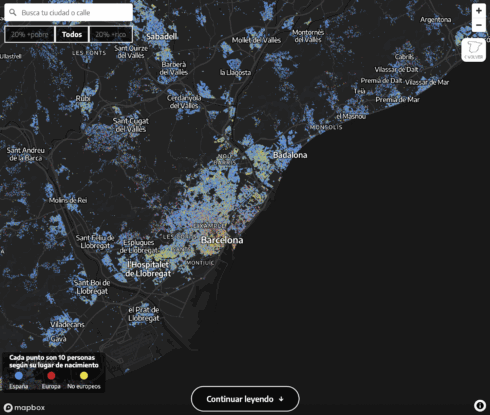
NON-EUROPEAN residents in Spain are gravitating towards some of the country’s poorest districts, new data has shown, amid concerns that the trend could lead to modern-day ghettos in major Spanish cities.
An investigation by elDiario found that immigrants from Latin America, Africa, and Asia overwhelmingly settle in peripheral neighbourhoods, where housing is more affordable, while European migrants are distributed more evenly across both high- and low-income areas.
Spain received around 2.5 million non-European migrants between 2016 and 2024, many of whom are now at heightened risk of social segregation.

In Madrid, districts such as Carabanchel, Puente de Vallecas, Usera, and Villaverde have absorbed a significant share of new arrivals. In Carabanchel alone, about 40,000 new residents were registered in the past decade – and today one in three residents comes from Latin America, Africa, or Asia.
Similar patterns are observed in the Barcelona metropolitan area, including La Florida district – one of Spain’s most densely populated areas – where residents born outside Europe now form a majority.
Sebastian, a young migrant from Colombia, told elDiario how he and his family managed to find a flat in Madrid’s Carabanchel after five months of fruitless searching.

“We found that either the rents were very high, or we were not suitable because of the paperwork they asked for,” he said.
Researchers attribute the trend to ballooning housing costs, limited availability of affordable flats, and widespread reports of discrimination in the rental market.
Many newcomers face difficulties securing accommodation without stable contracts or guarantees, which pushes them towards lower-income barrios with older or subdivided housing stock.
Historian Antumi Toasije, formerly president of the Council for the Elimination of Racial or Ethnic Discrimination (CEDRE), told elDiario: “People who arrive with a stronger economic situation can choose [where to live].”
“It is true that people want to live in neighbourhoods where there are compatriots, where there is local commerce, and where they feel more protected against the aggressions of the system. What is not desirable is that people are forced to live where they do not want to,” he added.

The concentration of recent migrants in these districts has also increased pressure on public services, with schools, hospitals, and social care systems in affected neighbourhoods now operating under far greater strain than those in wealthier areas.
While overall segregation levels in Spain remain moderate by European standards, analysts warn that the pattern is strengthening and becoming more geographically defined.
Urban planner Javier Moreno, quoted in the investigation, said: “If affordable housing policies are not reinforced, the divide between neighbourhoods may continue to widen, entrenching social inequality.”
Click here to read more Property News from The Olive Press.