
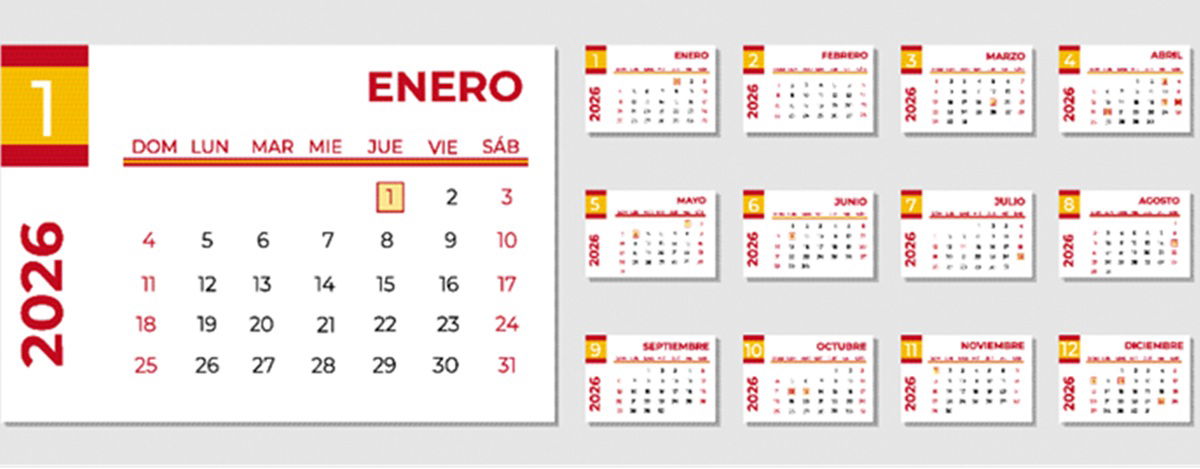
Spain’s 2026 calendar includes 14 public holidays and several long weekends to plan time off.
Credit : Huq Graphics, Shutterstock
If you’re the kind of person who plans holidays before the year has even started, Spain’s 2026 work calendar is one worth paying attention to. It won’t break records, but it does offer something many workers appreciate: 14 public holidays and several well-placed long weekends that make it easier to escape without using too many days off.
As always, the calendar combines national holidays with regional and local ones, meaning not everyone will enjoy exactly the same days off. Still, there are some dates that apply across the country and others that, depending on where you live, could stretch into proper mini-breaks.
Nine public holidays everyone in Spain will share
In 2026, nine public holidays will be observed nationwide, regardless of region. The year begins with New Year’s Day on Thursday January 1, followed by Epiphany on Tuesday January 6 – a date that all autonomous communities have chosen to keep, despite having the option to move it.
Spring brings one of the most important dates in the Spanish calendar: Good Friday on April 3, which will once again shape Easter plans across the country. Just a few weeks later comes Labour Day on Friday 1 May, offering a ready-made long weekend.
Summer’s main national holiday arrives on Saturday 15 August, marking the Assumption of the Virgin. While it doesn’t create a long weekend, it remains one of the most widely observed religious holidays in Spain.
Autumn improves things again with Spain’s National Day on Monday 12 October, followed by All Saints’ Day on Sunday 1 November. December then brings two key dates: the Immaculate Conception on Tuesday 8 December, and Christmas Day on Friday 25 December, which rounds off the year with another long weekend.
On top of these national holidays, each municipality will add two local holidays, bringing the total number of paid days off to 14 for most workers.
Regional choices make the difference
Where the calendar becomes more interesting is at regional level. Autonomous communities are allowed to shift certain holidays or replace those that fall on a Sunday with others that are locally significant.
One example is Maundy Thursday (2 April). Almost every region will observe it as a public holiday – except Catalonia and the Valencian Community, which have chosen not to include it in their calendars.
Several regions have also opted to move holidays that fall on a Sunday to the following Monday. As a result, Monday November 2 will be a public holiday in regions such as Andalusia, Madrid, Extremadura, Castile and León, Asturias and the Canary Islands.
The same happens in December. Monday December 7, the day after Constitution Day, will be a holiday in areas including Madrid, Andalusia, Murcia, Cantabria, La Rioja and Castile and León, effectively turning the early December period into a longer break.
Meanwhile, the Balearic Islands have decided to move their regional holiday to Monday March 2, creating an extra long weekend before spring really begins.
Four long weekends guaranteed nationwide
No matter where you live in Spain, at least four long weekends are guaranteed in 2026. These fall around:
– Good Friday (3 April)
– Labour Day (1 May)
– Spain’s National Day (12 October)
– Christmas Day (25 December)
Easter stands out as the most flexible period. In regions that observe Maundy Thursday, most of the country will enjoy a four-day Easter break. In seven regions, including Catalonia, the Valencian Community, the Basque Country, Navarra and the Balearic Islands, the break will stretch to five days, thanks to Easter Monday also being a holiday.
There’s also room for clever planning at the very start of the year. With Epiphany falling on a Tuesday, anyone able to take Monday 5 January off could turn it into a four-day break with just one day of leave.
A year that rewards planning
The 2026 calendar doesn’t overwhelm with holidays, but it does reward anyone willing to plan ahead. With several long weekends already built in and others easily extended, it offers a good balance between work and time off.
As always, checking local calendars is essential, especially when it comes to regional and municipal holidays. But one thing is clear: 2026 offers plenty of chances to pause, travel and recharge – without using up too much annual leave.
Stay tuned with Euro Weekly News for more news from Spain