
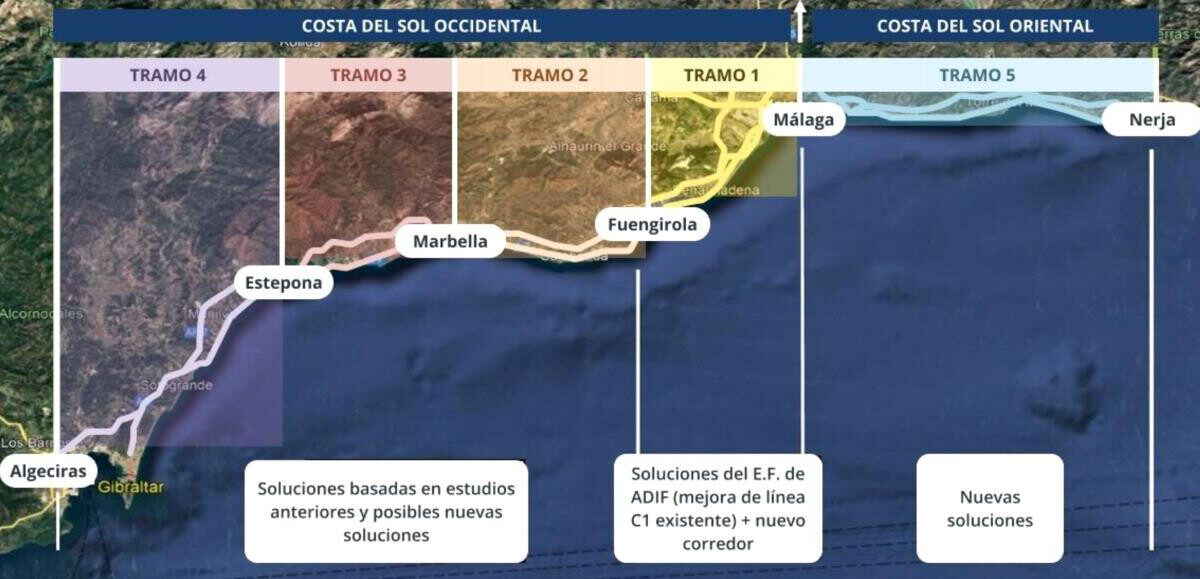
Ministry of Transport sketch of planned rail link
Credit: Ministerio de Transportes
The long-awaited Costa del Sol coastal train (Tren Litoral), a proposed railway linking Nerja in eastern Malaga province to Algeciras in Cadiz, continues to make progress as Spain enters 2026.
The project, which is hoped will ease chronic congestion on the A-7 motorway and boost sustainable mobility along one of Europe’s most densely populated coastal strips, is currently in the feasibility study phase, with key milestone objectives expected as early as January this year.
Feasibility study divided into segments
The Spanish Ministry of Transport awarded the €992,000 contract for the feasibility study in mid-2025 to a consortium led by WSP Spain-APIA and Multicriteri-MCRIT. Work on the 18-month study began shortly thereafter, dividing the potential 195 km corridor into five segments: Malaga-Nerja (east) and four western sections from Malaga-Fuengirola (upgrading the existing C1 Cercanías line) through to Algeciras.
As of early January 2026, the study is on track with no reported delays. The first major deliverable will be the initial study of alternatives outlining viable route options, potential alignments (such as parallel to the A-7 where possible, with underground sections in urban areas), and technical preferences, is expected by late January or February 2026. Preliminary indications suggest priority may be given to the high-demand Fuengirola-Marbella segment first, and options include partially buried tracks to minimise local environmental impact.
Definitive word by November 2026
The full feasibility study, including detailed demand forecasts, cost-benefit analysis, and socioeconomic evaluations, is scheduled for completion and final approval in November 2026. A public summary document will accompany the conclusions.
If the study confirms viability of the project, as earlier projections suggest, with potential socioeconomic benefits double the estimated €6 to 7 billion cost for the full route, the next step would be the more detailed “estudio informativo” (informative study), paving the way for environmental assessments and eventual construction tenders. Phased implementation is likely, starting with the most urgent sections.
Local authorities and residents view 2026 as a pivotal year, with sources describing it as crucial for defining the project’s technical framework and securing funding commitments. The train is seen as essential for serving underserved towns like Marbella (Spain’s largest city without rail access) and Estepona, while enhancing connectivity to Malaga Airport and main holiday resorts.
While no construction timeline has been set, positive feasibility results could accelerate planning into 2027 and beyond. The Ministry stresses the project’s role in promoting sustainable transport amid growing traffic pressures on the Costa del Sol.