
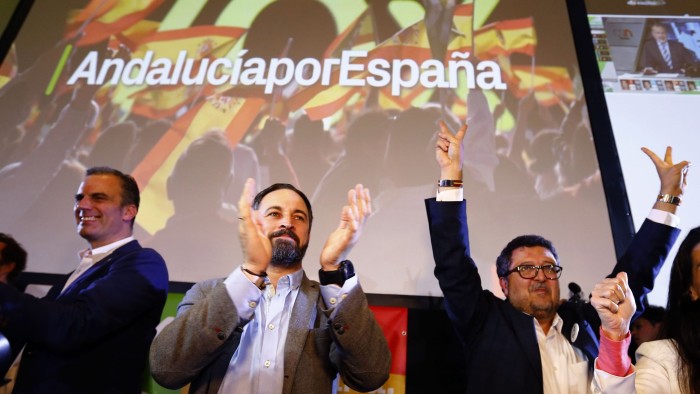
Spain’s young far-right party Vox upended the already fragmented political system Sunday, winning seats for the first time in one of the country’s regional parliaments.
In elections in Andalucia, Spain’s most populous region, Vox won 12 seats in the 109-seat parliament, far surpassing poll predictions in the weeks leading up to the vote. Vox took 11 per cent of votes cast.
In an election with voter participation of only 58.6 per cent, more than five per cent below the last polls in 2015, the ruling PSOE socialists took 28 per cent to lead the elections. The 33 seats it won were a loss of 14 from 2015, however. The opposition centre-right People’s party (PP) took 26 seats, a loss of seven, with 20.8 per cent of the vote.
“Despite having won the elections, it is a sad night for the socialists of Andalucia and the opposition as a whole. The retreat of the left is real, but the most serious thing is that the extreme right has entered the Andalucian parliament,” the regional first minister, Susana Díaz of the PSOE, said after the vote.
It was the worst showing in Andalucia for the PSOE — and the second worst for the PP — since the return of democracy after the death of dictator Francisco Franco in 1975.
Ciudadanos, a rising Liberal party, saw its representation rise by 12 seats to 21, with 18.3 per cent of the vote, while the leftwing coalition Adelante Andalucía won 17 seats, a loss of three, with 16.2 per cent.
“It’s a very bad night for the left,” said Antonio Barroso, deputy director of research at Teneo Intelligence.
The parties on the right of the political spectrum in Spain have been energised by opposition to the Catalan separatist movement and a surge in illegal immigration, mirroring the shift in Italy and other countries that have received large numbers of migrants.
The elections were the first electoral test for Pedro Sánchez, the Socialist prime minister who ousted Mariano Rajoy, the former PP prime minister, in a June confidence vote, and Pablo Casado, who took over the PP leadership after Mr Rajoy’s exit.
The vote signifies a seismic change for politics in Spain, which has not seen the rise of a far-right party since the death of Franco. National party leaders had painted Sunday’s election for the regional assembly as a proxy for the country’s future and a dry run for national elections.
Attention will now turn to the formation of a governing coalition. The PSOE has led the regional parliament since the first post-Franco elections in 1982, and analysts had expected that the socialists, led by Ms Díaz, would continue to govern with the support of Adelante Andalucía.
With poor performance by the its parties, however, a leftwing coalition is unlikely.
“Tonight we’ve ended 40 years of socialist hegemony in Andalucia,” said Juan Manuel Moreno, the lead PP candidate in Andalucia, in a post-election rally.
“Change has won the elections in Andalucia.”
Mr Barroso said a PP-led rightwing coalition was the most likely result, though its form will depend on whether Vox demands to enter the government and whether Ciudadanos will fear losing centrist voters if it entered a coalition with the far right.
Spain’s other regions hold their regional polls in May and a national election is due by mid-2020, though that could be brought forward and held within months if Mr Sánchez’s minority government cannot muster enough support to pass a 2019 budget.