
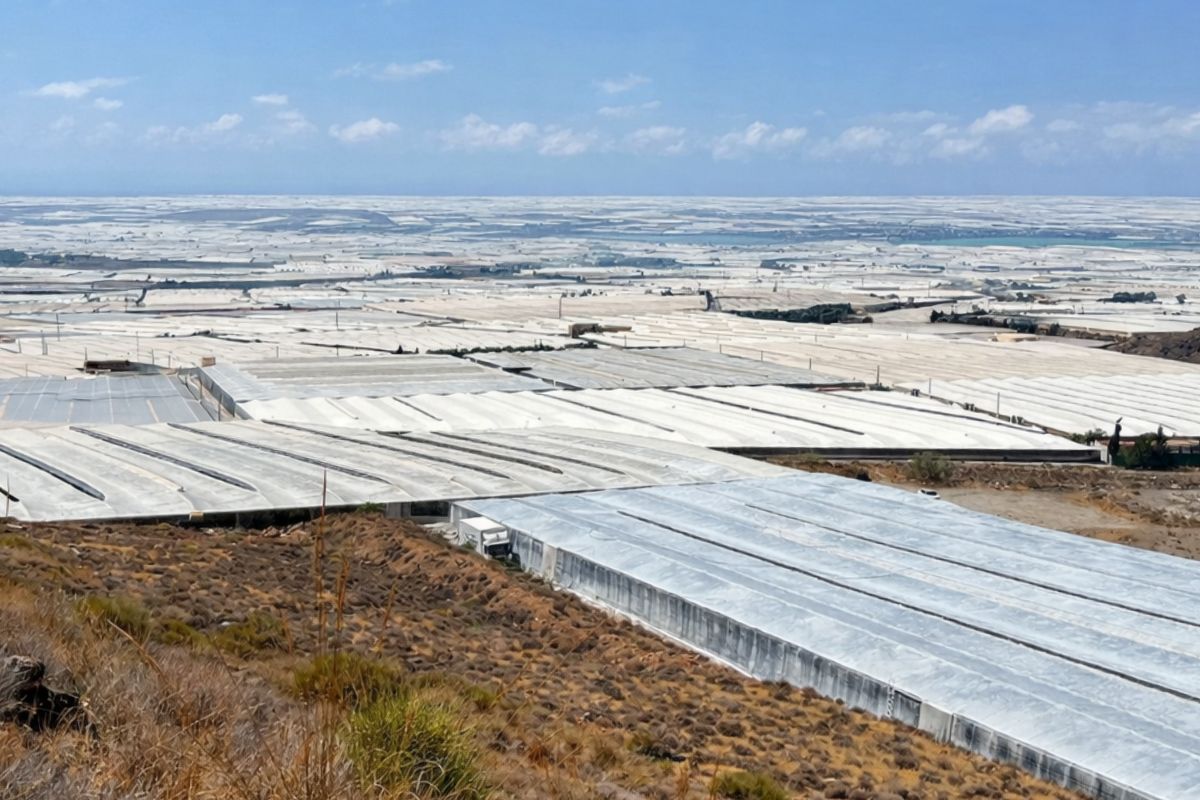
In southern Spain, a sea of plastic visible from space cools the local climate, generates billions in fruits and vegetables for Europe, creates jobs, and at the same time jeopardizes the region’s environmental future.
At first glance, what you see from the top of the Sierra de Gádor, in southern Spain, is almost surreal: a continuous white carpet covering dozens of kilometers along the Mediterranean coast. These are greenhouses, thousands of them, forming a veritable sea of plastic that today occupies about 370 km² in the province of Almería, an area larger than Malta. So extensive and reflective is this white stain that it is clearly visible in satellite images and has even caught the attention of NASA.
While much of southern Spain is warming up due to climate change, the region of sea of plastic It follows the opposite path: the reflection of the sun on the roofs causes the surface to cool down, in an unexpected climatic effect.
At the same time, inside the greenhouses, the reality is one of intensive agriculture, extremely high productivity, a multi-billion dollar economy, and a growing list of environmental and social concerns that put this model under scrutiny.
A sea of plastic in the middle of nowhere. European desert
The scenario would be improbable almost anywhere in the world, but it’s even more surprising when you remember that Almería is home to the only natural desert in Europe.
It rains very little, in some places less than 200 mm per year, and the original landscape consisted of arid hills and poor soil.
Today, this desert has been covered by plastic greenhouses built side by side, forming the famous sea of plastic.
There are approximately 14 producers, thousands of small family farms, and something between hundreds of thousands of tons of plastic covering the structures.
What was once dry, marginal land has become the largest fruit and vegetable hub in Europe, supplying millions of consumers throughout the year.
How the sea of plastic cools the local climate.
Viewed from space, the greenhouse area appears as a large white blotch. This color is not merely an aesthetic detail: it changes how the region interacts with the sun.
Instead of absorbing heat like the dark soil typical of deserts, the sea of plastic It reflects a significant portion of solar radiation back into the atmosphere.
Research cited by space agencies shows that this reflection is so intense that the area inside the greenhouses tends to cool down, while the surrounding area continues to warm up.
It’s a curious climate paradox: one of the symbols of plastic consumption and intensive agriculture helping to “cool” a piece of the map, while at the same time raising new questions about long-term environmental impacts.
The engineering behind greenhouses
The secret to this transformation lies in the design of the greenhouses. Most use a simple structure: a wire or metal frame covered by two layers of polyethylene plastic film, creating a kind of insulating “air bubble”.
When the sun shines on it, some of the radiation is reflected, some passes through the plastic and is trapped inside, raising the temperature and accelerating photosynthesis.
In more sophisticated greenhouses, The internal environment is controlled with meticulous care.Humidity, CO₂ concentration, ventilation, and shading are adjusted to ensure that every ray of sunlight translates into plant growth.
In the research areas, there are even greenhouses dedicated to testing different types of plastic, shading with lime (chalk) applied and removed according to the season, computerized fertigation systems, large tanks for dissolving nutrients, and drip irrigation networks a few centimeters from the roots.
The result? On average, One hectare of sea plastic can produce up to tens of times more than a typical open European field.…depending on the crop and technology used. It’s intensive agriculture taken to the extreme.
Scarce water, extreme productivity.

Almería is a dry region, and that’s precisely one of the biggest advantages of greenhouses. By controlling the internal environment, it’s possible to radically save water.
Drip irrigation systems, soil covering with plastic or sand, channels to collect the little rain that falls, and reservoirs protected against evaporation form a set of solutions that ensure every liter is used to its fullest potential.
While major European cities receive twice as much or more rainfall, the sea of plastic It can produce using less than 10% of the water that an equivalent open-field crop would use.
Part of the supply comes from aquifers in the mountains to the north, and part from constant improvements in efficiency.
It is this combination of mild winter weather and extremely sparing use of water that allows for two or even three harvests per year of tomatoes, peppers, cucumbers, watermelons, zucchini, and other products.
From impoverished desert to Europe’s largest agricultural hub.
In the 1940s, the region was one of the poorest in Spain. There was little more than pastureland for animals and low-productivity agriculture.
This changed when the government decided to encourage agricultural settlements and experimentation with new farming techniques.
First came the idea of covering the soil with sand, brought from the beaches, to reduce evaporation and improve production.
Later, with the popularization of cheap plastic, this technique evolved to the use of plastic films on the ground and, finally, to complete greenhouse structures.
The first prototype, back in the 60s, was small, only a few meters long, but it demonstrated something important: The implementation cost was high, but the return in productivity was even greater.
Rural financial institutions began to finance the expansion, experimental centers were created to teach farmers and test new technologies, and the model of sea of plastic It became consolidated.
Over time, the region integrated into the European market, taking advantage of a powerful logistical advantage: it is close to some of the world’s largest importers of vegetables, with high incomes and a year-round demand for salads.
A food vending machine for the continent.
Today the sea of plastic Almería is responsible for a significant portion of the vegetables consumed in Europe, especially in winter, when the cold makes open-air production unfeasible in much of the continent.
The greenhouses specialized in products with high perceived value for the consumer: bell peppers, tomatoes, cucumbers, watermelons, eggplants, zucchini, and other fresh fruits and vegetables.
Millions of tons of plastic emerge annually from these tunnels, generating billions of euros in revenue and supporting a chain that includes seeds, plastic manufacturers, distribution centers, desalination plants, and producer cooperatives.
Over 80% of the production is exported to Northern Europe, following strict pesticide residue regulations and quality standards of the European Union.
For many supermarkets and consumers, “Spanish tomatoes” has become synonymous with year-round availability.
The dark side of the sea of plastic.
But this model comes at a cost. And it’s not just financial. One of the most visible problems is precisely the material that gives the landscape its name: plastic.
Roof coverings need to be replaced every three or four years, and this generates a huge amount of waste.
There are rules and systems for recycling, but Not all plastic follows the correct path.Some of it is improperly disposed of, ending up in makeshift landfills, rivers, beaches, and over time, it turns into microplastics in the soil and the sea.
Studies indicate concentrations of microplastics well above average in coastal areas near… sea of plasticThis is a clear sign that the line between productivity and pollution is thin.
Another sensitive point is the workforce. Because the work is demanding and the competition is high, the region attracts thousands of migrants, especially from North African countries.
Many work in precarious conditions, with low wages and makeshift housing, without full access to rights. The human base that supports the sea of plastic doesn’t always appear in the glossy photos of greenhouses seen from space.
Plastics, energy, and the climate dilemma.
From a climate perspective, Spanish greenhouses present a paradox. On the one hand, they use far less energy than artificially heated glass houses in colder countries, as they take advantage of the mild climate and solar radiation to achieve optimal growing temperatures. This reduces dependence on natural gas and decreases some of the emissions associated with out-of-season food production.
On the other hand, the sea of plastic It depends on an entire chain based on petroleum derivatives: plastic films, soil mulch, pipes, containers, packaging.
And although controlled-environment agriculture uses less water and often fewer pesticides, the environmental cost of discarded plastic and production waste is still far from neutral.
What is gained in water efficiency and food security can be lost, in part, due to pollution and inadequate waste management.
What the sea of plastic reveals about the future of agriculture.
The case of Almería is not isolated. Similar greenhouse models are spreading across regions with water scarcity and strong pressure for production: Mexico, Turkey, Egypt, Morocco, and especially China, which already concentrates the largest area of greenhouses in the world.
The logic is similar: On a planet approaching 10 billion people, growing “into” existing structures seems more viable than expanding onto new land areas.
The question is how to do this in a socially and environmentally sustainable way. Better control of water use, reduction of fertilizers and pesticides, reuse of nutrients, limiting waste, and guaranteeing labor rights are challenges that go far beyond a single Spanish province.
O sea of plastic It is both a showcase and a warning: it shows what technology is capable of doing in a desert, but it also exposes the cost that comes with every ton of food harvested.
Ultimately, looking at the scale, impact, and contradictions of this sea of plasticDo you think this model of intensive greenhouse farming is a “necessary evil” for feeding the world, or is it high time to seek alternatives that are less dependent on plastic and more environmentally balanced?