
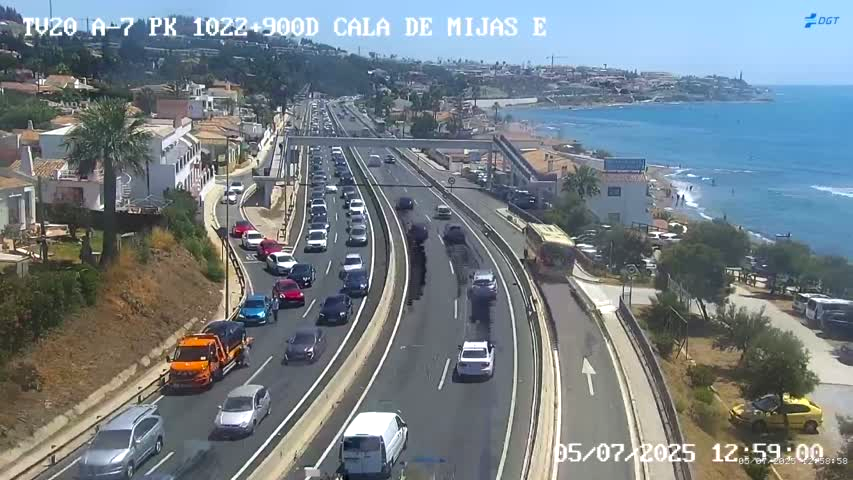
The A-7 motorway that connects Malaga and Estepona, is overwhelmed. There are no two ways about it. Persistent jams and accident blackspots – What can be done?
Daily, there is chronic congestion and frequent accidents that the Costa del Sol’s ever-increasing traffic struggles to cope with. Vehicle counts everyday range from 65,000 to over 100,000 in peak seasons, caused by population growth, booming tourism, and outdated infrastructure.
Traffic jams, once seasonal, are now a daily ordeal, doubling commute times. Design flaws like sharp curves, too few lanes, and hidden exits make the drive a nightmare, with merging onto the road often needing pedal-to-the-metal acceleration. The A-7 ranks as Spain’s third-worst motorway for users, with heavy traffic around Puerto Banús, San Pedro, and Rincón de la Victoria.
A-7 Costa del Sol – one long accident blackspot
Persistent safety risks
There are a couple of particularly nasty blackspots the DGT have highlighted: San Pedro Alcántara (km 1053–1050) and Fuengirola (km 1015–1013). The notorious La Cala de Mijas bend recorded 36 serious accidents over seven years. Other recent fender benders include a six-vehicle pile-up near Vélez-Malaga in 2024 and a five-vehicle collision in Marbella in 2025, causing hours-long closures. Speed limits of 80 km/h and average speed radars have marginally reduced incidents, but are clearly not enough.
What can’t the AP-7 be free like in other parts of the county?
The AP-7 toll road conundrum
The AP-7 toll motorway offers some relief but costing €18.85 for a full journey in high season, or €8.60 Fuengirola to Marbella, drivers are deterred, which pushes traffic back to the old A-7. The Spanish government has avoided making the AP-7 free, like in other parts of the country, because of a private concession agreement with Ausol, valid until 2054. Unlike other AP-7 sections (e.g., Alicante-Tarragona, freed in 2020), the Costa del Sol stretch still comes at a high price for drivers, as the government would need to compensate Ausol for lost revenue. However, the state also benefits from €384 million per year in tax revenue from the AP-7. Local leaders argue political bias is afoot, and the complexity of negotiations with Ausol get in the way of solutions like subsidies or a public buyout. Proposals for discounts, such as on Galicia’s AP-9 return-trip subsidies, are in consideration but lack much political commitment.
A-7 Costa del Sol – What can be done?
Government action and future fixes
A Ministry of Transport study launched in July 2025 at a cost of €690,000, Plans to explore solutions over the next 12 months, focusing on connectivity, flow, and safety, also coincides with the coastal train feasibility study (by, coincidentally, the same company). Some proposed measures include:
- Expanding A-7 capacity with additional lanes or straightened sections.
- Creating bypass routes to divert traffic.
- Improving A-7/AP-7 links or reducing tolls.
- Upgrading junctions to eliminate bottlenecks.
A €6 million A-7 rehabilitation project between Marbella and Fuengirola, completed in March 2024, has been deemed ridiculously insufficient by users, and calls for free AP-7 access during peak times or a coastal train line, (which has already been bogged down by bureaucracy for 20 years), remain unanswered.
Looking Ahead
The A-7’s woes come as the downside of the Costa del Sol’s spectacular growth in recent years. While the government’s study offers a glimmer of hope, a real solution would require more radical policy change. Drivers can monitor conditions via ViaMichelin or DGT updates, but real, long-term solutions, such as road improvement, public transport, and smarter traffic management are essential in transforming this congested, hazardous corridor into a safer, efficient route.