
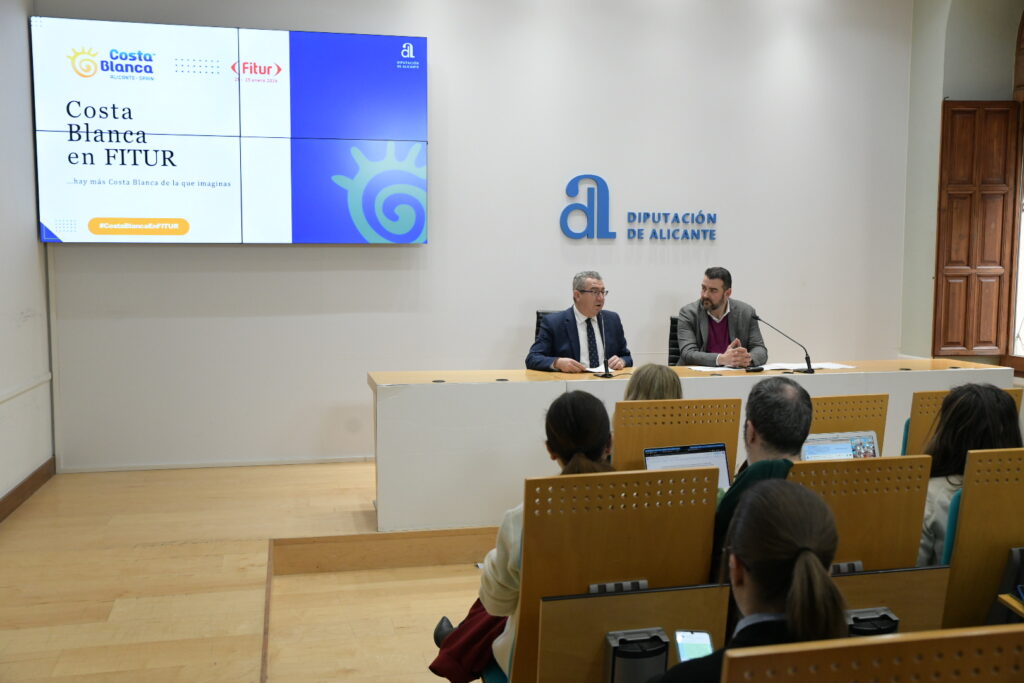
En FITUR 2026, province of Alicante is deployed in two scenarios: the great showcase of IFEMAwhere the Provincial Council supports the municipalities, and the center of Madrid, with Callao like the other stronghold. There, with the «2.0 cube“And with a busy schedule, the director of the Costa Blanca Tourist Board, José Mancebo, warns that they are going to “to attract attention and give people something to talk about“But behind the noise—the good kind—there”s a serene message: that of a destination that feels…” mature, from “extremely high customer loyalty“that gives for achieved la deseasonalization And that, judging by the numbers, she lives immersed in the climb.We strive for quality service and, above all, quality of experience.“This veteran of the sector summarizes, focusing on the diversity of the offer, the innovation And yes, in opening up opportunities for those who see tourism as a business.
Q.- What are the main challenges for tourism in the province of Alicante in 2026?
A.- We must at least consider two very clear goals. The first is to maintain our position. To maintain that quantitative challenge.
The numbers are looking very good in terms of passengers, visitor numbers, occupancy rates, tourist spending… and we’ve maintained our target ratio throughout the year, not just during peak periods. It seems we’ve achieved the goal of reducing seasonality.
When things are going this well, the Board of Trustees takes advantage of the situation to launch new projects, promote new connections, explore new markets, sow seeds for the future, and avoid complacency. That would be the second factor.
And above all, focus on quality. When a destination, let’s say a hotel, already has its numbers more or less guaranteed, it needs to concentrate on improving service, improving accessibility, and promoting environmental and social sustainability policies… That’s where we are right now. We’re looking for quality service and, above all, quality of experience.
Seasonality reduction has been achieved
Let me give you an example: We’ve done well in promoting cycle tourism over the last few years, and I think we’re already a benchmark for cycling and sports tourism. Now, the focus should be on promoting accessible sport and good practices, including coexistence with cyclists on our roads. It’s about launching different kinds of messages and initiatives that promote this quality.
Q.- What are the Costa Blanca’s objectives at FITUR this year?
A.- For me, it’s not just one Fitur, it’s many Fiturs. There’s the one at IFEMA and there’s the FITUR in the city center (of Madrid). The overall goal is to leverage all the platforms to make the Costa Blanca shine. And above all, the fundamental difference for me compared to other fairs is that we put the entire province front and center, because ultimately, the work isn’t just the responsibility of the Tourism Board. It belongs to the whole province. Leveraging that strength also allows us to really shine in the activities we organize.
This is evident in the activities we do in Callao, in the action with the designations of origin, in the WOW campaign, which is the second year that we maintain with “WOW, there is more Costa Blanca than you imagine!”, trying to also show the most unknown aspects of the province.
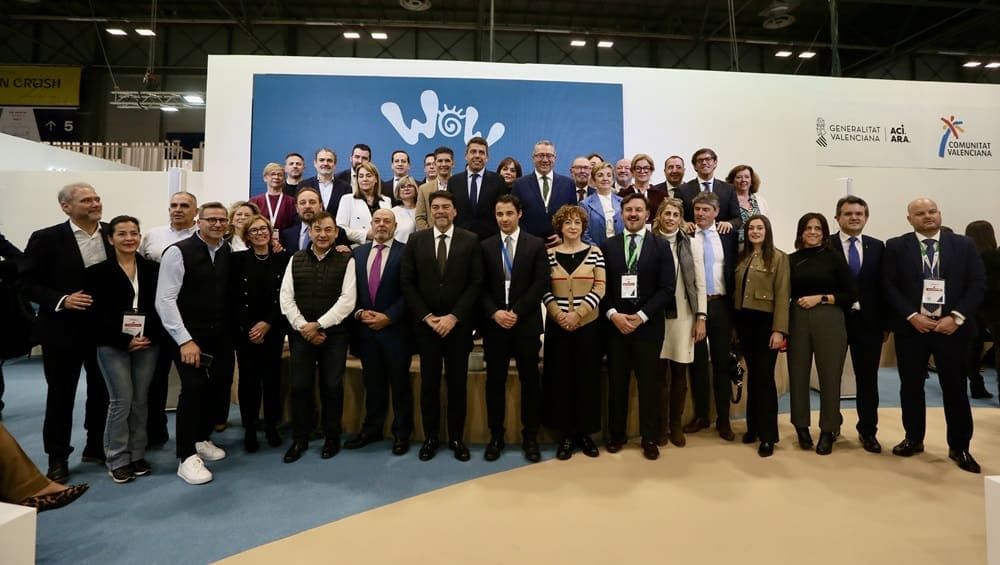
Of course, there’s Fitur at Ifema, which in turn encompasses several Fiturs, because we’re present in all the LGBT+ franchises, Sports, Screen, and also at FITUR Lingua. We have a panel where we’ve been invited by FEDELE—the Federation of Spanish Language Schools in Spain—to talk about language tourism. And, of course, we’re in Hall 7, at the Valencian Community stand, assisting the municipalities, which is our fundamental role.
In addition to this, there’s the professional Fitur event. It’s a meeting place for us to connect with Spanish tourism offices abroad, travel agents, tour operators, and airlines. I hope we can share some important news during these days of new initiatives for 2026.
We are a destination with extremely high customer loyalty.
Q: Can we expect any new developments in markets or air connections?
A.- We were the leading airport in Spain in terms of British visitors, with 6,55 million. This year, we also surpassed all other airports in the Aena network.
Traditional markets continue to respond positively; we are a destination with extremely high customer loyalty. For two years now, we have emphasized that the board would be working on both short-haul and long-haul tourism. This translates into actions that we hope will be effective and bear fruit.
(In Callao) We’re going to be attracting attention and giving people plenty to talk about
Q: The Costa Blanca will also be present in Callao. What has been prepared?
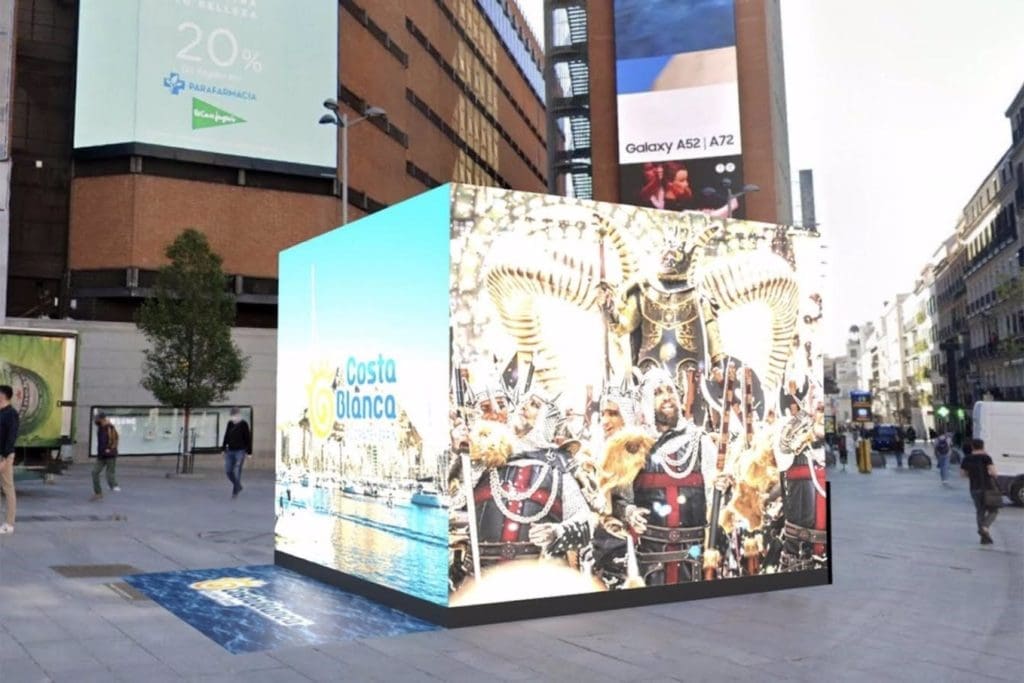
A.- On Wednesday we’re opening Callao, the second major hub, which this year includes some new features. We have a Cube 2.0 and there will be activities around it involving municipalities, festival associations, festivals like Benidorm Fest, and on Saturday afternoon, a Carnival parade. TorreviejaWe’re going to be attracting attention and giving people plenty to talk about.
The cube will be there until Sunday at noon and we are extending the opening hours thanks to the agreement and collaboration we have with the Madrid City Council.
Regarding IFEMA, we have ongoing presentations from municipalities, meetings, and participation in various forums at the fair, such as those with the Association of Sun and Beach Tourism Municipalities and those related to the activities of the Provincial Council. The aim is to take advantage of the full range of opportunities to promote the Costa Blanca.
Q.- What is the cube like this year and how does its presence in Callao change compared to previous editions?
A.- It’s a solid cube with four screens, roughly 5 x 3 meters, located in Callao. It’s complemented by an animation team from the Patronato (a local cultural organization) plus any additional team brought in by the municipality or association responsible for the event. The cube is conceived as a street performance.
It’s not advertising because we can’t do private advertising, but it is an action where even the smallest municipality will be visible, taking into account the number of passersby and people visiting Madrid these days and from all the countries that are in Madrid these days for Fitur.
Alicante, along with Madrid, Salafalta and Malaga, are the four territories in the country that are very well positioned (in language tourism)
Q: The International Tourism Fair is launching FITUR Lingua, and the Costa Blanca has been invited to present its product. How did it become a benchmark?
A.- At first it was a little difficult to see. I remember that Luisa Pastor was the president when we started working with the University of Alicante on the entry of North Americans.
We talk a lot about the United States now, and we have an increasingly strong presence there, but we began to explore that market through agreements and collaborations focused on international student mobility. We first launched campaigns with both the Federation of Spanish Language Schools in Spain (FEDELE) and the University of Alicante. Later, the Miguel Hernández University of Elche (UMH) in the United States also joined us.
I believe that this approach, working with universities on one hand and schools on the other, over the past 10 years, has allowed us to play a very significant role at the national level. Alicante, along with Madrid, Salafalta, and Málaga, are the four regions in the country with a strong presence.
Furthermore, our region also offers a significant bilingual education program that combines Spanish and English. This is very attractive and opens doors for us in Asia and the Americas. It diversifies our offerings and helps us access new markets.
The student comes, but then they also travel themselves with friends or family members who visit them, so it’s giving us very good results.
The paradigm shift is to design experiences for specific tourist profiles.
Q: At the Costa Blanca presentation at Fitur, you talked about the personalization of experiences. What is this more “à la carte” tourism like?
A.- We’ve been making this effort for many years. It’s about trying to hyper-segment, for each tourist profile—not every tourist, but each profile. You or I are sometimes vacation tourists, sometimes business tourists, and sometimes tourists looking for culture, sports, or active tourism.
What is the paradigm shift? It’s not about designing experiences for tourists in a bulk, generic sense, but about designing for specific tourist profiles, so that you have the opportunity to visit us at various times of the year and for various reasons.
This translates into strategies that allow you to go to trade fairs, or any type of promotional activity, with specific messages to offer visitors what truly interests them.
If you combine that with the excellent connectivity we have in a destination like the Costa Blanca, which has already seen over 20 million passengers (projected for 2025), it creates a powerful combination. It sends messages to cruise passengers, mountain tourists, inland tourists, and coastal tourists alike. That’s how we work.
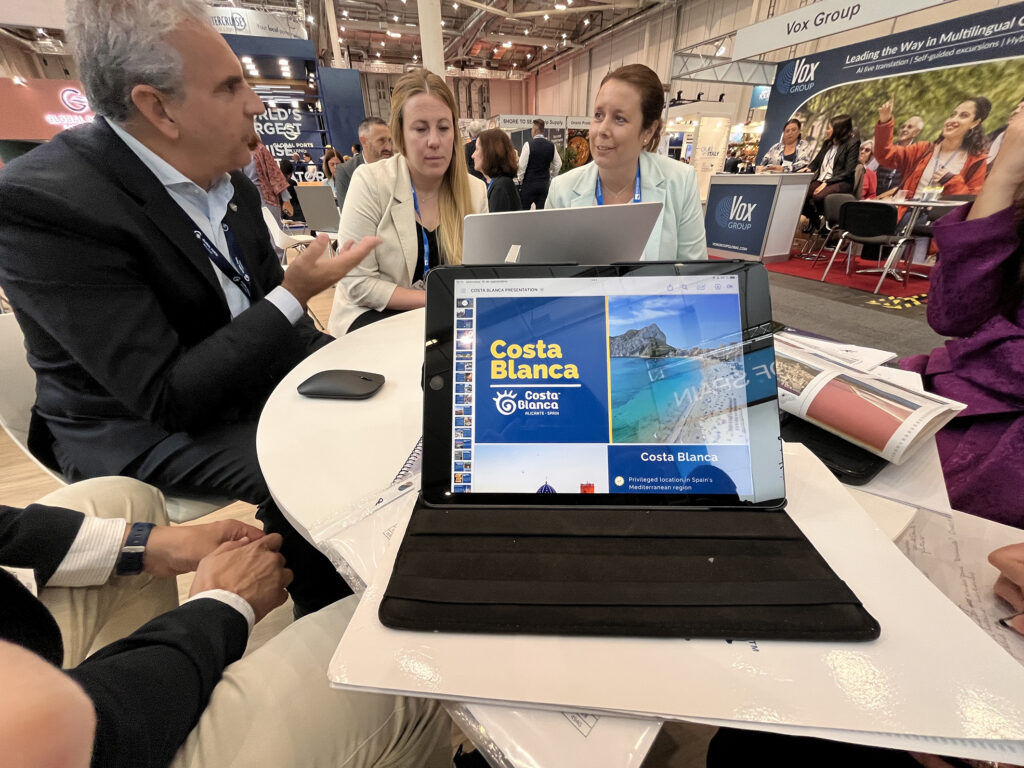
Q: You just returned a few days ago from the Matka Fair in Finland. A market that, like most, is increasingly demanding sustainability. How is this integrated into the tourism product?
A.- Integrating respect for local products, the circular economy, and coexistence with nature. In Finland, for example, local products are heavily promoted. This respect for local products and the promotion of activities that benefit and coexist with nature is something that the Nordic profile strongly demands.
They also seek to combine leisure and lively environments with quieter and more authentic experiences: industrial tourism, culture, tradition, immersion.
Tourists want to immerse themselves in what they visit, to take away something they can’t find anywhere else. What fulfills tourists most is being able to say, “It was wonderful to be in the province of Alicante. I enjoyed it immensely, and I’ll carry this experience with me for the rest of my life.”
Q.- Putting it on the map of Alicante…
A.- For example, in terms of industrial heritage, the remains are extremely important, particularly in Alcoy and nearby, where papermaking is prominent, for instance, in Bañeres. Further south, there’s the ceramics in Agost, the toys in the Toy Valley, the dolls of Onil, and the toys of Ibi, to name just a few examples.
In addition, there are museum companies in the industrial or agri-food segment; chocolate in La Vila, Jijona nougat, etc., provide experiences that are in high demand and that, combined with a visit for other reasons, such as leisure, the beach, or nature, complement each other very well.
When you visit a local winery or try your hand at pottery in Agost, that’s what you end up talking about. Or the salt industry, or olive oil tourism, and so on. All these kinds of experiences are what we’re gradually promoting, and they’re becoming increasingly well-known.
Promoting local culture and healthy activity is a trend
Q.- In what niches do you see clear opportunities for companies in the province linked to tourism in 2026?
A.- The clear focus right now has to be on strong specialization. I think it’s key. Having had the opportunity to travel extensively for work and see what’s being done in other parts of the world, I can say that all the conditions are right here, which is why things continue to open up and innovate. Experiences related to sports, culture, and gastronomy are currently winning propositions.
Anything that promotes local culture, anything that promotes healthy activity, is a clear and strong trend. In that sense, sport, culture, and differentiation seem like a winning combination to me.
Note on the interview about the Fitur 2026 Agenda
Due to the tragic train accident in Adamuz (Córdoba), the agenda of the Costa Blanca Tourist Board, like that of the vast majority of institutions, is subject to modifications as a sign of mourning and solidarity with victims, family members and loved ones.
This Monday, the Alicante Provincial Council conveyed its condolences and support to all those affected and announced the Cancellation of the event scheduled for today, Tuesday, at the Kitchen Club in MadridA gastronomic event prior to FITUR 2026, entitled ‘Taste Costa Blanca. Authentically ours’, aimed to promote the province’s native products with designation of origin.