
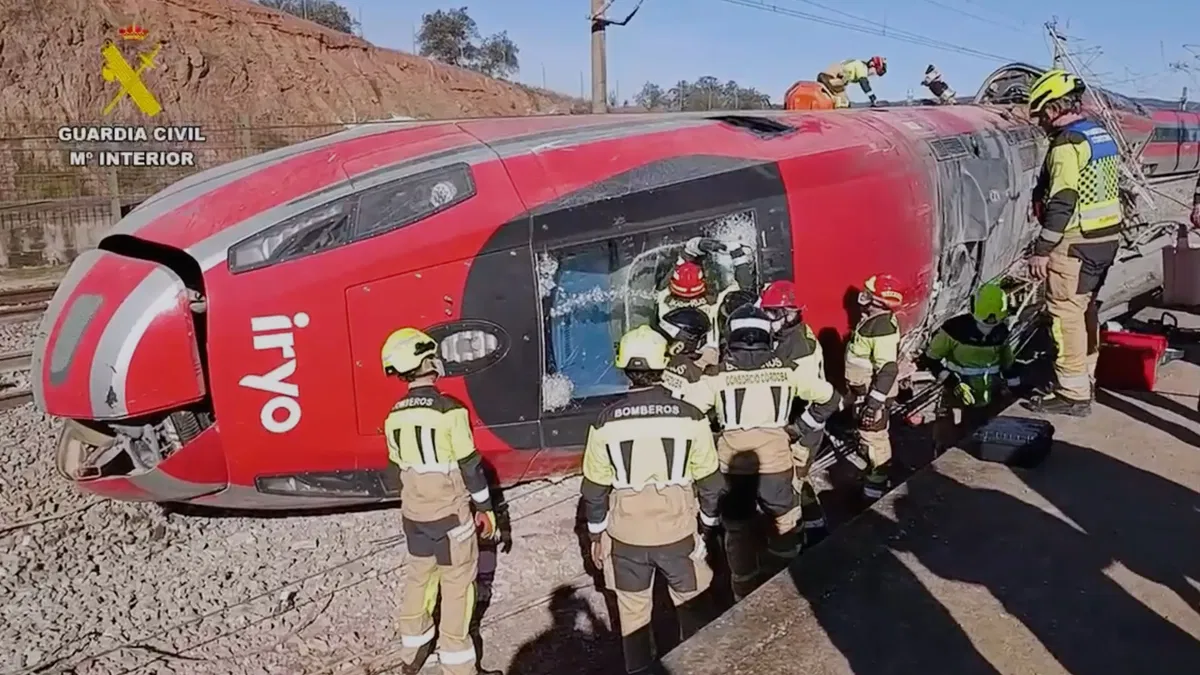
Emergency services inspect an overturned Renfe train as part of the official investigation into the rail accident in Spain. Photo Guardia Civil.
Spain’s rail system was often described as modern, reliable, and strategically vital. It was presented as a symbol of technological progress and effective public investment. That narrative has become increasingly difficult to sustain. In the space of a single week, Spain has suffered five separate train accidents, exposing systemic weaknesses that can no longer be dismissed as isolated incidents.
These events do not point to coincidence or bad luck. They point to a deeper and more structural problem. One where abnormal practices, both technical and institutional, have been allowed to persist for so long that they have become part of normal operations.
This normalization does not happen overnight. It develops when warning signs are ignored, oversight weakens, and accountability becomes blurred. Over time, systems adapt to risk instead of eliminating it, creating conditions where failure is no longer an anomaly but an eventual outcome.
Normalization of the Abnormal in Complex Systems
In complex infrastructure systems, serious failures are rarely isolated events. They are usually preceded by long periods of minor irregularities. Delayed inspections. Deferred maintenance.
Procedural shortcuts justified as temporary solutions.
When these irregularities do not produce immediate consequences, they begin to lose their ability to generate alarm. Staff adapt. Managers rationalise. Institutions continue operating as if nothing is fundamentally wrong.
This is the normalization of the abnormal. A process where unsafe or improper conditions are tolerated long enough to be perceived as standard practice.
The Bird’s Safety Pyramid and Accumulated Risk
The Bird’s Safety Pyramid explains how catastrophic outcomes are built on layers of ignored issues. At the top sits the visible failure. Beneath it lie dozens of minor incidents and hundreds of unsafe or irregular conditions.
In rail systems, these conditions include underfunded maintenance, repeated technical alerts, governance weaknesses, and opaque decision making. When these issues persist without decisive intervention, risk accumulates quietly.
The absence of immediate disaster is often mistaken for proof of stability. In reality, it is often a sign that the system is absorbing damage.
Public Funds, Oversight, and Structural Weakness
Rail infrastructure depends heavily on public funding. How that funding is allocated, supervised, and audited directly affects safety outcomes. When funds intended for maintenance or system improvement are misused, diverted, or poorly controlled, technical risk increases.
Allegations of misuse of public funds and favour granting to private companies strike at the heart of this issue. When procurement decisions are influenced by personal or political interests rather than technical need, preventive maintenance suffers.
A system cannot remain safe if resources are not directed where risk is greatest.
Political Context and Alleged Misuse of Privileged Information
José Luis Ábalos served as Spain’s Minister of Transport from 2018 to 2021, a role that placed him at the highest level of political responsibility for rail infrastructure and public transport oversight.
During that period, RENFE appointed Koldo García as a board adviser in 2019. The appointment was widely questioned due to his lack of technical qualifications and professional experience in the railway sector.
That role granted access to sensitive and strategic information related to Spain’s rail system. According to reporting by eldistrito.es and other media, judicial investigations are examining allegations that such privileged access may have been used to grant favours to certain companies and to influence public contracts.
These matters remain subject to legal proceedings. However, the case highlights a broader governance risk. When individuals without relevant expertise are placed in positions with access to confidential information, institutional safeguards weaken.
How Governance Failures Reinforce Normalization
Governance failures do not remain isolated at the political level. They shape organisational culture. When oversight is weak and accountability unclear, abnormal practices spread.
Maintenance delays become easier to justify. Procurement irregularities are harder to detect. Risk assessments lose authority when political considerations dominate technical judgement.
Over time, the system adjusts to these distortions. What should trigger intervention becomes background noise.
What Happens If This Continues
If the normalization of technical and institutional abnormality continues, the consequences are predictable. Maintenance backlogs will grow. Safety margins will shrink. Minor failures will multiply.
Eventually, the system will face a failure it cannot absorb. Investigations will then reveal patterns of ignored warnings, misallocated funds, and governance decisions that prioritised short term interests over long term safety.
Public trust will erode further. Legal and financial consequences will escalate. Most critically, preventable harm will occur.
The Cost of Letting the Abnormal Become Normal
Spain’s rail system challenges are not the result of a single incident or individual. They reflect a broader pattern in which abnormal practices, both technical and political, were gradually accepted as normal.
The Bird’s Safety Pyramid explains why this trajectory is so dangerous. Ignoring the base does not remove risk. It concentrates it.
When misuse of funds, weak oversight, and normalized technical failures coexist, the system is no longer resilient. It is merely waiting.
And in complex systems, waiting is not stability. It is delay. That quiet acceptance was echoed by Pilar Almagro Marcos, who observed in a video shared on Instagram that when failures happen often enough, the abnormal slowly starts to feel normal.