
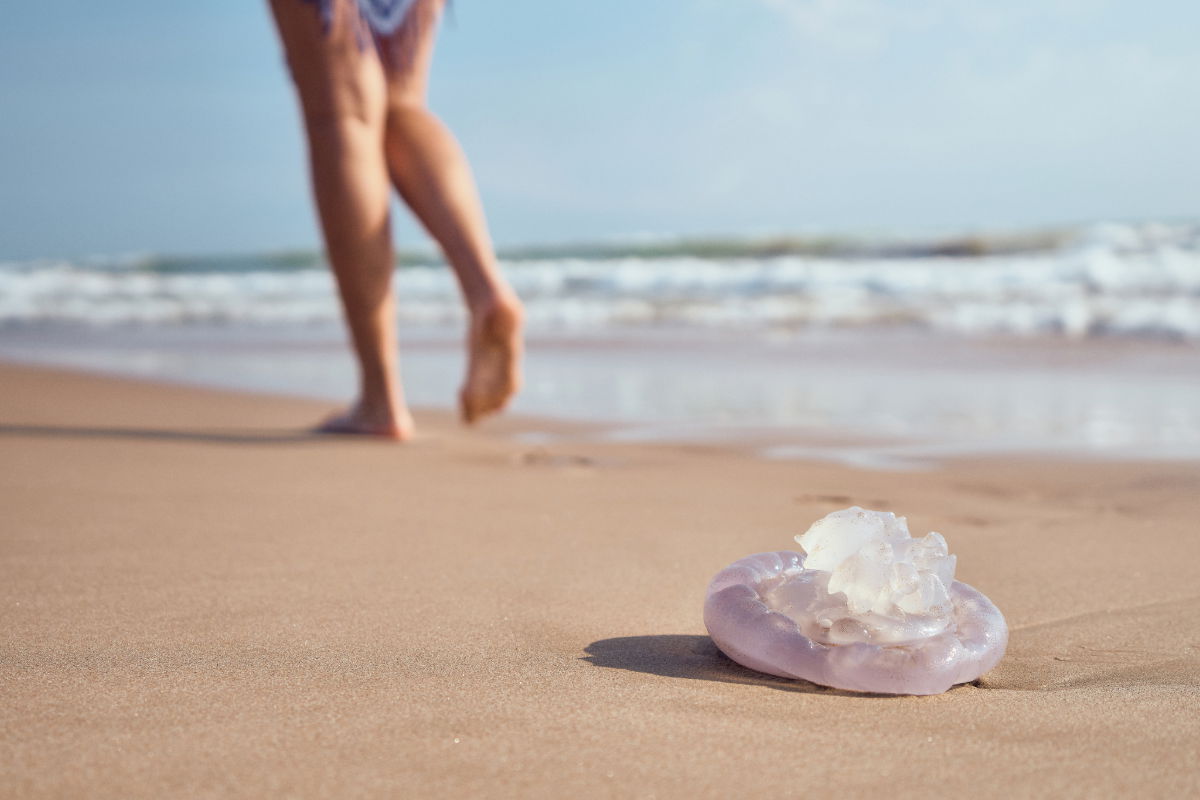
Jellyfish sighting in Spain have been increasing in recent years
Credit: Shutterstock: a2gover
With an increase in the volume of jellyfish appearing along the Spanish coast in recent years, this guide explains the various types, how dangerous they are, and what to do if you are unfortunate enough to be stung.
Spain has always had its fair share of jellyfish, but the number of sightings appears to be growing with each passing year. This has been put down to rising sea temperatures and climate change. For example, last year alone, across some of Spain’s most popular beaches on the Catalan coast, there were 7,500 jellyfish stings reported that required medical attention.
It is important to note that the toxic level of the sting does depend on the type of jellyfish itself, and there are a number of different varieties native to Spain, with stings ranging from mild right up to a very painful sting.
Jellyfish can still sting even after they are dead
Something else to be aware of is that jellyfish tentacles remain toxic for some time after their death, which is perhaps why so many get caught out when they accidentally tread on one on the beach after the sea has washed it up.
Portuguese Man O’war is not actually a jellyfish
The most talked about jellyfish is arguably the Portuguese Man O’ war on account of just how painful a sting it has. However, this creature is not technically a jellyfish at all, but is categorised as a species of siphonophore.
While this is closely related to jellyfish, its unusual characteristic is that it is made up of a colony of specialised, genetically identical zooids (think clones) that work together as one while performing various functions. For example, in the case of the Man O’war, each would be responsible for tasks such as floating, capturing prey, feeding and reproduction.
Portuguese Man O’war gets its name from resembling a Portuguese warship
It gets its name from the fact that it resembles an 18th-century Portuguese warship under full sail. It has a balloon-like float, and this can be blue, violet, or pink in colour. Below this are the tentacles, which can grow up to an alarming 10 metres and extend by as much as 30 metres, giving them some serious reach.
The venom within these tentacles is capable of paralysing and killing small fish and crustaceans. As far as human contact is concerned, they are rarely considered deadly, but they definitely pack a painful punch and can cause welts on exposed skin. Get stung by one of these, and you are definitely going to know about it.
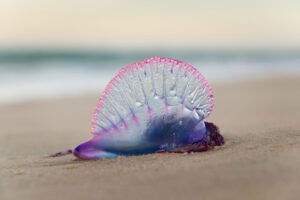
Credit: Shutterstock: Donatas Dabravolskas
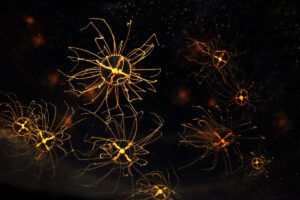
Mauve Stinger has a glowing body and a very painful sting
Another with a painful sting that is classed as a ‘jellyfish’ is the Mauve Stinger, which is also one of the more common, so definitely one to be aware of. In terms of its characteristics, it is typically pink-red, although younger species may also be light brown, and it has a glowing body.
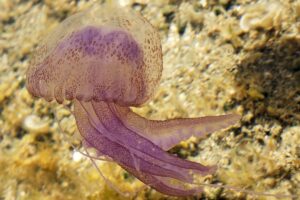
Credit: Wikipedia: Hans Hillewaert
Box Jellyfish are in the ‘ very painful sting’ category
Alongside the Mauve Stinger, and equally as painful is the Box Jellyfish. As its name suggests, it has a unique cube-shaped umbrella and four long tentacles. It is transparent blue/white and tends to favour very shallow waters.
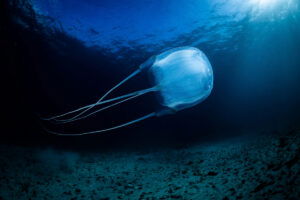
Credit: Shutterstock:Henryp982
Orange-striped Jellyfish can be found atttached to sea algae
One final one to be aware of in the ‘high sting’ category is the Orange-striped Jellyfish, which tends to frequent the Mediterranean in the spring and summer months. One of its features aside from the orange, is its many suckers and for this reason, it will often be found attached to sea algae.
Credit: Shutterstock: Mickyteam
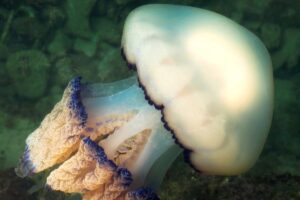
Barrell Jellyfish can be found in the Mediterranean most of the year round
Moving on to the Barrel Jellyfish, which thankfully has a slightly less painful sting, but will undoubtedly still hurt. This is a large jellyfish with a bell-shaped umbrella. It is white-bluish in colour with a violet border. It tends to frequent the Mediterranean Sea most of the year-round, with winter being the exception.
Credit: Wikipedia: Ales Kladnik
Spain has four types of jellyfish that have mild stings
The final category is the jellyfish that are considered to have mild stings. Having never been stung, I cannot say what exactly constitutes ‘mild’ in jellyfish sting terms, but I imagine that it is still probably more than uncomfortable.
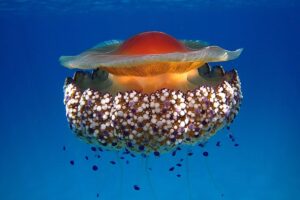
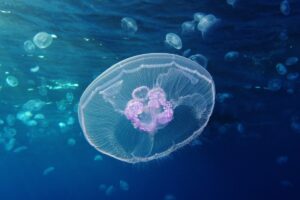
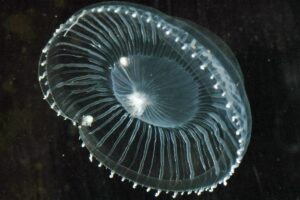
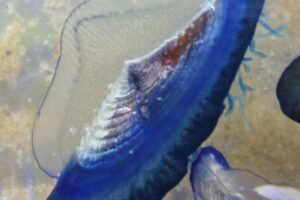
There are four jellyfish in this final category: Fried Egg Jellyfish, Moon Jellyfish, Crystal Jellyfish and Purple Sailor Jellyfish. Of the four, the Fried Egg Jellyfish is the one that is most frequently seen on Spanish Mediterranean shores, particularly towards the end of summer and into autumn.
Credit: Wikipedia: Fredski2013
Credit: Wikipedia: Alexander Vasenin
Credit: wikipedia: Sierra Blakely
Credit: Wikipedia: Jymm
What should you do if you get stung by a jellyfish in Spain?
If you are unfortunate enough to get stung by one of these jellyfish, while painful, the important thing to remember is that the venom in the sting is not life-threatening to humans. In terms of what to do, fans of the American series Friends will remember a famous episode in which Monica does indeed get stung and one of the ‘Friends’ ends up having to urinate on her to ‘take the sting out’!
In reality, you will be pleased to hear that this is the last thing you should do as this can actually aggravate and worsen the sting.
Instead, the advice is to carry out the following steps:
Exit the water: Sounds obvious, but leaving the water ensures no further contact with the jellyfish.
Clean the wound: It is best to do this with either vinegar or saltwater
Remove the tentacles: Use tweezers if you have them, or alternatively, the edge of a credit card to remove any remnants of the tentacles that may be attached to the skin.
Soak in hot water: Immerse the area in hot water (not scalding) for at least 20 minutes. This will help reduce the toxins and pain.
Use pain relief: Creams containing cortisone that can be purchased over the counter will help reduce swelling and further reduce the toxins.
On a final note, should you experience any extreme adverse effects, such as difficulty breathing or chest pain, medical help should be sought immediately; otherwise, this shouldn’t be necessary.