

Published on
December 25, 2025
Andalusia has always been a land of superlatives. From the dizzying heights of the Sierra Nevada to the intricate gold leaf of the Seville Cathedral, the region thrives on being “more.” But as we close out 2025, a new, staggering figure has local residents and policymakers pausing mid-siesta: Andalusia has officially surpassed 700,000 registered tourist beds.
To put that in perspective, that is enough capacity to house the entire population of Seville in holiday rentals and hotels every single night. While the regional government (Junta de Andalucía) celebrates the economic windfall, a growing chorus of voices is asking a difficult question: At what point does a boom become a burden?
The Numbers: A Region Under Pressure
According to the latest data from the Registry of Tourism of Andalusia, the region saw a massive surge in capacity over the last twelve months. The breakdown reveals a shift in how travelers are consuming the south of Spain:
- Total Capacity: Exactly 712,435 registered beds across hotels, apartments, and rural houses.
- The Apartment Explosion: More than 60% of this growth is driven by Viviendas de Uso Turístico (VUTs)—holiday apartments. There are now over 130,000 registered tourist flats in the region.
- The Geographic Giants: The Costa del Sol remains the epicenter. Málaga province alone accounts for nearly 40% of the total capacity, with hubs like Marbella and Fuengirola reaching saturation points.
The Human Cost: “A City for Tourists, Not for Us”
Statistics are cold, but the reality on the ground is deeply human. In cities like Málaga, Seville, and Cádiz, the “tourism gold rush” is fundamentally altering the DNA of neighborhoods.
Local residents are finding themselves priced out of their own heritage. As traditional long-term rentals are converted into lucrative Airbnb-style properties, the “barrio” life is fading. The local bakery is being replaced by a luggage storage locker; the corner hardware store is now a brunch spot serving avocado toast in three languages.
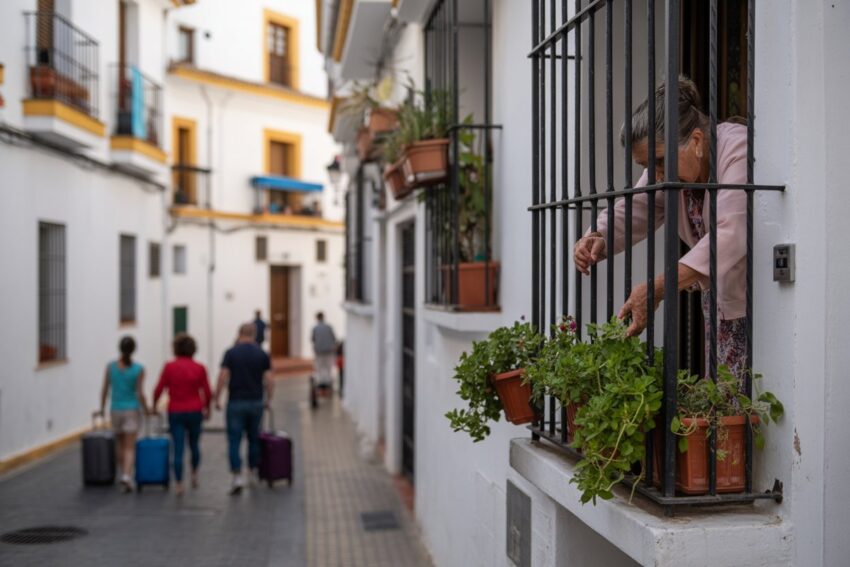
“We love that people want to see our home,” says Maria, a resident of Seville’s Santa Cruz district. “But I don’t know my neighbors anymore. Every week there is a new face, a new suitcase rattling on the cobblestones. It feels like living in a theme park rather than a community.”
The Infrastructure Strain: Water and Waste
Beyond the housing crisis, the 700,000-bed milestone is pushing Andalusia’s physical infrastructure to the brink. The region has faced historic droughts over the past few years. A single tourist in a high-end hotel consumes, on average, three to four times more water per day than a local resident.
With the 2025 holiday rush bringing occupancy to nearly 100% in many coastal towns, the pressure on water reservoirs, waste management, and public transport is immense. The regional government is currently debating a “Tourism Tax” (Tasa Turística) to help fund the necessary upgrades, a move that has sparked a fierce debate between hoteliers and local councils.
The Junta’s Stance: Quality Over Quantity?
Arturo Bernal, the Regional Minister for Tourism, has maintained that the goal is to shift toward “high-value” tourism. The strategy involves attracting travelers who stay longer and spend more, rather than just increasing the “headcount.”
However, critics argue that the sheer volume of beds makes “quality tourism” an oxymoron. When 700,000 people are looking for a spot on the beach or a table for tapas at the same time, the “premium” experience begins to evaporate, replaced by queues and crowded plazas.
The Rise of “Phobia” and the Path Forward
2025 has been the year of the “Turismofobia” headlines. From protests in Málaga to restrictive new laws in Barcelona that are being watched closely by Andalusian mayors, the social contract between the industry and the inhabitants is frayed.
The path forward likely involves a “cooling off” period. Several Andalusian municipalities have already begun implementing moratoria on new tourist licenses.
Strict Zoning: Limiting the percentage of tourist flats allowed in historic centers.
Decentralization: Encouraging travelers to visit the “Inland Andalusia”—towns like Jaén or the white villages of Cádiz province—to spread the economic benefits and the physical load.
Digital Regulation: Stricter crackdowns on unregistered, “black market” holiday rentals that bypass safety and tax regulations.
Traveling Responsibly in Andalusia
If you are one of the thousands contributing to that 700,000-bed figure this winter, you can help humanize the impact:
- Stay in Registered Hotels: Hotels create more stable, year-round employment than unstaffed apartments.
- Shop Local, Eat Local: Skip the chains. Seek out the mercados and family-run tabernas.
- Be Water Wise: Andalusia is a dry land; treat water as the precious gold it is.
- Travel Off-Peak: Explore the region in February or November to enjoy its beauty without the crowd-induced stress.
The Verdict
Andalusia remains one of the most beautiful places on Earth, a kaleidoscope of Roman, Moorish, and Christian history. But the 700,000-bed milestone is a warning light on the dashboard. For the region to remain a top-tier destination, it must first remain a livable home for the Andalusians themselves.
As the sun sets over the Giralda, the hope is that 2026 will be the year of “the Great Balance,” where the boom is finally managed with a human touch.
