
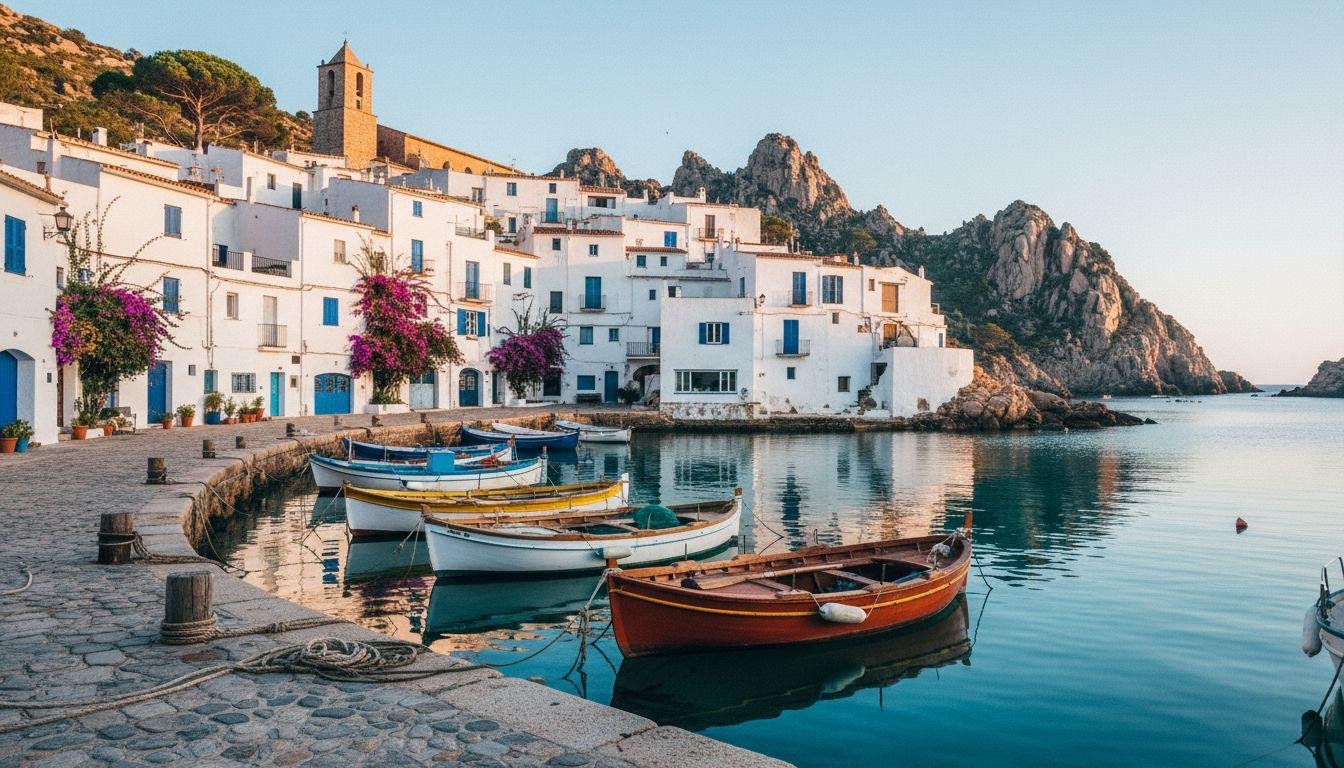
Tossa de Mar draws over 2 million visitors annually to its fortified walls, with mid-range hotels hitting $220 per night and parking fees of $16 daily during peak season. Just 62 miles northeast, Cadaqués delivers the same whitewashed Mediterranean magic with deeper artistic heritage through Salvador Dalí’s preserved home and that crystalline morning light that made this fishing village a 20th-century creative sanctuary. All for $130 per night and free coastal access.
Better than Tossa de Mar where crowds cost $250 and Cadaqués keeps Dalí’s light empty for $130
Tossa de Mar’s Vila Vella fortress processes 8,000 daily visitors during July and August. Lines snake for 45 minutes past overpriced cafés charging $8 for basic sandwiches. The medieval charm drowns under selfie sticks and tour bus exhaust.
Drive 2.5 hours further along winding coastal roads to reach Cadaqués. This journey filters casual tourists, leaving behind a village of 2,900 residents where morning fog lifts to reveal the same light that inspired Dalí’s surrealist masterworks. Saint-Céneri-le-Gérei’s painted charm shares this quality: small artist colonies where creative genius once flourished.
The Dalí advantage that Tossa cannot match
Tossa rebuilt its fortress walls for tourism. Cadaqués preserves the actual house where Salvador Dalí lived and worked for 40 years. The difference matters profoundly.
Portlligat’s authentic artistic heritage
The Casa-Museu Salvador Dalí limits visitors to 250 daily across guided tours of just 8 people each. You walk through rooms where Dalí painted “The Persistence of Memory” and “Dream Caused by the Flight of a Bee.” His easel still faces the harbor window where morning light streams across Cap de Creus.
Book 5-7 days ahead during summer versus Tossa’s fortress accepting walk-ins with endless queues. This advance planning creates intimacy instead of chaos.
Cost comparison reveals Cadaqués’ value
Mid-range hotels in Cadaqués average $130-180 nightly during peak season compared to Tossa’s $180-250. Restaurant mains run $18-25 versus Tossa’s tourist-trap pricing of $25-35. The Dalí museum charges $15 with guaranteed small groups while Tossa’s fortress costs $8 but delivers crowded disappointment.
Three-day totals: Cadaqués averages $485 per person including accommodation, meals, and activities. Tossa reaches $615 for comparable experiences with inferior cultural depth.
The filtering effect that preserves authenticity
Barcelona to Tossa takes 1 hour via highway A-7. Barcelona to Cadaqués requires 2.5 hours through winding mountain passes and coastal curves. This journey weeds out day-trippers seeking Instagram shots without cultural investment.
Morning blue hour walks without crowds
Sunrise at 7:45 AM in December 2025 bathes Cadaqués’ cubic white houses in rose-gold light. Harbor waters mirror empty fishing boats while seagulls cry overhead. The village belongs to photographers and early risers until 10 AM when tour groups finally arrive from Barcelona.
Tossa’s beaches fill by 8 AM with resort guests claiming prime sunbed positions. Ploumanac’h’s granite drama offers similar coastal magic with morning fog revealing ancient geology.
Winter character when locals reclaim their streets
Cadaqués maintains year-round life with 65% of residents staying through December. Family-run restaurants serve locals suquet de peix (traditional fish stew) for $12 while Catalan conversations fill the harbor promenade. December temperatures reach 55°F with clear Mediterranean light perfect for photography.
Tossa essentially hibernates from November through March. Hotels close, restaurants shutter, and the fortress echoes empty despite mild 52°F weather.
Access details and practical planning
Fly into Barcelona-El Prat airport then drive the scenic coastal route through Girona and Figueres. Rental cars cost $45 daily plus $35 in tolls and fuel for the 100-mile journey. Public transport requires connections: Barcelona to Figueres by train (1.5 hours, $18), then bus to Cadaqués (1 hour, $12).
Park free along Carrer de Vigilant or pay $8 daily in Parking Sa Pedrissa. Koufonisia’s authentic island life demonstrates how small Mediterranean communities preserve character through mindful tourism management.
Stay at Hotel Cala Joncols ($140 nightly with harbor views) or Casa Nun ($95 for traditional fisherman’s cottage charm). Both properties close January-February but reopen March 15 for shoulder season rates 30% below summer pricing.
Your questions about Cadaqués answered
When should I visit for the best light and fewer crowds?
May through June offers 75°F days with morning blue hour at 6:15 AM and tourist numbers 40% below July peaks. September provides similar conditions with warmer 68°F sea temperatures. Avoid July-August when accommodation doubles in price and Dalí museum tours book solid weeks ahead.
What makes Cadaqués culturally superior to other Costa Brava towns?
Dalí chose Cadaqués over everywhere else on Earth for the quality of light and protected harbor setting. The town inspired 40 years of his most famous works including “Metamorphosis of Narcissus.” Sifnos’ living pottery tradition shows how authentic craft heritage elevates destinations beyond scenic beauty.
How does the experience compare to Tossa de Mar specifically?
Tossa processes 5x more daily visitors than Cadaqués during summer with corresponding noise, crowds, and commercialization. Cadaqués limits Dalí museum capacity to preserve intimate experiences while Tossa’s fortress becomes a medieval theme park. The 90-minute extra drive filters serious cultural travelers from casual beach-seekers.
Dawn breaks over Portlligat harbor where Dalí’s white house reflects in mirror-still water. Fishing boats bob empty in morning mist as the first light touches cubic walls that inspired surrealist dreams. This is Cadaqués before tourists wake, when genius still whispers in Mediterranean silence.