
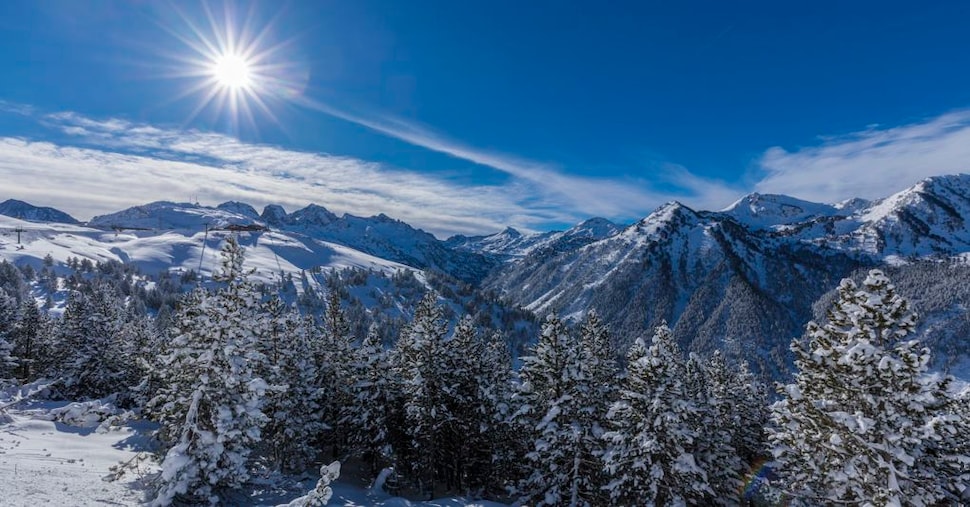
Before one’s eyes are the spectacular beaches of the Costa Brava, world-famous gastronomy and works by famous artists such as Gaudí or Dalí, places like Tarragona or Lleida with their monuments declared World Heritage Sites by Unesco. But at this time of year, the Catalan winter holds many surprises in store for those who reach it: there is no shortage of ski slopes and ice skating rinks in its mountains, or you can go snowshoeing, relax at the spa or try an ice bar on the beach. Incidentally, 2026 will be a crucial year for Catalan culture, dominated by international events such as the Gaudí Year, the Unesco World Capital of Architecture (Barcelona) and the Pau Casals Year (150 years after his birth), celebrating the centenary of Gaudí’s death and the region’s strong artistic and cultural heritage, with a focus on architecture, music and tradition. Here are five proposals to immerse yourself in the cold season in Spain.
Skiing in the Pyrenees in the province of Lleida
Weather permitting, the Baqueira/Beret ski resort, for sixty years the reference point for ski enthusiasts in the Pyrenees in the province of Lleida, will remain active until spring. Between the mountains of the Val d’Aran, with peaks approaching 3,000 metres, large forests of fir, pine and beech, and the Valls d’Àneu, the neighbouring valleys located in the municipality of Alt Àneu, you can ski on 122 slopes for a total of 171 km of pure adrenaline. There is also Nordic skiing here, with 7 km of trails to try your hand at the classic or skating technique, and equipped areas for the little ones. Alternatively, thanks to its northern exposure, at the gateway to the Aigüestortes National Park and Estany de Sant Maurici, at 2,751 metres the snow remains in the Boí Taüll ski resort, the highest in the Pyrenees. With 45 km of slopes, ski mountaineering routes, a snow park and a toboggan run, it is the ‘place to ski’ in the Alta Ribagorza region.
Relaxing at spas in fifteen cities
The Associació de Viles Termals de Catalunya unites fifteen Catalan spa towns that share a wealth of mineral, mineral-medicinal and thermal waters. On the Costa Brava, Caldes de Malavella has been famous since Roman times for the beneficial waters of Puig de les Ànimes, Puig de Sant Grau and Puig de les Moleres. A curiosity: the town’s coat of arms depicts a girl immersing herself in a tub of hot water. Also dating back to the same historical period is the thermal tradition of Caldes de Montbui, the town 30 km from Barcelona, which has the best-preserved Roman thermal baths on the Iberian Peninsula and natural springs that emit one of the hottest thermal waters in Europe, over 74 °C. Try it for yourself at the Font del Lleó, the fountain that has been the hub of Caldes de Montbui town life since 1581. Don’t miss a visit to Thermalia, the thematic museum on thermal water culture and an art section with works by Manolo Hugué and Pablo Picasso.
Shoes on feet and headlamp: walking in the snow
Located in the heart of Cerdanya (historical Pyrenean region), close to Berguedà and Ripollès, and reachable from Barcelona in just two hours by car or alternatively by train or bus, La Molina is the oldest ski resort on the Iberian Peninsula and one of the most popular in the Catalan Pyrenees. Discovering it at night, snowshoes on your feet and with the help of a head torch, is one of the most exciting experiences you can have in winter in the province of Girona. Among the excursions, there is one that goes up to the Niu de l’Àliga refuge, accompanied by expert guides. A very interesting alternative for walking in the snow is also the area of Port del Comte, in the Solsonès region, where you can walk through black pine forests and enjoy the magnificent views of the Cadí and the Pyrenees. Rutes Sílvia Rovira, a local agency attentive to environmental sustainability issues, organises trips of various levels and durations, with snow equipment hire included.
In Barcelona for ice skating
After snow and water, in the Catalan winter there can be no shortage of ice. In Barcelona, you can skate on the brand new rink at the Westfield La Maquinista shopping centre on Passeig Potosí in the Sant Andreu district. The outdoor area of the car park is transformed into a huge ice amusement park, with the largest natural ice rink in the city: over 800 square metres and a slide, where you can have fun with the whole family. Other rinks, in Barcelona, are at the port of Moll de la Fusta and the new sustainable ‘ice’ rink (made without the consumption of water and energy) at Tibidabo. Staying on the ice theme, you can order or learn how to make one of the cocktails offered by Icebarcelona at the Platja del Somorrostro, complete with handmade furniture, walls and ice sculptures. Gloves and a courtesy jacket, here, are included in the experience.
Between trades and traditions: a journey through historic workshops
Among so many outdoor activities, a little healthy shopping is a must. In the heart of Barcelona, amidst modernised alleys and glittering signs, small shops still survive that tell of another city: that of slow time, of handed-down trades and old-fashioned scents. These are historic shops, set in beautiful buildings, which preserve their original furnishings. Entering them is like crossing the threshold of a small living museum, where every shelf and every gesture of the shopkeeper speaks of tradition and authenticity. In the heart of the Barri Gòtic is the historic Fargas chocolate shop, founded in 1827, while Cereria Subirà is considered the oldest shop in Barcelona. Its founder started his business by importing waxes from Genoa, before opening a first workshop in 1761. On the street where Picasso used to visit his Demoiselles d’Avignon, La Manual Alpargatera, founded in the 1940s, is much more than just a shoe shop: it is a living piece of Catalan craft tradition. Also worth a visit is La Colmena, one of Barcelona’s most emblematic patisseries, which has seen three generations at work since 1928.