
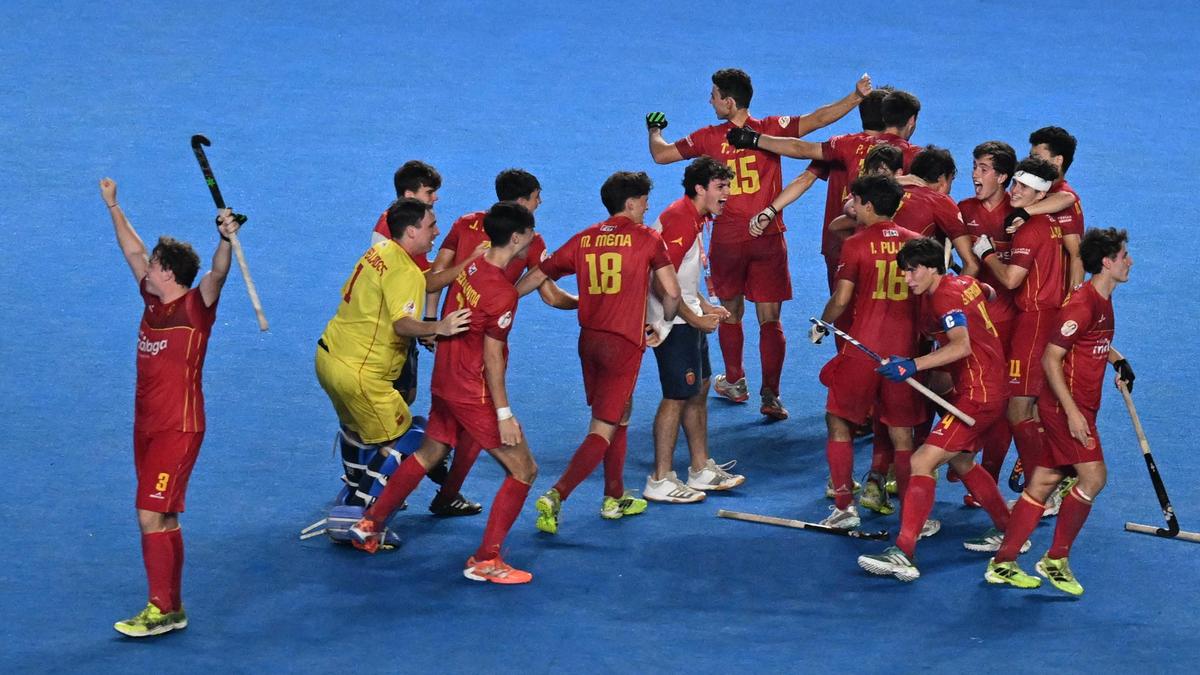
The grand finale of the FIH Men’s Hockey Junior World Cup 2025 between Spain and Germany is a classic David vs. Goliath battle. On one side, Germany is aiming for a historic eighth title in the U-21 tournament, while on the other, Spain is dreaming of securing the first-ever world title in its history.
While past achievements don’t guarantee future success, they certainly can fuel growth and the pursuit of excellence. For Germany, a global hockey superpower, the world stage of this men’s age-group tournament has always served as the first litmus test for its meticulous, nationwide club academy system.
The ongoing tournament in Chennai and Madurai is no exception. After a measured, almost quiet, progression to the semifinal, the German juggernaut shifted gears, delivering a chilling 5-1 dismantling of host India. It was a masterclass in structural efficiency and cold-blooded winning mentality.
Midfield general Lucas Kossel captured its ethos perfectly after the semifinal, stating, “Mentality is very important… We all have that winning mentality in big moments… We just want to be relaxed and play our game.”
READ: Madurai facelift for Junior World Cup provides hockey hopefuls platform to dream
Tactically, Germany suffocated India by executing an efficient man-to-man marking system, coupled with midfield overloading. This tactical straitjacket offered India no breathing room, denying it meaningful goal-bound attacks or the crucial lifeline of a Penalty Corner (PC) in the first half.
However, the reigning Men’s EuroHockey Under-21 Champion, Spain, presents a radically different tactical riddle. Coach Oriol Puig Torras encapsulates the philosophy: “The Spanish culture is fast… they are technical players. They move the ball quickly, pass the ball, and drive the ball.”
Unlike the towering physiques often seen in other European powerhouses, the Spanish squad is typically comprised of shorter players who adopt a uniquely low centre of gravity—often kneeling to receive the ball—which enhances their supreme ball control and agility.
This inherent natural flair and reliance on intricate, short passing will be Spain’s crowbar against the German fortress. Their strategy will pivot on using lightning-fast link-up play to open up the German defence, which will undoubtedly prioritise tight marking on the Spanish forward line. The Spanish attackers are encouraged to roam freely, pulling defenders out of position to manufacture space for teammates crashing the ‘D’.
The Junior Redsticks will draw immense encouragement from Germany’s quarterfinal scare against a highly technical France, a match that ultimately went to a shootout. Spain also possesses a crucial match-winner in Bruno Avila, a prolific drag-flicker whose power and precision are matched only by his calm temperament under pressure.
Crucially, the Spanish mindset is geared towards outscoring the opponent rather than containment. This suggests the summit clash is primed to be an open, high-tempo contest, provided Spain can execute a blistering start and secure the vital first breakthrough to put the unshakeable German confidence to the test.
Published on Dec 09, 2025