
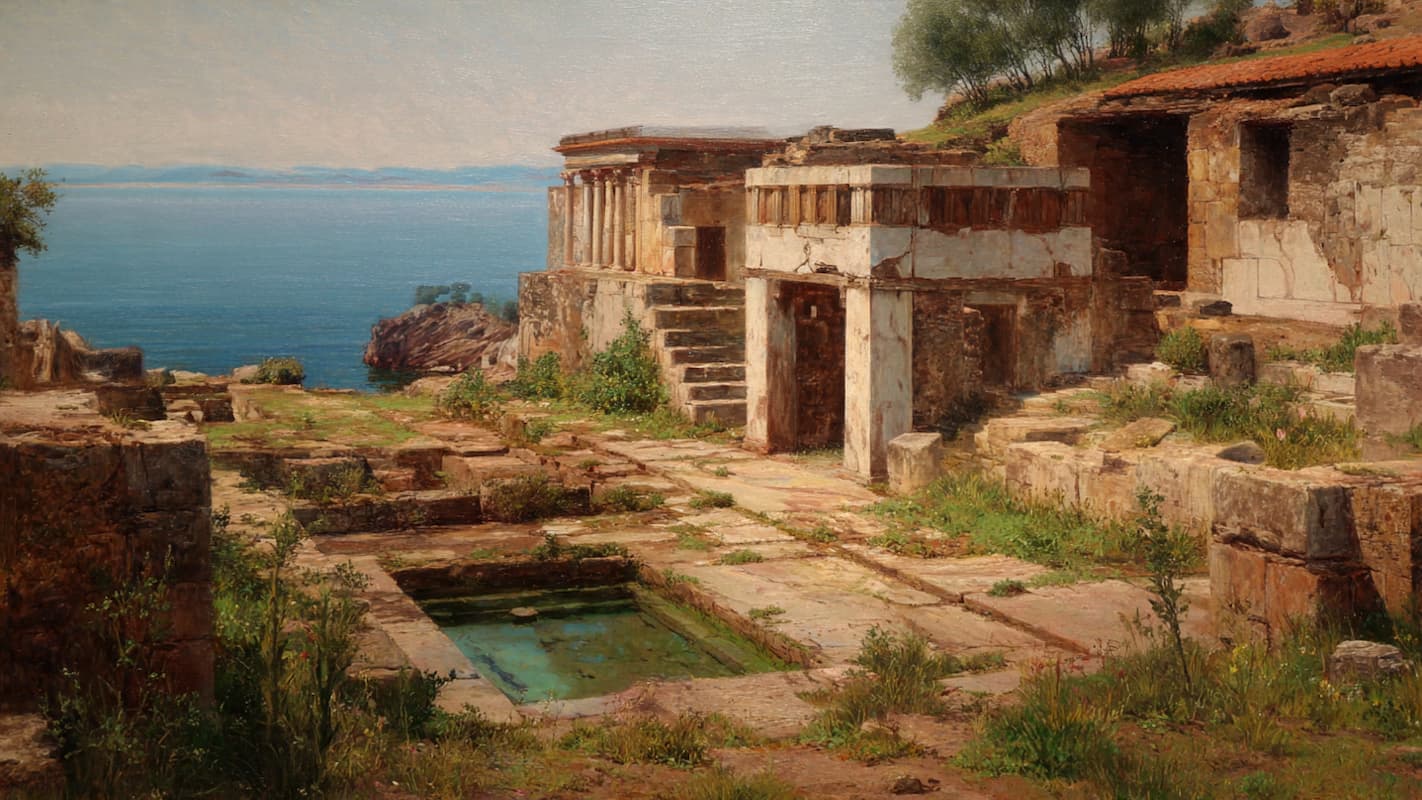
An archaeological study brings together, for the first time, evidence of luxury in the villas of Galicia and Asturias, linking them to high-ranking individuals of the 4th and 5th centuries AD.
An academic study focused on the northwest of the Iberian Peninsula has succeeded, for the first time, in bringing together all the archaeological evidence confirming the presence of the upper classes of the Late Roman Empire in this region, which was then considered a frontier of the known world. The research, conducted by Diego Paya Augusto of the University of Oviedo, combines the analysis of historical sources with the examination of luxury remains found in the Roman villas of present-day Galicia and Asturias.
For a long time, literary sources from Late Antiquity (4th–5th centuries AD) had mentioned the existence of prominent figures in the ancient Roman province of Gallaecia. However, there was a lack of a systematic archaeological assessment that could demonstrate, through material remains, the presence and power of these elites. This work fills that gap, especially for the westernmost and Atlantic areas of Gallaecia, where previous studies were almost nonexistent.
At the end of the 3rd century, Emperor Diocletian reformed the administration of the Empire and expanded the boundaries of the province of Gallaecia. According to the study, this large province was bounded by the Douro River to the south, the Atlantic Ocean to the north and west, and extended eastward as far as Iuliobriga. Within this vast territory, the study focuses specifically on the areas that today make up Galicia and Asturias, regions incorporated later into the Empire and with a lower level of urban development compared to other areas of Hispania.

Despite this, the northwest had three important urban centers: Lucus Augusti (Lugo), Bracara Augusta (Braga), described by the poet Ausonius as “opulent,” and Asturica Augusta (Astorga), called urbs magnifica by Pliny. Nevertheless, the focus of power and wealth in the rural landscape was not only in the cities, but in the villae: large estates for leisure and production where the Roman aristocracy displayed its status.
In these villas, economic activities such as agriculture, livestock raising, or horse breeding were managed, the latter a highly prized source of wealth since the Republican period. Above all, however, they were the stage on which the powerful displayed their wealth. Thanks to written references, chance finds, and some archaeological interventions, around 80 potential villa sites have been identified in Galicia and 26 in Asturias. However, very few have been scientifically excavated.
Prosopography: the names of power
Who were the owners of these properties? The study conducts a brief prosopographical analysis, that is, it identifies the historical figures who can be linked to Gallaecia in those centuries. Eighteen individuals from the upper classes have been identified, mainly connected to the religious world (bishops, presbyters, monks), but also to the provincial administration and even imperial power.

Among them are figures such as Emperor Theodosius, originally from Cauca (present-day Coca, Segovia, then within Gallaecia); Priscillian, the controversial ascetic and bishop born into a noble and extremely wealthy family; the presbyter Paulus Orosius, from Braga; or the mysterious Egeria, a possible woman of high social standing who undertook a famous journey to the Holy Land.
The author clarifies that, in many cases, the exact origin of these figures in the northwest is debated. It is not unanimously accepted that Egeria was originally from the northwest of Hispania, the text notes. However, this does not detract from the central fact: The key point is that the existing data allow us to corroborate the presence in northwestern Hispania, during the 4th and 5th centuries, of a series of individuals belonging to the upper classes of late Roman society.

Subscribe to our newsletter
Receive our news and articles in your email for free. You can also support us with a monthly subscription and receive exclusive content.
Luxury underfoot: mosaics
The most tangible evidence of this wealth consists of the luxury elements found in the villas, beginning with mosaics. Varro, a Roman writer of the 1st century BC, already considered that a perfect villa was one that combined economic productivity with beauty provided by elements such as mosaics.
In Asturias, eight villas with mosaic remains have been identified, although only two (Veranes and Andallón) are preserved in situ. All feature geometric or marine motifs, and none are figurative (with human or mythological representations). Polychrome and dated to the second half of the 4th century, they decorated noble rooms such as the triclinium (dining rooms).
The mosaic from the villa of Memorana (Pola de Lena), whose design of rows of rectangles with motifs of flowers, fish, and birds is uncommon in late Hispano-Roman mosaics, is now preserved in the Archaeological Museum of Oviedo. But the most impressive is that of the villa of Andallón (Las Regueras), a polychrome pavement measuring 11.80 by 3.60 meters in excellent condition. Its decoration includes a cup with stylized branches, a motif that researchers link to wine and the cult of Bacchus, reinforcing the idea that the room was a dining space where the banquet, a central ritual of power, took place.

In Galicia, the situation is similar: 17 villas with evidence of mosaics, but none preserved in their original location. The most important have been documented in places such as A Cigarrosa (A Rúa, Ourense), Parada de Outeiro (Vilar de Santos, Ourense), or Panxón (Nigrán, Pontevedra). Marine motifs (fish, dolphins, mollusks) and geometric designs predominate. A key finding is the water-fly motif, a series of schematic marks that simulate the movement of water and appear in several Galician mosaics. This detail led, years ago, to the hypothesis of the existence of an itinerant workshop operating in the northwestern peninsula.
The most outstanding ensemble is that of A Cigarrosa, almost completely destroyed after its discovery in 1969. Its mosaics, which decorated pools (natationes), displayed a great variety of marine species with high realism. Their chronology, between the late 3rd century and the 4th century, coincides with the period of maximum expansion of the villas.
The walls speak: mural paintings
Another indicator of luxury is mural painting, for which evidence exists in 13 villas in Galicia and Asturias. In most cases, these are only small fragments of painted stucco that confirm their presence, but little more.
Two cases stand out. The first is the villa of Cambre (A Coruña), where in 1998 the paintings of the frigidarium (cold room) of a bath complex were discovered. Against a blue-gray background, a varied array of marine fauna (tuna, eel, carp, clams…) was depicted with great naturalism, whose reflection in the pool water must have created the illusion of a submerged environment. The walls imitated marble and featured an architectural motif that may represent a harbor.
The second case is the villa of Andallón, in Asturias, which offers enormous potential for study. Recent excavations (2018–present) have brought to light paintings preserved to heights of more than one meter. They combine al fresco and al secco techniques, with vegetal and geometric elements and silhouettes that may be felines. Their in-depth study is still pending.

A singular find comes from the villa of O Cantón Grande (A Coruña), where a fragment of painting shows a circle with two axes in the form of a Greek cross. The study suggests that it is likely a schematic Chi-Rho, which would confirm the arrival of Christianity at the villa in its final centuries of occupation.
Sculpture: the scarcest testimony
The chapter on sculpture is the most limited. In Asturias, no sculpture has been located that can be securely associated with a villa. In Galicia, there are some examples, but their connection to villas is probable rather than certain.
Three pieces stand out. A marble bust of Lunensis found in Abegondo (A Coruña), which would reinforce the idea of the arrival of luxury goods in the northwest. The sculptural group of Dionysus and Ampelos, discovered at A Muradella (Verín, Ourense), a marble statue 0.93 meters tall that symbolizes the culture and education to which the aristocracy aspired. And a small bronze statuette of Mercury found in San Salvador de Seiro (Ourense), which may have formed part of the lararium (domestic altar) of a private residence.
The study reaches several fundamental conclusions. The first is that historical and archaeological analysis corroborates the presence of wealthy landowners in northwestern Hispania during the 4th and 5th centuries. These individuals had the economic means to acquire luxury elements typical of Roman residential architecture of the period.
In the study’s own words: From the evidence analyzed, it can be deduced that the territory of the present-day regions of Galicia and Asturias was fully integrated into the dynamics that characterized the Roman Empire during the second half of the 3rd century and the 4th century. It was during this period that the display of wealth and property, expressed through the magnificence of the villa and a refined lifestyle, became the most effective means of demonstrating power. Ostentation itself had become the emblematic measure of the intensity of this power.
The settlement pattern shows that the territory was first structured around the three great Augustan cities (Lugo, Braga, and Astorga) and that, subsequently, the road network (such as Via XVIII of the Antonine Itinerary) facilitated the emergence and spread of villas. Many of them are located alongside these routes or on the coast, linked to fishing and the fish-salting industry, which explains the abundance of marine motifs in their decorations.
The owners of these villas may initially have been Roman citizens connected to the administration or to gold mining, and later, army veterans returning to their places of origin.
The study also notes regional peculiarities. The level of monumentalization of Galician and Asturian villas is lower than that of the famous villas of the Douro Valley, such as La Olmeda (Palencia). The mosaics lack figurative or mythological scenes, displaying an aniconic character (without images of living beings). And evidence of sculpture is far scarcer than in other provinces.
The author makes it clear that this interpretive framework is a working hypothesis that requires future confirmation. It will be essential to undertake new archaeological excavations at the identified villas. In addition, the study should be expanded to include other indicators of luxury not examined in depth, such as hypocausts (heating systems) or architectural elements (columns, capitals), and complemented by a specific analysis of the architecture of these residences.
Despite the limitations of current research, the author is optimistic: The economic development of the northwestern peninsula during the 4th and 5th centuries is becoming increasingly evident. The presence of long-distance trade materials, the demand for marble, and the very spread of villas point to unprecedented prosperity in the region during Late Antiquity. The pieces of the historical and archaeological puzzle are beginning to fit together to shed light on how Roman elites lived and displayed their power in that Hispanic finis terrae.
SOURCES
Piay Augusto, D. (2025) Ornamenta urbana in the finis terrae: Some Observations on Elites and Luxury Elements in the Roman Villas of Northwest Hispania, Ktisis – Journal of Late Antique Housing. Bologna, Italy, 1(1), pp. 1–26. ktisisjournal.unibo.it/article/view/23560