
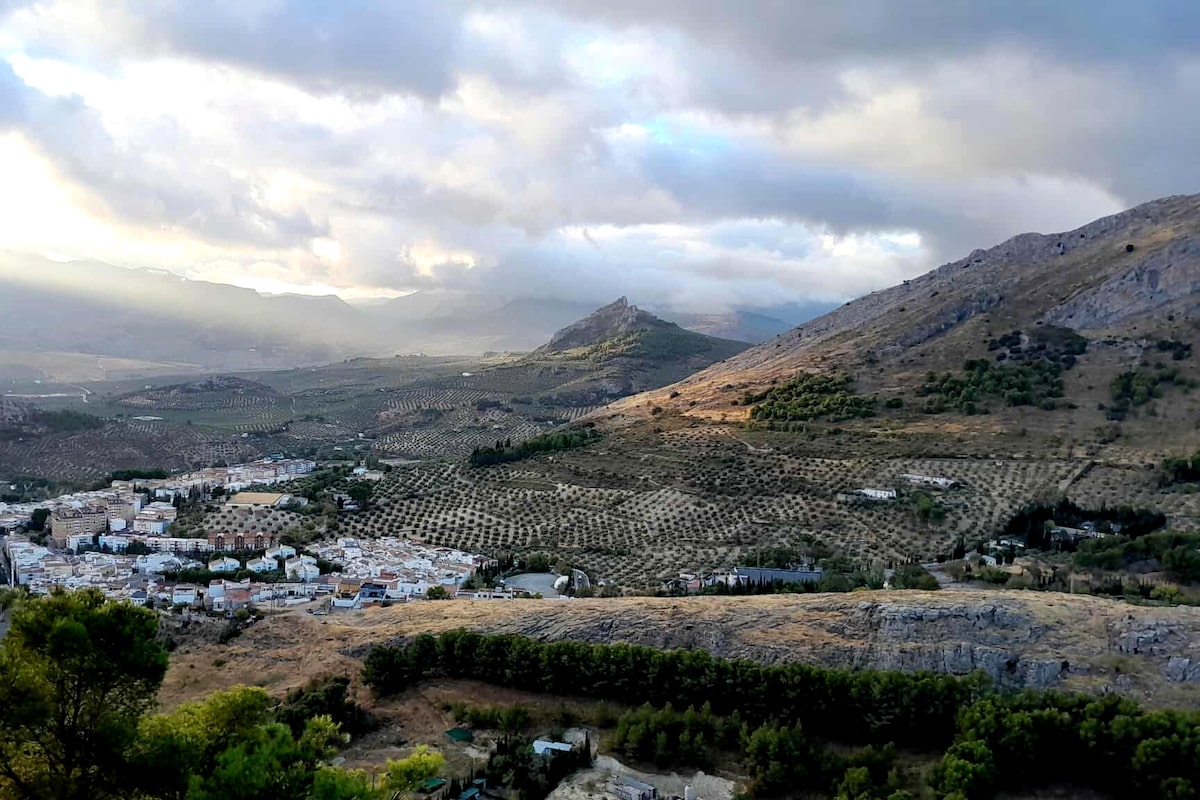
The view from the Parador de Jaén, a state-run hotel in the Andalusian town of Jaén, in the valley of the Guadalquivir River.Robert Everett-Green/The Globe and Mail
Years ago, I trekked between several villages in the southern Spanish region of Andalusia. We walked through the arid countryside during the mornings and afternoons, arriving each day at a different village, where we would have dinner and stay at an unmarked guest house. The looks we got from the locals as we hobbled into their tidy, white-washed hamlets made it clear that this kind of tourism was very new to them.
Spain today is the world’s second-most-popular tourist destination, just behind France. Ninety four-million people visited the country last year, almost double the population. National and regional tourism bodies are trying to ease the pain of overtourism by urging visitors to venture outside heavily trafficked zones along the coast and major cities such as Barcelona. Hiking, cycling, engaging with wildlife and historic sites, and gastro-tourism can all be done in comfort in the Spanish heartland.
When I returned recently to the region, a road trip in southern Spain led me to a pair of historic towns – Úbeda in Andalusia, and Almagro in Castilla–La Mancha – that made me glad I’d left the big cities. Using each of these towns as a hub, I was able to sample much of what the Spanish interior has to offer.
Starting in Úbeda
Úbeda, with its sand-coloured Renaissance architecture, is great for walking, or people-watching over tapas.Spanish Tourism Board/Supplied
This city in Andalusia’s Jaén province is quite different in look and feel from the region’s typical white-washed villages. The light reflected by the sand-coloured Renaissance palaces and chapels around the Plaza Vázquez de Molina is warm and buttery. The Plaza’s 16th-century El Salvador chapel, dedicated by a local grandee to his own glory, is restrained on the outside but riotously baroque inside. An adjacent palace is now an elegant parador, one of 98 state-owned hotels fashioned over the past century from dilapidated historical buildings (or built new).
Walking is the thing to do in Úbeda, and many guided tours are available, though the town feels unharried by tourists. The area around the Plaza de Andalucia is a great place for people-watching or for enjoying a lunch of tapas.
Fifteen minutes west of Úbeda is Baeza, another showplace of Renaissance architecture. It’s in the heart of Andalusia’s olive-oil industry, and the rolling hills of the surrounding countryside are blanketed with rows of silvery-green olive trees. During a guided tour of Baeza’s El Alcazar mill, I saw freshly harvested olives stripped of leaves and twigs, ground into a thick paste, and pumped into huge steel containers where the oil gradually floats free. The early harvest begins in the fall, and the bright-green oil is bursting with grassy, peppery flavour.
The hills of Andalusia’s countryside are covered with olive trees.Spanish Tourism Board/Supplied
After my tour, I ate a meal of terrific invention and flavour at Baeza’s Bar Paco’s, which specializes in a kind of Spanish-Asian fusion that you might expect to find only in Madrid or Barcelona.
Half an hour west of Baeza, the 10th-century hilltop fort of Baños de la Encina dominates the skyline. This is Spain’s oldest castle, a massive structure of rammed earth painted to look like stone. It’s open to the sky and has 15 towers, the tallest of which affords panoramic views and a romantic, almost mythic, frisson, especially as the sun goes down.
Another half-hour west brings you to Andújar, gateway to the Parque Natural Sierra de Andújar, a great site for hiking, biking and fauna-watching. It’s a mountainous refuge for red deer, mouflon (sheep with curved horns) and many species of birds, including kites, eagles and cinereous vultures – the largest birds in Europe.
There are many marked trails through this dramatic terrain, of varying levels of difficulty. I took a guided tour, the climax of which was a sighting of wild Iberian lynx, which are well-camouflaged for the terrain. Andújar is also a good place to sample the game meats that figure heavily in the cuisine of this part of Andalusia.
Enjoying the gastro tourism around Almagro
Almagro has one of the few 17th-century theatres in Europe.Spanish Tourism Board/Supplied
An hour north of the Parque, in the neighbouring province of Castilla–La Mancha, lies Almagro, a beautiful town with one of the few 17th-century theatres in Europe. The open-air Corral de Comedias, just off the historic Plaza Mayor, hosts a festival of classical Spanish theatre every summer. If the town seems familiar, that’s because Pedro Almodóvar shot several films here, including the 2006 Oscar-nominated Volver. The comfortable Almagro parador was built from local materials within the shell of a 16th-century convent destroyed during the civil war.
Encomienda de Cervera, a nearby olive estate and winery, is lodged near a dormant volcano. I took a guided tour of its dramatic, red-soiled grounds and unusual wine operations. These include a first fermentation in century-old tanks made with volcanic sand, and an aging process inside volcanic caves. One sign of changing times: 20 per cent of the winery’s income comes from gastro-tourism, up from nothing before the pandemic.
Manchego cheese is made with milk from white manchego sheep.Spanish Tourism Board/Supplied
An hour east of Almagro is Las Terceras, a manchego creamery. Here, on a picturesque estate that includes a 400-year-old chapel, cheese wheels of 3.5 kilograms each are made by hand from milk from white manchego sheep grazing nearby, and cured for three to eight months. Tours and tastings are available here and at others among Spain’s 68 registered manchego creameries.
No gastro-tourist should miss Restaurante Retama, a Michelin-starred dining room at La Caminera, a hotel and country club 45 minutes from Almagro. There, I enjoyed a fabulous meal that included duck fritters and pickled leek, sea bass with squid ink and cardamom sauce, and pumpkin with pickled pistachio ice cream. The Retama’s wine cellar boasts superb Spanish wines to match everything on the menu.
For a really atmospheric meal, however, you’ve got to have lunch in a gastromolino – a classic Spanish windmill retooled to feed travellers on the Don Quixote Trail that runs through Castilla-La Mancha. Several of these stubby white structures are visible from kilometres away on a hilltop at Consuegra, on the road north to Toledo. It’s suddenly easy to imagine Cervantes’s delusory Don charging these bucolic mills with his lance.
While you lunch in a cozy round room just under the roof, you can learn how each array of four blades was rotated manually to take advantage of the prevailing wind. The winds have different names: the Solano, blowing up from the Sahara, is a hot untimely blow that can destroy the olive harvest. The local name for a cold northern wind speaks for itself: Matacabras, or goat-killer. The zephyrs blow hard from every direction, so hold on to your hat.
If you go
Parador de Almagro.Spanish Tourism Board/Supplied
Fly into Malaga or Granada, head north by car and connect with local guides when necessary. The roads are good.
Paradores, state-owned hotels in historical architecture, are reasonably priced, and a great way to learn a little about what the building was centuries before you slept there.
Be sure to try salmorejo, a creamy variant of gazpacho; migas, a mixture of fried bread crumbs, sausage or sardines, garlic and olive oil; Spanish lamb stew; jamon iberico, long-cured ham; partridge escabeche; the venison stew known as guiso de ciervo.
The writer was a guest of the tourist office of Spain. It did not review or approve the story before publication.