
This article was produced in collaboration with Costa Brava and was first published in Rouleur Issue 140
Sometimes, when people talk about wine, they make the association with drinking until the senses blur. However, for Marta Cortizas, wine means something deeper: it is territory, landscape, and culture. “Wine is about getting to know a place, feeling it, delving into its terroir. It goes far beyond the wine itself. And the bicycle is the perfect way to discover it – especially the gravel bike, because it brings me even closer.” Cortizas speaks with the calm assurance of someone who truly lives what she describes. Those two passions – wine and cycling – are an essential part of her life.
She is professionally involved in the first one: she is Head Sommelier at El Celler de Can Roca, the three Michelin-starred restaurant run by the Roca brothers, world leaders in avant-garde cuisine alongside Ferran Adrià, and voted the best restaurant in the world in 2013 and 2015. The second one, cycling, came into her life just over five years ago and soon became, as she puts it, her “personal therapist”. Riding helps her unwind before long service shifts, share moments with her ‘gravel grupetta’, and, above all, keep learning. Because for Marta, cycling is another way of studying wine: travelling through the landscapes that inspire it, smelling the earth that makes it unique and learning about the history and the people who cultivate it.

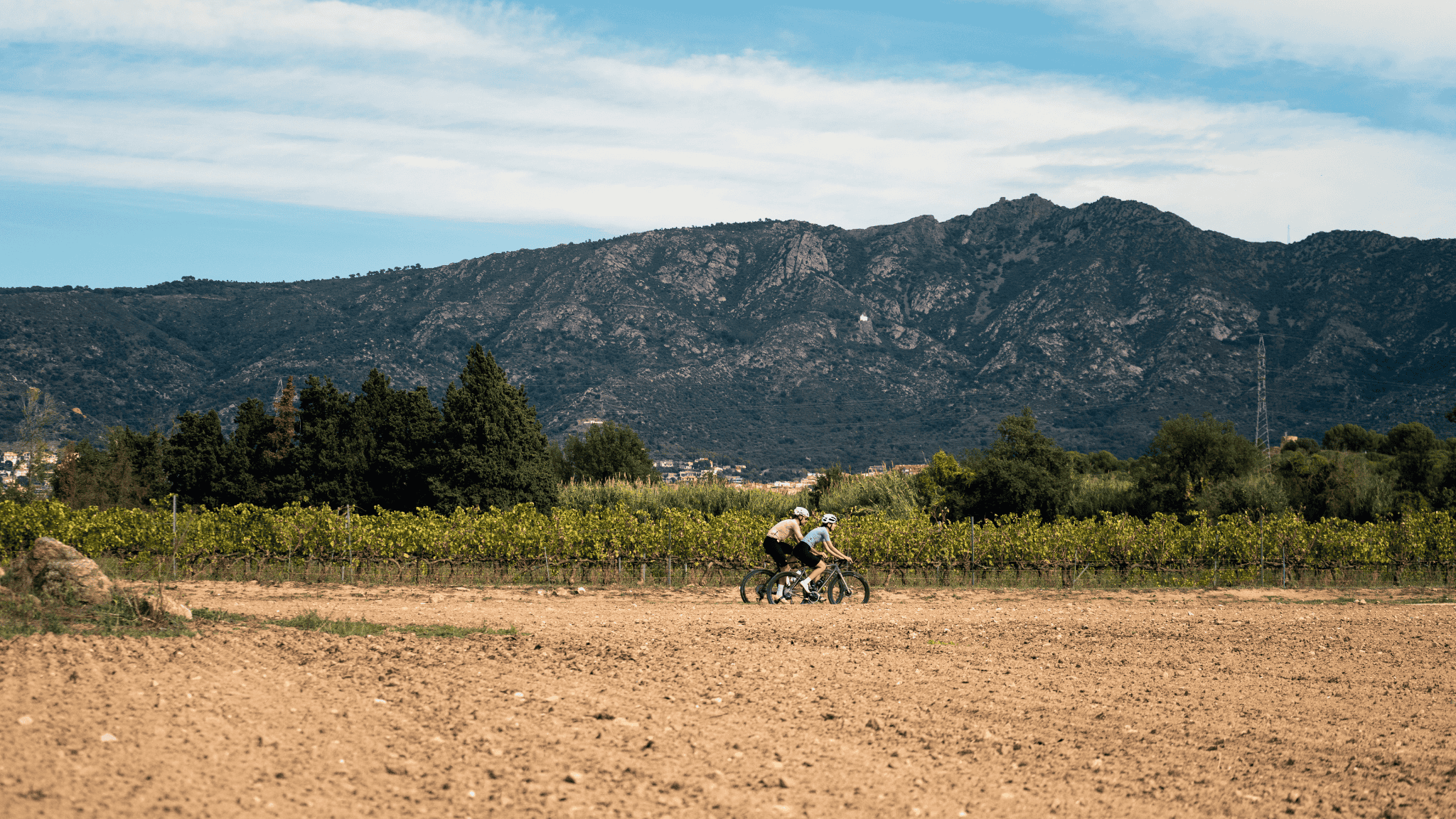
This route through the Empordà Designation of Origin, in the province of Girona in north-eastern Catalonia, is the perfect reflection of her two passions. Although born in Galicia, at the opposite end of the Iberian Peninsula, Cortizas has become one of the finest ambassadors for this corner of Catalonia, as many local winemakers acknowledge. She has naturally blended into the landscape — studying it, tasting it, and riding through it. The route links three representative wineries in the area, out of the fifty or so that exist, and allows to discover, via gravel roads, the territory where the vines and grapes of this DO are grown. Cycling along these roads gives you a better understanding of the wine produced here: its character forged between the Mediterranean Sea and the Pyrenees, the land that feeds it with more than 2,000 hectares of vineyards, the light that makes it grow and the wind that shapes it, the Tramuntana. Every bend, every slope tells a story about the landscape and what is grown there. Each year, according to data from the regulatory council, some 65,000 hectolitres of wine are transformed into nearly six million bottles. Figures that, beyond the quantitative, reflect the vitality of a land that has learned to dialogue with the wind, to tame the light and to draw from a diverse soil – granite, slate or sand – the unique personality of its wines.
“I often come to this part of the Costa Brava with a group of girls I ride gravel with in Girona, but I haven’t done the full route yet”, says Cortizas before facing the challenge. She reveals some of the secrets and subtle details hidden along the way: “It crosses truly spectacular landscapes. You could call it ‘Sea and Mountains’. It’s a route where you can see and understand the different vineyard orientations. Those facing north, for instance, endure a harsher climate, shaped by the Tramuntana — that distinctive wind from up here. It also allows you to get a real feel for the different soils of the region. Some, like those around Cap de Creus, are far rockier, although the tracks in general are very pleasant to ride.” The route links three landscapes that define this corner of Catalonia: the Mediterranean Sea, the Aiguamolls de l’Empordà wetlands, and the Pre-Pyrenees. In total, it stretches for 75 kilometres with just over 500 metres of elevation gain — a perfect combination for taking it slow and savouring the surroundings with every pedal stroke.
Mas Marès, cosmic energy
The route begins at Mas Marès, a farm nestled in the heart of the Cap de Creus Natural Park, a few kilometres from the town of Roses. “Starting here is like starting with the crowning jewel, it’s a gift. A place where the sky and the sea merge. A spectacular viewpoint,” says Cortizas as she gazes at the horizon. She adds, evoking one of the great geniuses of this land, painter Salvador Dalí, and his work The Cosmic Athlete: “It has a cosmic energy.” Perhaps it is no coincidence. Before devoting herself to wine, she studied fine art, which is why she looks at the landscape as if she were contemplating a canvas. Or perhaps it is because Marta sees in the work of Anna Espelt, winegrower and director of Espelt Viticultors at Mas Marès, or in that of other winemakers in the area such as Carlota Pena and her mother at Vinyes d’Olivardots, a connection with the artistic genius of the Empordà painter. “People like Anna and Carlota inspire me. They think beyond the conventional and do so with extreme sensitivity”, she explains.

At Mas Marès, the vineyards grow surrounded by menhirs and megalithic remains that remind us that this land was already inhabited and worked more than 5,000 years ago. The eternal stones have seen generations of men and women, who shaped the landscape we see today with their hands. First the Greeks, then the Romans, and later the medieval monks of the monastery of Sant Pere de Rodes. Today, it consists of an agroforestry mosaic of great natural value, a world reference that goes far beyond wine. “We call it that because it is made up of different ecosystems. Synergies, biodiversity and a land more resilient to fires are created. In 2022, for example, we managed to stop a fire that affected the Natural Park. Everything worked as planned,” explains Anna. Its mark can be seen, for example, in the dry stone walls, in the huts hidden among the vineyards, in the cows that feed on the scrubland, creating more open spaces, in short, in the balance between nature and cultivation.
At this first stop, Cortizas emphasises: “Mas Marès commands respect, it imposes itself on you. But it’s important to remember that many vineyards sit along public paths, and nature must always be treated with care.”

As Anna Espelt explains, it takes more than 500 years for a soil to form. Preserving the stone walls and preventing erosion is therefore essential. Above all, it’s vital not to stray from the marked trails. Respect for the land is everyone’s responsibility. Cyclists, too, must learn to understand and protect the environment that welcomes us. If we wish to keep enjoying these landscapes – and the wines they produce – we must do so with awareness, especially as gravel cycling continues to grow.
The route leaves the sea behind through one of its most rocky and broken stretches, heading inland. It crosses Roses before entering the Aiguamolls de l’Empordà Natural Park from the north – a section that seems flat and gentle, yet subtly climbs as it winds through rural tracks carved by the passage of tractors. Among isolated farmhouses and meadows where cows graze, the landscape breathes tranquillity. Yet this plain is alive – filled with the movement of birds, where the sky feels vast and the view stretches all the way to the Pyrenees. The day couldn’t be better: the sun shines, the clouds infrequent, and on the horizon the imposing Canigó mountain (2,784 m) stands as a silent beacon – a symbol of the Catalan spirit of the Pyrenean counties, a reminder that the Empordà is a land forever open between the sea and the mountains, and adjacent to France.

Female Entrepreneurship
After passing through aiguamolls, or wetlands, the route winds through a series of small inland villages – Pedret, Marzà and Masarac – before reaching its northernmost point, roughly halfway through. Here, the vegetation is different, becoming denser and more wooded. In Capmany, a simple, burgundy-coloured farmhouse marks a pause along the way. The vineyards, already harvested, show only their bare branches, a reminder of the quiet that comes after the harvest. Now the work is focused on the next process involved in making wine. “Just before you arrived, I was pressing,” Carlota Pena tells Cortizas. “And how long ago did you harvest?” asks the sommelier, knowing that climate change has forced winegrowers to adapt. “About two weeks ago, in mid-October, we had everything harvested. In our case, we have about 20 hectares of vineyards and 17 different wines; that’s quite a few for the small volume we produce”, replies Pena.

Vinyes d’Olivardots is one of those projects built on care and detail – and led by women. Carlota Pena and her mother, Carme Casacuberta, are the heart and voice of this family venture. “My mother left her job in the chemical industry because she had a dream: to make wine. Nineteen years ago, she went back to university to study oenology, and together with my father, they planted the first four hectares from scratch. Today, that dream has become a shared project between the two of us, because I always knew I wanted to dedicate my life to wine,” Pena explains, while Cortizas listens with the familiarity of someone who already knows the story. For sommeliers like her, understanding the stories behind the bottles – the people, the soil, the philosophy – is an essential part of their craft. They become storytellers of the land. As Pena puts it: “The sommelier is the extension of our hands. We make the wine, but they are the ones who tell its story, who carry our work to the people who finally enjoy it.”
The stop also offers a moment to catch their breath and gather strength for what lies ahead. With around 40 kilometres in their legs and most of the elevation already conquered, the road back towards the sea grows gentler – helped, above all, by the absence of the Tramuntana, that wind as feared as it is loved in the Empordà.

Touched by the Tramuntana The Tramuntana is a fierce north wind that sweeps across the north-eastern corner of the Iberian Peninsula, particularly in Catalonia and the Balearic Islands. But beyond its meteorological definition, it carries a certain mystique. ‘To be touched by the Tramuntana’, as locals say, is a way of life. In the Empordà, this wind shapes everything – the vineyards, the landscapes, and those who tend them. It’s a dry, unrelenting wind that sculpts both the land and the character of its people. The climate is more arid than rainfall alone would suggest, which makes organic farming not only possible but natural. Yet the Tramuntana leaves behind more than dryness: it leaves a special kind of energy, almost magnetic, that many artists and winemakers regard as a source of inspiration. Its gusts, which can reach over 130 km/h, seem to stir a certain creative madness.
“We’re not mad – we’re creative. We’re simply touched by the Tramuntana. Here in Cap de Creus, there’s a concentration of creative people well above average. Maybe it’s a coincidence… or maybe it isn’t,” reflects Anna Espelt. The same wind once whipped through Salvador Dalí’s surreal landscapes, inspired Ferran Adrià at El Bulli, the Roca brothers at El Celler de Can Roca, and even Nobel Prize–winning Gabriel García Márquez, who found in it the tone of his Strange Pilgrims: Twelve Stories collection of short stories. And, of course, it breathes through the vineyards of the region. “Empordà wines carry in their flavour that same roughness, that quiet resilience that the wind teaches to those who live here,” says Cortizas.

Before reaching Peralada town, the route glides down a gentle descent of just over ten kilometres, winding through vineyards and tracing the course of the Llobregat de l’Empordà river, and later, the Muga. These are kilometres made to be savoured – to soak up the autumn hues that could have been painted for a postcard. Because cycle tourism, at its best, is also about that: slowing down, noticing the small details, choosing routes defined not by numbers on a cycle computer, but by the stories you gather along the way. Like the native grape varieties that line the path. Among them, two that Cortizas mentions with a mix of pride and affection: “When I think of Empordà, I think of grenache and carignan. Carignan has stolen my heart, especially the grey variety, because it’s rare to find it anywhere else in the world. It’s a grape waiting to be discovered.” When Cortizas speaks, she does so with passion, radiating the same freshness you find in a good wine. Riding alongside her is a constant lesson in both oenology and sensitivity. Proof of her dedication came in 2025, when she was named Best Sommelier in Spain and graduated with distinction from the prestigious Court of Master Sommeliers in the UK.

Peralada, the Nature of Design
The final stop on the route is Peralada, an emblematic town in the area, reached by following part of the Pirinexus route. The Peralada winery is a landmark filled with history. With over a hundred years of tradition, it holds the largest volume of sales and exports within the Empordà DO. The route first passes by the Castle of Peralada, designated a Site of Cultural Interest, and then embraces the Peralada Winery, opened just three years ago.
From the outside, the winery is barely visible. There is no grand façade demanding attention or structure breaking the horizon – only gardens and, at most, the roof, which seems to dissolve into the landscape. Then the historic buildings, carefully restored, where you’ll find the Wine Bar of Celler 1923, the perfect spot to stop for a bite and recharge before heading back to Roses. “It’s the ideal end to the route. The architecture of this winery is spectacular. It’s a majestic place worth visiting,” says Cortizas.

As Delfí Sanahuja, oenologist and technical director of Peralada Winery, explains, the goal was clear: the new space aimed to showcase the terroir before the architecture, to respect the environment, and to minimise visual impact. It is a natural extension of the terrain, covered with local gravel and soil, where the building nestles – a true statement of intent. The project bears the signature of RCR Arquitectes, the Olot-based studio awarded the 2017 Pritzker Prize for creating spaces grounded with their surroundings. The technical solution was as ingenious as it was poetic: to take advantage of the ten-metre slope beneath the old farmhouse to build an underground, gravity-fed winery that integrates naturally into the landscape.In its final stretch, the route follows the Natural Path of la Muga, with a few bonus single tracks, before crossing the old bridge of Castelló d’Empúries and entering the town’s medieval centre. In the 11th century, far from direct contact with the sea, the Counts of Empúries chose this site as their new residence and transformed it into the true medieval capital of the Empordà – something still tangible in its streets and squares. The final kilometres take you back into the Natural Park of Aiguamolls de l’Empordà, a mosaic of water, reeds, and silence that signals we are near journey’s end: back at Mas Marès near Roses. And you don’t have to be a master sommelier to visit Peralada or any of the wineries on Marta’s ride – all are welcome to drop in and sample the fine wines proudly produced in Empordà.
One of Salvador Dalí’s most repeated maxims was: “To be universal, you must begin with the ultra-local”. A sentiment that also resonates in the wines of the Empordà DO. The fact that world-renowned restaurants like El Celler de Can Roca champion local products and give them visibility inspires people like Anna Espelt, Carlota Pena and Delfí Sanahuja to pursue their territory-rooted projects. It’s a way of proving that the wines and soils of Empordà can stand shoulder to shoulder with the gastronomy created here; that they speak the same language of excellence and identity. As Cortizas says: “A good wine must respect the land where it was born; without needing words, you should feel that it has a special energy.” Riding the paths of the Empordà is enough to understand: that energy vibrates through the landscape, the wind, and every tasting.