
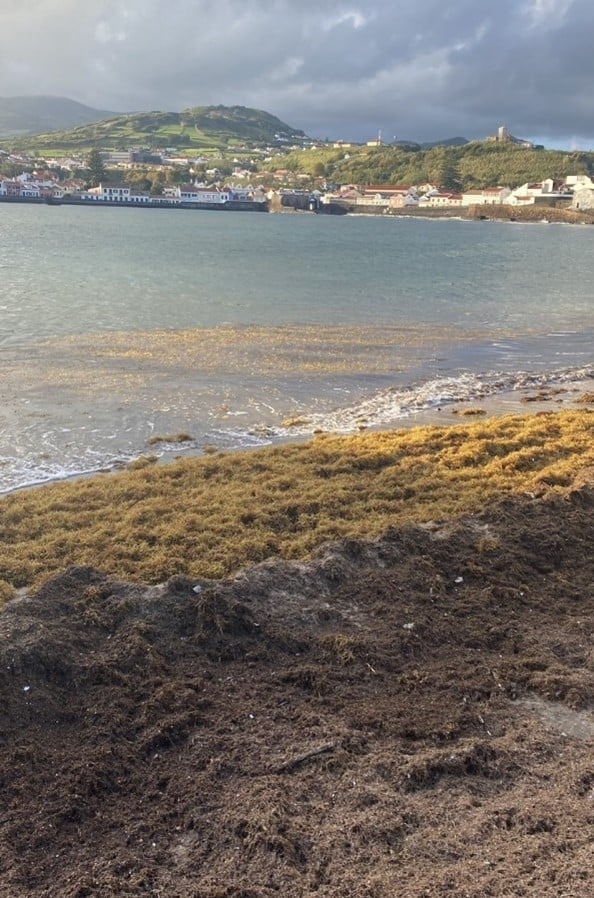
AN invasive species of seaweed that seaside towns near Malaga are spending millions to remove could instead be repurposed for profit – but local governments are missing the opportunity, scientists warn.
Maria Altamirano, professor of botany at Malaga University, explained that seaweed can be processed for use “in biotechnology, as a raw material, as an energy source, or in healthcare” – generating revenue that could help offset clean-up costs.
But under the Andalucian government’s current management plan, the algae collected from Malaga’s beaches may only be converted into compost for agriculture – with much of it effectively going to waste.
READ MORE: Key regions of Spain are hurtling towards an ecological catastrophe – including the Balearic Islands
Rugulopteryx okamurae, a species of brown algae native to the Pacific, became invasive in the Mediterranean around 2015, when it was first spotted near Gibraltar.
Since then, it has caused disastrous biodiversity loss in the area and saddled Costa del Sol towns with millions in removal expenses.
Altamirano said the Andalusian government’s strategy focuses on putting part of the seaweed to commercial use – but falls short of mitigating its environmental impact or properly compensating local administrations and fishers, who bear the brunt of clean-up costs.
She added: “[We] should help reduce the strain on local councils and the fishing sector, not increase the profits of a private company that has not suffered any harm.”
Fishers have also criticised Andalucia’s management plan as “useless.”
READ MORE: Help the recovery: WWF launches new model to restore Spain’s rural areas and cut wildfire risk
Maria del Carmen Diaz, president of the Spanish Federation of Artisanal Fishing (FENAPA), said: “[the plan] focuses only on the beach wash-ups and is limited to producing compost for agriculture within a single specific project.”
“It does not open up possibilities for other industrial activities,” she added, noting that the algae could be used to make “cosmetics, shoes, bricks, or packaging” and create “jobs and alternatives to fishing.”
The seaweed invasion has weighed heavy on Costa del Sol seaside towns so far – with local administrations shouldering massive expenses and months of backbreaking clean-up work.
Estepona has cleared 5,900 tonnes so far in 2025, with an estimated extra cost of more than €1 million due to increased labour and resources.
In comparison, the council removed 3,400 tonnes in 2023 and reached a record 9,700 tonnes in 2024. In 2020 and 2021, municipal crews cleared 2,700 and 2,800 tonnes, respectively.
Mijas allocated more than €690,000 for seaweed removal in 2024. As of 2025, almost 2,500 tonnes have been removed at a cost of €515,000.
Marbella cleared roughly 3,000 tonnes between June and August 2025, spending nearly €490,000.
Over the first eight months of the year, more than 4,600 tonnes were removed from its 27 kilometres of coastline, costing the city €750,000.
READ MORE: Spain’s mystery swine fever outbreak declared a national emergency – as finger of blame points at high-security lab undergoing building works
Manilva removed 1,300 tonnes last summer, at an estimated cost of €112,000 — an increase of 150 to 200 tonnes compared to the same period in 2024.
Meanwhile, Casares invested €30,000 to remove more than 600 tonnes of algae from its 3 kilometres of coastline between June and August, with figures similar to those of 2024.
Click here to read more Green News from The Olive Press.