
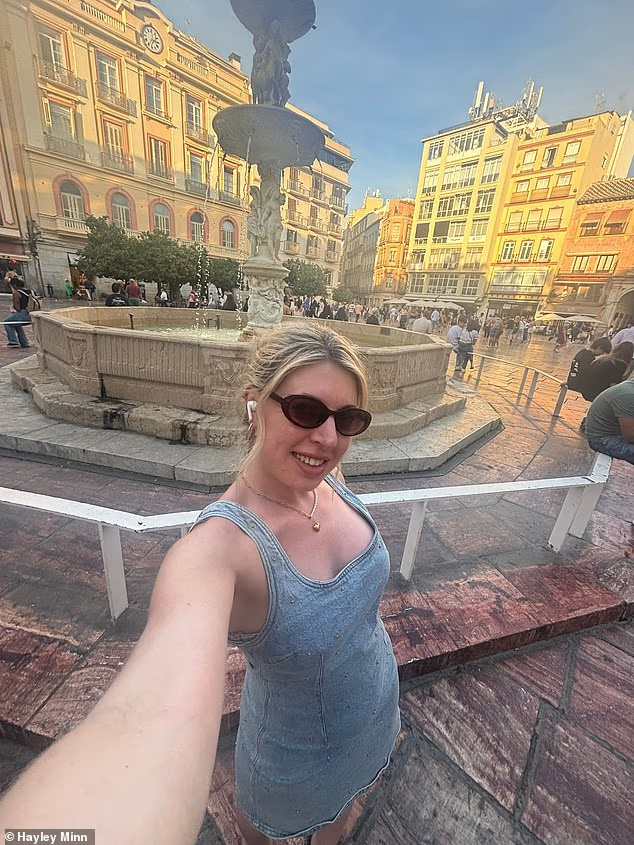
Moments after landing in Malaga, a satisfying chime comes from my phone signifying that I have just completed my 526th day of Spanish lessons on Duolingo.
I’m one of 46.6million people around the world who log into the free language learning app every day to extend their streak – and, of course, attempt to learn a language.
I’m here in Spain to test how much I’ve actually picked up. Surely, all those lessons will count for something in the real world – not just online?
After breezing through passport control with simple ‘olas’ and ‘gracias’, however, my first proper challenge comes when meeting my taxi driver.
Aside from the initial ‘Hayley Minn?’ – followed by my reply of ‘Si’ – he only says ‘gracias’, as he wheels my suitcase to the car, where we sit in silence the entire 15-minute drive to my hotel in the centre of Malaga, Hotel Vincci Seleccion Posada del Patio.
I keep trying to work myself up to ask: ‘Vives en Malaga?’ (‘Do you live in Malaga?’). But I’m too nervous about my pronunciation.
Instead, I frantically Google how to say ‘check-in’ in Spanish – having realised I’ve not learnt that phrase on Duolingo – only to discover it’s ‘check-in’.
I say a final ‘gracias’ to the driver. But the receptionist immediately greets me in English, so I forget the reason I’m in Spain and reply in my mother tongue.

Daily Mail’s deputy travel editor, Hayley Minn, visited Malaga to see whether the hours spent learning Spanish on Duolingo will count for something in the real world

Pictured: The path leading to the historic Gibralfaro Castle in Malaga. The castle dates from the 10th century and offers panoramic views of the city below and the Mediterranean Sea
Once in my room, I sink into the king-sized bed and switch on the television to immerse myself in the Spanish language.
Randomly, I find myself watching surgeons slice into someone’s nose, yet I realise I can understand a few words, but only enough to know that something is ‘rota’ (broken) and the doctors are ‘trabajando’ (working) to fix it.
I’m not sure I needed to understand Spanish to figure that out.
The next morning, I really started testing my Spanish. I manage to say my room number at breakfast – ‘Uno, cero, uno’ (‘101’) – before plucking up the courage to ask a staff member where the gym is (‘Donde está la gimnasio?’).
It turns out that, in reality, Spanish is spoken much more quickly than on Duolingo. Picking up the phrase ‘a la derecha’, I understand the gym is ‘on the right’, but I miss the end part of what he says.
He repeats in English: ‘Do you have a reservation?’ I booked a workout in English, once again, which hadn’t been the plan.
More than 590,000 people live in Malaga, making it Andalusia’s second-largest city after Seville, and once I leave the hotel, it quickly becomes clear that Spanish will be required.
In Mercado de Atarazanas, a food market housed in a warehouse with beautiful stained-glass windows, vendors are yelling out, selling everything from ‘queso’ (‘cheese’) to ‘cervezas’ (‘beers’) to ‘aceite de oliva fresco’ (‘fresh olive oil’).

The massive stained-glass window of Mercado Central de Atarazanas (Atarazanas Main Market) is pictured

In the food market, vendors are yelling out, selling everything from ‘queso’ (‘cheese’) to ‘cervezas’ (‘beers’) to ‘aceite de oliva fresco’ (‘fresh olive oil’)
A huge part of me wants to sit at one of the many heaving bars and order ‘unos tapas y un vasito de vino tinto, por favor’ (‘some tapas and a small glass of red wine, please’).
But, shamefully, I admit I find it all a bit overwhelming, so I grab a ‘bocadillo’ (‘sandwich’) to go.
I stop off at the Roman theatre, before hiking to Castillo de Gibralfaro, with its breathtaking city and sea views.
There’s no need to speak during this time, though at the Picasso Museum I’m happily surprised to find that I am able to read much of the Spanish display information.
I have a solo dinner at restaurant Terraza Catedral Malaga. Things are going well as I ask for ‘una mesa para uno, por favor’ and am led to what I asked for: ‘A table for one, please.’ But things soon go downhill.
‘Croquettes jamon,’ I say to the waitress.
Having assumed I’m an English-speaker, she replies: ‘Salmon?’ ‘No, jamon!’ I cry.
‘Salmon?’ she repeats. I revert back to English and manage to order the ham croquettes I’m after. It seems Duolingo has taught me to read Spanish but not to converse in it.

Alcazaba of Málaga, a historic fortress-palace in Andalusia, Spain, built on a hill overlooking the city and port, is pictured. Adjacent to it are the ruins of a Roman theater

Hayley enjoyed the breathtaking city and sea views during a hike to the Castillo de Gibralfaro
Back at my hotel, I go to the bar for a Diet Coke at the rooftop pool. All I say is ‘gracias’ as he hands me my drink, and the bartender says: ‘I didn’t know you spoke Spanish!’
I reply ‘un poco [a little],’ and he says in English: ‘That’s more than most tourists here. Your pronunciation is good!’ I feel much more confident in the next day or so.
In the taxi back to the airport, I try to strike up a conversation with the driver. ‘Carro bueno!’ I exclaim, (‘good car’). But he looks confused and says ‘Qué?’ I repeat myself, and he simply says ‘si’. We spend the rest of the journey in silence once again.
At least it’s a start. I’m determined to keep on going: Duolingo and real lingo on more trips, too.