
The place I visited most frequently during the first Covid lockdown — in my head, that is — was the Costa Brava. The year before the pandemic, my family and I spent a fortnight just outside Cadaqués, a whitewashed seaside town backed by a wild national park on the easternmost point of mainland Spain, where Salvador Dalí had a home. As our local parks turned to dust that pandemic summer, I longed for Cadaqués’s saturated Mediterranean blues, vivid pine greens, and the bright whites of its 17th-century buildings, which turned pink as the sun dipped. Whenever I stirred pesto into pasta or put yet another chicken pie in the oven, I thought of the fresh anchovies and marbled shards of jamón ibérico we’d eaten there.
The Catalan coast is where Spain’s package holiday industry was born, an attempt, under Franco, to pull the country out of its postwar economic turmoil; Brits flew to Perpignan in France and were bussed over the border from the 1950s. But while you’ll find plenty of high-rises in places like Lloret de Mar, the bays to the north remain unspoilt.

I heard about Begur, a medieval hilltop town south of Cadaqués, from a friend one lockdown afternoon in the playground. Her grandparents had bought a villa between the town and Sa Riera beach in the mid-seventies when — as a faded photo she showed me later attested — the hillside and coast were completely devoid of development, and she’d been coming since she was a child. With its cluster of pebbly beaches and ample opportunities for teenage high jinks (we’d be travelling with our 17-year-old, as well as our seven- and six-year-old), Begur sounded like a great alternative to Cadaqués. We decided to crash my friend’s August holiday and book into El Convent, a hotel in a former convent close enough to her villa for our sons — primary school friends — to shout to each other across the hillside.


Our first stop in Begur, a five-minute drive from our hotel, was the castle that tops the town, accessed via narrow streets so steep that their inhabitants offered the feudal lords a refreshing glass of water whenever they passed. Originally built in the 11th century, sold to the town in 1607, and sacked by the English during the Napoleonic wars, its hefty crenellations are all that remain, but the views of medieval terracotta roofs and stone watchtowers, Playa Sa Riera and the inky Mediterranean beyond, made it well worth a visit.
Like Cadaqués, Begur has links with Cuba: local émigrés made their fortunes exporting tobacco, flour, and cork, and built grand, stucco-adorned houses with wrought-iron balconies and cloistered gardens on their return. Now, the streets are lined with boutiques selling wafty cotton dresses and silver jewellery, townhouse hotels and a range of fine dining and family-friendly restaurants.


After dinner at La Pizzeta, a vast courtyard spot turning out regional classics such as confit duck with pears as well as tasty pizzas, we made our way to the town square, where a brass band was tuning up for the Saturday sardana dancing session. I was expecting costumes, but it was a low-key affair: townspeople, some wearing backpacks, gathered into ring-o-roses, raising linked hands above their heads, and shuffling neatly back and forth. It reminded me of a sedate Scottish reel, and I was tempted to join in, but my son, predicting, probably justifiably, that I’d make a spectacle of myself, barricaded my route to the dance floor. I hung back with my salted caramel ice cream and tapped my foot instead.
We were charmed by Begur and returned several times that week, as well as driving inland to the fortified medieval villages of Palau-Sator and Peratallada, built from the stone that was dug to make its moat. But it was the area’s coastline we’d come for. Playa Sa Riera is a 15-minute walk from El Convent hotel, which, with its tranquil atmosphere, small pool, pretty terrace restaurant and excellent breakfast buffet (I was soon copying the Spanish with my DIY pan con tomate, toasting bread rolls and spreading them with olive oil and squashed tomato), suited our party perfectly.


You pass two new developments on the walk — Talaia Plaza Ecoresort, a collection of densely packed cabins whose eco credentials seemed, when I toured it, scant at best, and between it and a dilapidated villa where Franco is rumoured to have stayed, a sprawling apartment complex, unfinished due to persistent objections by the local community. Fortunately, the only recent addition to Sa Riera beach — a generous sweep of sand with sparkling water and waves just wild enough to excite the six- and seven-year-olds — is La Gandula bar. Its Balearic beats allowed us to reminisce about pre-children summers past, while keeping one eye on our offspring as they buried each other up to their necks in the sand.
The hillside behind Sa Riera is now speckled with Grand Designs, glass-and-steel boxes and curvaceous stone two-storeys, many of which are owned by Barcelonian weekenders, and a path winds around the craggy yellow rocks to the left and right of the beach. One morning, I set my alarm for seven and joined a couple of other early risers for a swim at a tiny cove. Afterwards, I followed the path, shaded by pine trees, north. As I gazed at the intense greens of the trees and the turquoises of the sea and sky beyond, I realised I’d found the colours I’d craved during lockdown.


As far as beaches go, you’re spoiled for choice in this part of the Costa Brava, and none we visited was more than a 20-minute drive from El Convent. Many are small and were busy in August but, I was told, are empty in September and early October when the weather and water are still warm, and most hotels and restaurants continue to open. If I had to pick favourites, I’d choose the small port of Sa Tuna, a gravelly cove wrapped by a jumble of houses with green shutters, for aesthetics, and white-sand Aigua Blava for food. It was here, at a rainbow-striped table on the terrace of Toc al Mar, that we had the best meal of the trip: creamy gazpacho in chilled glasses, a sophisticated take on patatas bravas — hasselback potatoes dotted with spicy aioli and squid ink sauce — and fideuà, a type of paella made with short noodles, plus clams, mussels and cuttlefish, which had a flavour and texture far deeper than its cousin’s.


That evening, my husband and I sneaked off for another memorable meal, at Hostal Sa Rascassa, which also overlooks the sea. The owner, Oscar Górriz, left his career in advertising in Barcelona to open the five-bedroom hotel and restaurant 20 years ago, and serves “local food treated in a respectful way — the kind people want to eat on holiday”. In our case, this included broad beans with squid, steamed clams, and a stracciatella and tomato salad, simple dishes that went perfectly with the crisp bottle of Empordà white wine Górriz recommended and the laid-back vibe of the restaurant’s leafy courtyard, a white umbrella shading each table and dogs snoozing underneath.
Details
Where to stay El Convent Hotel (hotelconventbegur.com; doubles from €130), a sympathetic conversion of 17th-century convent, has 28 simple rooms, including four adjoining chalet rooms in the grounds for families, a restaurant serving Catalan classics and a small pool. Just above Port Fornells, Hotel Aigua Blava (hotelaiguablava.com; doubles from about €170) has a slightly more formal atmosphere, a large pool, tennis court and a terrace restaurant.
Where to eat For beachside dining, Toc al Mar is hard to beat — it serves only wild local fish and grills them over oak, as well as Catalan specialities, tocalmar.cat. Just 130ft from a swimming cove, Hostal Sa Rascassa is a delightful restaurant with five bedrooms that share a terrace, hostalsarascassa.com.
Watersports Paddle-boards and kayaks can be rented at most beaches. Kate Maxwell’s boat trip was hosted by Aiguablava Experience (aiguablavaexperience.com; half-day motor and sailing trips, with a skipper, cost from €900)
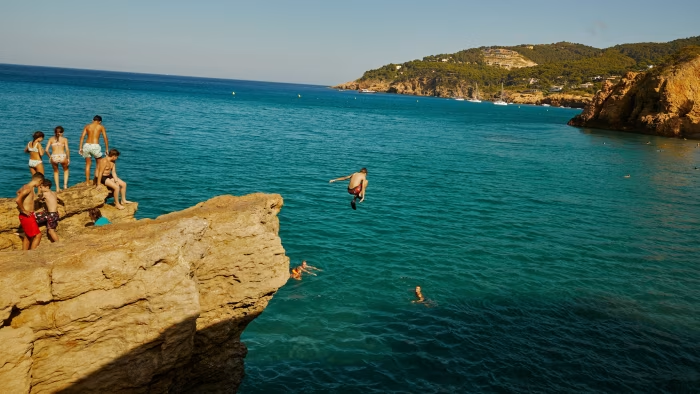
Having stuck — apart from a couple of kayak and paddle-board forays — to land all week, I was keen to see the area’s rugged coast from a distance and arranged a boat trip for our last day. The jagged, golden rocks, topped with patchy pine forests, looked even more dramatic from our 40-foot yacht. As we sailed south, our captain, Xavier Crosas, one of those rare souls that radiates so much joy and equanimity you want to hug him, pointed out the clifftop eyries of Barcelonian business leaders and caves cleft deep into the hillside. He dropped anchor a wavy swim from some jumping rocks, and my stepson climbed and then dive-bombed from them while we shuddered on the jetty below.
As we returned to Port Fornells, munching anchovy-stuffed olives and drinking cans of Estrella on the way, Xavi and I chatted about his meditation practice. Whatever he was doing, and his fingers, it seemed, were in many pies, his modus operandi was “in the moment”. Never allow your mind to drift elsewhere, he cautioned: “When you’re making the tortilla, you should be making the tortilla.” It became the catchphrase of the holiday. Still, as I took another look at those Costa Brava colours and contemplated a last long lunch, it occurred to me that something other than daily meditation might account for the profound sense of contentment Xavi exuded, and that, once again, it had left its mark on me.
Kate Maxwell is the author of ‘Hush’ (Little, Brown)
More autumn escapes in the Mediterranean

Sicily Southeastern Sicily has glorious baroque towns, long unspoilt beaches — and very hot summers. In August, Syracuse recorded a provisional European record of 48.8C. By October the heat should finally have eased, though the sea remains warm and the evenings balmy enough to stroll through Noto’s early 18th century streets eating a mulberry and almond granita. Newly opened this year, Il San Corrado di Noto (ilsancorradodinoto.com) is a former masseria (farmhouse) surrounded by citrus and olive groves in the Val di Noto, now converted into a peaceful retreat of 26 suites (from €590 per night) and six villas. Just outside Noto, I Lentischi, a stylish villa for seven with a 14-metre pool, costs from £3,696 per week in October with The Thinking Traveller (thethinkingtraveller.com).
Corsica Its enduring popularity among tourists from mainland France makes Corsica hugely seasonal; when August is over and the French return home, the island feels transformed. Cooler temperatures are also better for hiking the mountainous interior, including the celebrated GR20. Scattered through the maquis beside the southern coast, the Domaine de Murtoli (murtoli.com) is a dreamy collection of 20 shepherd’s houses and villas from the 17th-century (most with private pools), plus a hotel and three restaurants. Prices are dramatically lower in autumn — A Tiria, for example, a house for two, costs €1,620 per night in August but €560 in October.
Santorini With perhaps the most dramatic scenery of any Greek island, famous sunsets and its own international airport, Santorini can get uncomfortably crowded in summer. Autumn, however, is ideal: the hordes have gone but the restaurants remain open and the sunshine lasts well into November. Prices drop too — suites at the Nobu Hotel (nobuhotels.com), typically more than €1,000 per night in August, start at €595 in October; the Aressana Spa Hotel (aressana.gr) has doubles from €234. Meanwhile, sleeping 10 and looking out over the edge of the caldera, one of the island’s finest private villas (known as Santorini Naf by its agents Five Star Greece; fivestargreece.com) is available from €35,000 per week in October, rather than the usual €63,000.
Find out about our latest stories first — follow @ftweekend on Twitter