
Osmond Resources has jagged another set of encouraging assay results from step-out drilling at the company’s Orión EU Critical Minerals Project in southern Spain, reinforcing the scale and grade potential of its growing titanium, zirconium and rare earths discovery.
The latest diamond drill hole, SOR-02, intersected the same primary heavy minerals-rich quartzite layer that has delivered standout results from earlier drilling in zone one. This time, though, the drill rod struck paydirt 1.7 kilometres from the initial discovery holes AV-01 and AV-01bis. The result adds a strong vote of confidence that mineralisation extends over a substantial area.

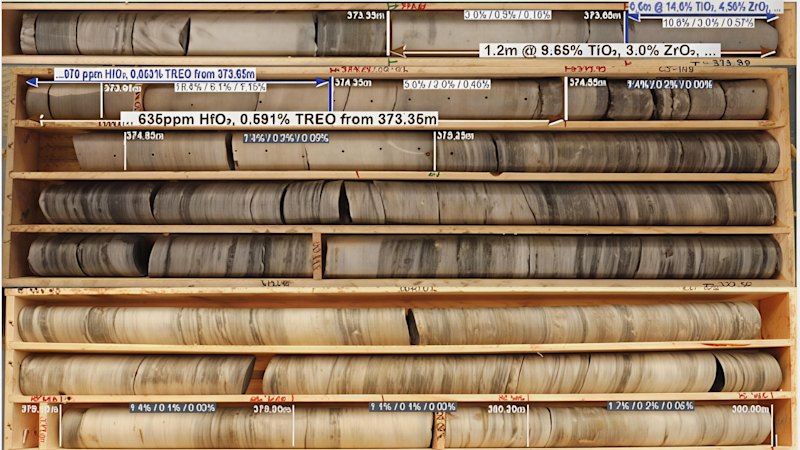
Diamond drill core SOR-02 photos showing individual sample assays and weighted average assay highlights.
SOR-02 intersected the target horizon at a depth of about 373 metres, deeper than earlier drill holes. Osmond says the increased depth reflects the hole’s position south of the initial drilling and on the downshifted side of a fault that cuts through zone one, rather than any change in the mineralised stratigraphy.
Fresh assays from the lab delivered some headline-grabbing numbers. A 1.2-metre interval from 373.65m returned a hefty 9.65 per cent titanium dioxide, 3 per cent zirconium dioxide, 783 parts per million (ppm) hafnium and 0.73 per cent total rare earth oxides (TREO). Within that zone sits a particularly rich 0.6m section grading 14.6 per cent titanium dioxide and 4.56 per cent zirconium dioxide.
Another narrow, but still impressive, intercept of 0.3m ran at 4.43 per cent titanium dioxide, 1.25 per cent zirconium dioxide and 0.285 per cent TREO, further underlining the consistent tenor of the heavy mineral layer.
Initial modelling suggests the mineralised interval could contain up to 14.4 per cent rutile, 5.5 per cent ilmenite, 7.9 per cent zircon and about 1.3 per cent monazite. For a single stratabound heavy mineral layer, those figures place Orión firmly among the upper echelon of global deposits.
The Orión project sits in Spain’s Jaén Province and targets the Ordovician-aged Pochico Formation – a siliciclastic sequence interpreted as a lithified placer sand system. In simple terms, the minerals were initially concentrated in ancient coastal sand deposits, then cemented into quartzite over time.
A key attraction is that the mineralisation is stratabound, occurring within predictable layers of a relatively flat-lying sequence. Where the quartzite unit outcrops at surface, it can be traced along strike, making exploration far more straightforward than many hard-rock systems.
Orión ticks multiple boxes on the European Union’s critical raw materials list. It hosts rutile, zircon and monazite – all primary sources of titanium, zirconium, hafnium and rare earth elements. Titanium underpins aerospace, defence and medical technologies, while zircon and zirconium are essential in ceramics, refractories and nuclear applications. Hafnium, which is rarely found in meaningful quantities, is prized for its use in nuclear control rods and high-temperature alloys.