
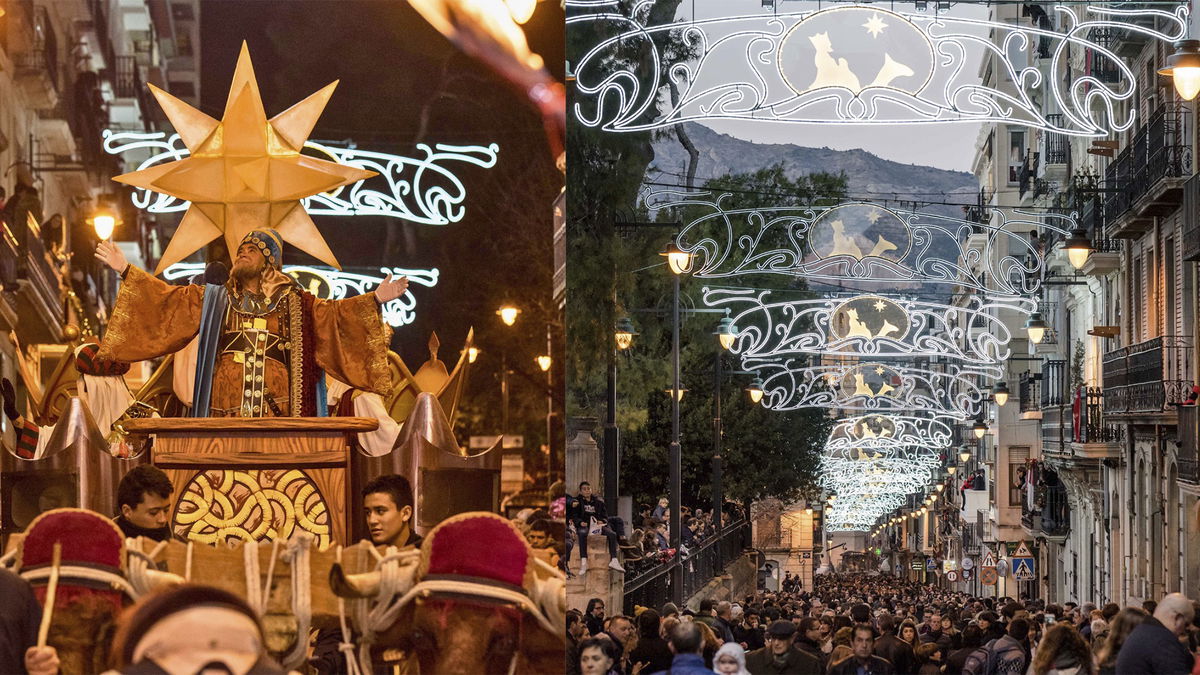
A deeply rooted Spanish tradition. Credit: Alcoy Town Hall
Rain is set to return just as one of the most magical days of the year approaches. On the eve of Epiphany, Monday January 5, the Three Kings are due to parade through towns and cities across the Costa Blanca before visiting homes to deliver gifts.
While the latter is not in doubt — after all, they are magicians — their traditional street parades could be affected by the expected rainfall. Gata has already announced the cancellation of its Misteri de Reis.
According to the latest forecast from Spain’s State Meteorological Agency (AEMET), there is a 100 per cent probability of rain in the Costa Blanca on Monday. The snow level is expected to be around 1,100 metres, an altitude that is only just reached by the Bernia mountain peak (1,128 metres), on the boundary with the Marina Baixa.
Snow in urban areas is therefore ruled out, but rain now appears almost certain. This could force last-minute cancellations of the popular Three Kings parades.
For the moment, all municipalities are maintaining their planned events. In Denia, however, municipal sources have confirmed that a final decision on whether the parade will go ahead will be taken on the day itself, depending on weather conditions at the time.
A deeply rooted Spanish tradition
The Cabalgata de Reyes is one of Spain’s most cherished traditions and marks the climax of the Christmas season. Held on the evening of January 5, the parade recreates the arrival of the Three Wise Men — Melchior, Gaspar and Balthazar — who, according to Christian tradition, brought gifts to the baby Jesus.
Across the country, the Three Kings parade through the streets on elaborately decorated floats, accompanied by music, dancers and costumed characters. During the procession, sweets are thrown to children, who eagerly await the moment when the Kings pass by before heading home to prepare for their own gifts.
The event is especially important for families, as in Spain it is traditionally the Three Kings, rather than Father Christmas, who bring presents to children. As a result, the Cabalgata carries a strong emotional and cultural significance, blending religious symbolism with popular celebration.
A highlight on the Costa Blanca: the example of Alcoy
On the Costa Blanca, the tradition takes on particular importance, with towns competing to offer ever more spectacular parades. One of the most famous examples is Alcoy, home to what is widely considered the oldest Three Kings parade in Spain, dating back to 1866.
Alcoy’s Cabalgata is renowned for its historical staging, with torchlit processions, biblical scenes and the iconic moment when the Kings’ assistants climb ladders to deliver gifts directly into homes. The event attracts thousands of visitors each year and has been declared an Asset of Cultural Interest.
Celebrations across the rest of Spain
Beyond the Costa Blanca, major cities across Spain also host large-scale Three Kings parades. In Madrid and Barcelona, the Cabalgata is a major public event, featuring large floats, performances and live broadcasts, drawing crowds of tens of thousands.
Other cities such as Seville, Valencia and Zaragoza also hold highly popular parades, each adding its own local flavour to the celebration. Despite regional differences, the message remains the same across Spain: the Cabalgata de Reyes is a night of magic, hope and excitement for children and adults alike.
Yellow weather warning for Sunday
AEMET has already activated a yellow weather warning for rain on Sunday. In the Marina Alta, the probability of rainfall is between 40 and 70 per cent, with up to 20 millimetres expected to accumulate in just one hour.