
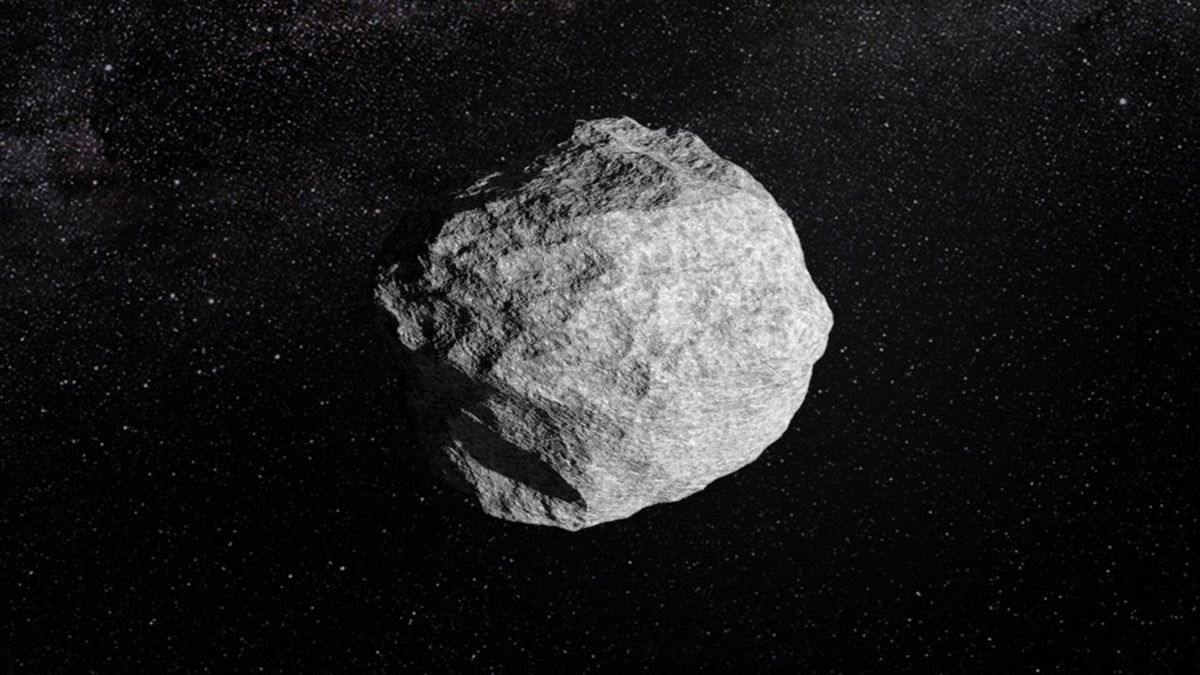
Artist’s impression of asteroid 2024 YR4, the object behind NASA’s latest 2026 warning to Spain.
Credit : www.esa.int
Spain has received an unusual heads-up from NASA, and it’s not the kind of update that usually lands on the desks of government ministries. The agency has alerted Spanish institutions to two major astronomical events coming in 2026 – one expected to draw crowds of excited sky-watchers, and another that scientists are treating with far more caution.
NASA is not sounding an alarm, but the message is unmistakable: Spain should be paying attention.
A once-in-a-century total eclipse will cross Spain from coast to coast
The first event is a spectacular one. On August 12 2026, a total solar eclipse will sweep across the country, cutting a dramatic path from A Coruña all the way to Palma, passing through cities such as Oviedo, León, Bilbao, Zaragoza and València. For astronomers, it is the sort of moment that comes around once in a lifetime – literally. It will be the first total eclipse visible from mainland Spain in more than 100 years.
Professional observatories, amateur astronomers and thousands of curious spectators are already gearing up for it. The Spanish National Geographic Institute has encouraged anyone planning to watch the eclipse to follow official guidance, as interest is expected to surge in the months leading up to August.
The phenomenon itself carries no danger, but authorities are already mindful of what happens when large numbers of people flock to rural areas in a short window of time: heavy traffic, crowded viewing spots and potential safety risks if people ignore proper eye-protection advice.
Still, there’s little doubt the eclipse will be one of the biggest scientific attractions of 2026 – a rare moment where the entire country stops to look up at the sky.
The second event is far less scenic: A “potentially dangerous” asteroid will pass near earth
Alongside the excitement, NASA has also flagged something more sobering. The asteroid 2024 YR4, officially classified as a Near-Earth Object (NEO), is expected to make a relatively close approach to our planet next year. It is not predicted to hit Earth – and NASA is being very clear about that – but the agency still places it in the category of “potentially dangerous” due to its size and orbital behaviour.
Spain is being briefed because European scientific institutions contribute heavily to the monitoring of NEOs, and disruptions from such objects don’t always involve dramatic collision scenarios. A close approach can affect satellites, GPS systems, radio communications and geomagnetic fields, systems that modern life relies on more than most people realise.
Earlier projections had suggested a theoretical impact possibility around 2032. That scenario has largely been dismissed, but close-approach calculations are regularly updated as new observations come in. NASA wants Spain – and the EU more broadly – to keep paying attention, run simulations and maintain clear communication between scientific bodies.
So no, there is no imminent threat, and Spain is not in the path of a Hollywood-style asteroid strike. But the agency is urging governments not to treat the approach lightly simply because a direct impact is unlikely.
Why NASA is alerting Spain now
In both cases, NASA’s message is about preparedness rather than panic.
For the eclipse, Spanish authorities will need to plan for movement across the country and ensure public safety messaging reaches people well before August. With so many Spaniards and international tourists expected to travel to rural and coastal zones, the event could strain road networks and local services if there is no advance coordination.
The asteroid, meanwhile, touches on wider issues: satellite security, communications and space-weather resilience. Spain is a key part of Europe’s space infrastructure, and NASA wants national bodies to be aware of every scenario – even those that seem remote.
NASA’s alert also reflects increasing global attention to how space events can affect Earth indirectly. As the agency notes, disruptions from the asteroid are unlikely, but not impossible. And in a world where aviation, digital banking, GPS navigation and meteorology depend on satellite stability, governments are expected to stay ahead of the curve.
For the public, the takeaway is simple: 2026 will be a landmark year in Spain for anyone who enjoys looking to the sky – but it will also be a year where scientists and institutions work quietly behind the scenes to make sure that admiration is the only thing we experience.