
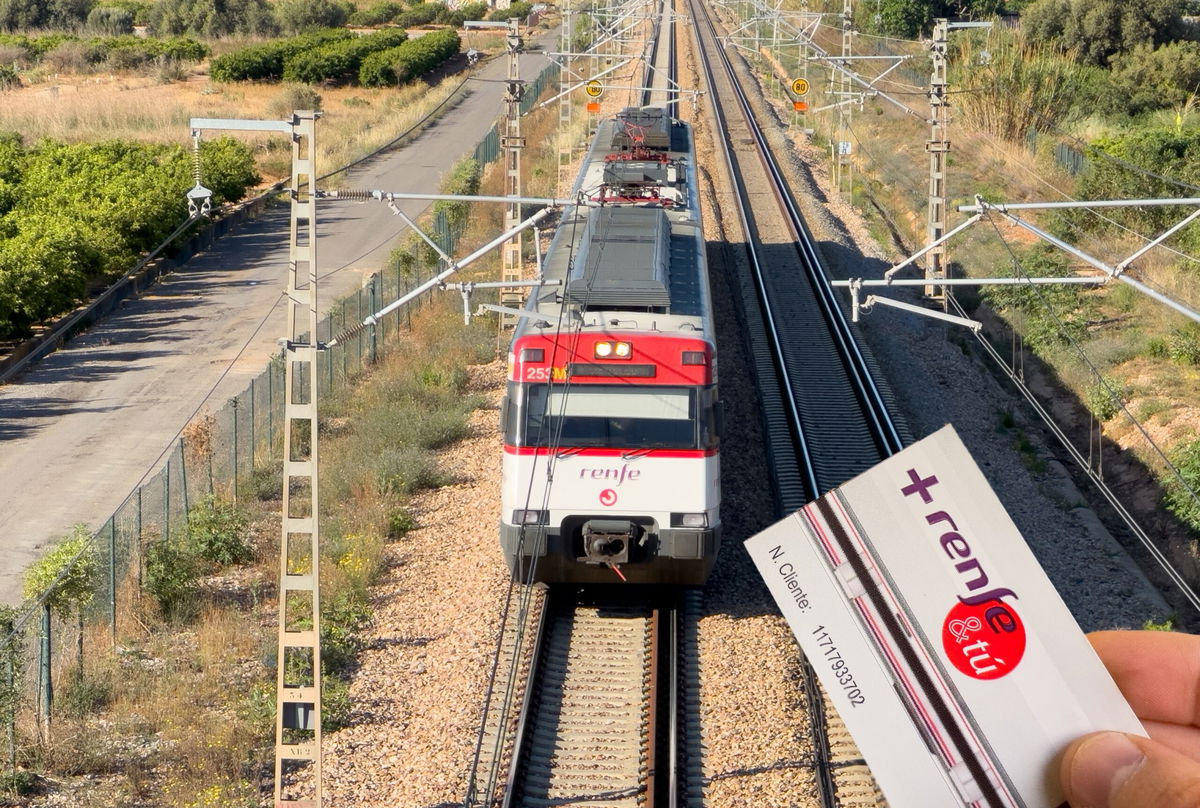
the pass will cover travel on Cercanías commuter trains, medium-distance intercity trains, and state-run bus networks throughout Spain. Photo credit: Maksim Safaniuk/Shutterstock
The Spanish government has announced the introduction of a national transport pass costing €60 per month, designed to allow passengers to travel across the country on a range of public transport services for a single flat fee. The measure was announced by Prime Minister Pedro Sánchez as part of the annual progress report and is scheduled to be approved at the final Council of Ministers meeting of the year before being implemented in the second half of January 2026.
Under the plan, the pass will cover travel on RENFE Cercanías commuter trains, medium-distance intercity trains, and state-run bus networks throughout Spain, offering a simplified and more affordable option for commuters and long-distance travellers alike. A reduced rate of €30 per month will be available for people under 26 years old, reflecting an effort to encourage younger residents to use public transport more frequently.
Aiming to reduce travel costs and boost sustainability
Discounts throughout 2026
The government has pitched the new pass as part of a broader strategy to reduce living costs and promote sustainable mobility. Sánchez highlighted that commuters who travel daily between cities could save up to around 60% on transport costs compared with current ticket prices. Supporters say the measure could ease financial strain on working-class and middle-income households, especially those who rely on public transport for daily travel.
The announcement also affirmed that existing transport discounts will continue throughout 2026, offering additional financial relief to regular users. The government has invited regional and local authorities to collaborate in extending the pass’s reach by integrating additional transport networks over time.
What the pass includes and limits
Services covered and implementation timeline
The pass will initially apply to Cercanías trains, medium-distance rail services and state buses, with the possibility of gradual inclusion of regional and local transport networks if local authorities choose to participate. This flexible approach recognises the complexity of Spain’s varied transport systems and the autonomy of local administrations.
Details about coverage remain partly provisional. Some commentators have noted that the pass will not initially include high-speed AVE services, and the degree of integration with metros and municipal buses will depend on future agreements. Authorities have emphasised that the measure is a starting point that can be expanded over time.
Public reaction and political context
Responses from users and officials
The scheme has drawn a mix of praise and questions. Many commuters and advocacy groups have welcomed the move as a significant step towards making travel more affordable and integrated nationwide. Analysts suggest that by streamlining ticketing and reducing costs, the pass could encourage more travellers to choose public transport over private cars, potentially aiding in climate and air-quality goals.
At the same time, some commentators and transport experts have pointed out unresolved details, such as the extent of coverage in the Balearic and Canary Islands or in smaller municipalities, and the practical arrangements for local transport authority participation. Authorities have encouraged regional cooperation to broaden the pass’s utility across all Spanish territories.
Key points
- The Spanish government will introduce a national transport pass costing €60 per month for travel on Cercanías, medium-distance trains and state buses nationwide.
- A reduced rate of €30 per month will be available for people under 26.
- The pass is expected to be approved by the Council of Ministers and come into effect from January 2026.
- It aims to reduce commuting costs significantly, with potential savings of up to 60% for frequent travellers.
- Existing transport discounts will continue through 2026 alongside the new pass.
- Inclusion of regional and local transport networks is planned progressively based on cooperation with local governments.
- Some coverage limitations and integration questions remain as authorities finalise operational details.
What comes next for the public transport sector
Looking ahead to implementation
The government plans to finalise the legal framework for the pass in the coming weeks, ahead of its formal adoption. Implementation will require coordination between national, regional and local authorities to ensure the smooth roll-out of ticketing and pricing systems. Officials have said that ongoing dialogue with transport providers and stakeholders will be crucial to expand the pass’s reach and effectiveness throughout Spain in 2026 and beyond.