
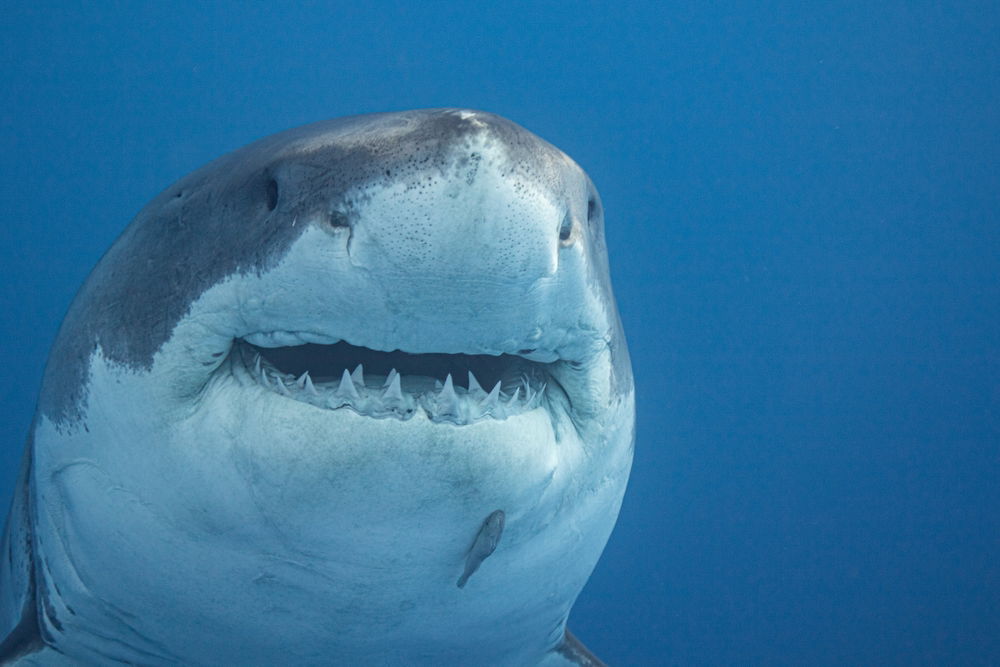
Great white shark close up. Spain’s Top 3 Deadliest Sharks: The most lethal predators spotted off the Spanish coast.
Credit: screamingtrees_22, Shutterstock
Whether you’re splashing in the shallows or sailing beyond the surf, Spain’s crystal-clear waters have a few slippery secrets. From lightning-fast predators to deep-sea legends, sharks do roam the Spanish coastline—and while attacks on people are rare, they do happen, and some of these toothy tourists pack a serious punch. Here’s your crash course in the top three most dangerous sharks found in Spanish waters—where they swim, what they eat, and how scared you really need to be. Let’s start with number 3…
3. The Blue Shark – Sleek and deadly
This open-water assassin is the most common predator seen off Spain’s shores.
Known locally as the tintorera, the blue shark (Prionace glauca) cruises both the Atlantic and Mediterranean, often venturing surprisingly close to popular beaches in Valencia, the Balearics, and the Canaries.
Blue sharks aren’t usually aggressive—but don’t get too cosy.
In August 2023, a blue shark bit a man on the foot at Rabdells Beach in Valencia, prompting a beach evacuation. According to Shark Sider, the man suffered minor injuries, but the panic was real. Screams, sirens, and TV crews—by the time it was over, the beach looked more like a movie set than a holiday spot.
Blue sharks in Spain can grow up to 3.8 metres and are known to travel in groups—like a gang of underwater hooligans. While they mostly chase squid and fish, they’ve got curious natures, and aren’t afraid to nose around swimmers.
2. The Shortfin Mako Shark – Strong, fast, and aggressive
Fancy a shark that can outpace your jet ski? Meet the shortfin mako —the fastest shark in the sea, clocking speeds of up to 50 km/h during their hunts.
Found mainly in northern Atlantic waters off Galicia, this musclebound missile of a fish can launch itself several metres out of the water like a rocket.
These sharks are powerful, aggressive, and not afraid to investigate potential prey—including humans. Luckily, they prefer deep water and have rarely been spotted near Spanish beaches.
Still, if you’re out in open water, you’d do well not to dangle your toes too long. Makos can grow over 4 metres, and they’re equipped with dagger-like teeth perfect for tearing into tuna—and anything else that gets in the way.
1. The Great White Ghost – Spain’s rarely-seen apex predator
Yes, great white sharks in Spain are real. Yes, they’ve been spotted in Spanish waters. And yes… it’s probably best not to think about that next time you go snorkelling.
The great white shark is the deadliest shark on Earth, and while they’re incredibly rare off Spain, they do appear—especially around the Balearic Islands and Strait of Gibraltar.
In 2018, marine biologists confirmed a great white near Mallorca, the first such sighting in over 30 years. The shark was filmed calmly circling a research boat, prompting headlines across Europe. The Guardian reported: ‘The presence of a great white shark in Spanish waters is a significant find,’ said Alnitak research team member Ricardo Sagarminaga.
These ocean giants can grow up to 6 metres, with jaws strong enough to bite clean through bone. Although no recent confirmed beach attacks have been linked to great whites in Spain, they’ve earned their reputation for a reason.
Death in the deep – the 2024 tragedy
Shark fear isn’t just tabloid talk. In September 2024, a 30-year-old German woman was killed in an unprovoked shark attack while swimming near a catamaran in international waters south of the Canary Islands.
As reported by Reuters, the shark bit her leg, leading to massive blood loss and cardiac arrest. Authorities couldn’t confirm the species, but experts suspect a large shark, possibly a mako or great white.
It was Spain’s first fatal shark incident in modern history—a grim reminder that while shark attacks are rare, they can be deadly.
Should we panic?
Not at all. In fact, according to the International Shark Attack File, Spain has recorded just 13 confirmed shark attacks in its entire history — with only 6 unprovoked. This doesn’t include the 2024 fatal incident, which may not be listed as it was ‘technically’ in international waters.
Sharks generally avoid humans, and most sightings in Spain are harmless.
Still, it never hurts to follow basic beach smarts if you’re swimming off the coast in deep waters:
- Avoid dawn and dusk swims
- Stay in groups
- Ditch the shiny jewellery (it looks like fish scales!)
Final take
Spain may not be the US, Australia, or South Africa, but that doesn’t mean it’s shark-free. Whether it’s the sleek blue shark, the turbocharged mako, or the legendary great white, the deep holds plenty of secrets—and sometimes, they come a little closer than we’d like.
So go on—take that dip. Just don’t forget to glance at the water…
Read more news written for people living in Spain.
Get more original news and insights from around Europe.