
The floods that hit Valencia have claimed more than 200 lives and will cost at least 17 billion euros in damages. But even this has so far failed to merit a visit from the president of the European Commission, Ursula von der Leyen. Not even a single commissioner has visited the region. This deliberate decision is at odds with the reaction to the German and Belgian floods of 2021, which left well over 50 billion euros in damage (according to the European Commission) and dozens of deaths. President Von der Leyen then rushed to visit the affected areas. Fourteen out of the twenty-seven European Commissioners, including the German herself, are part of the European People’s Party (EPP). But none of them have had time to support their Spanish partners.
“Almost three months later, Von der Leyen has not had a day to pass through Valencia”
A month before the Valencia disaster, there were floods with dozens of deaths in Poland and other central European countries. Von der Leyen immediately rushed to the region with 10 billion euros. Almost three months later, she has not had a day to pass through Valencia. If even Alberto Núñez-Feijóo did not appear with Carlos Mazón when he visited the affected area, why should the commissioners do it?
According to diplomatic sources in Brussels, the decision has been carefully considered. The European authorities would rather not be portrayed with Carlos Mazón, whom they have no intention of receiving in EU institutions either. The Valencian president is a political corpse. This explains why no European official wishes to appear next to him in any way.
“The Valencian president is a political corpse. This explains why no European official wishes to appear next to him in any way”
There are no free lunches at the European Commission. That is why, last week, three commissioners —Italian Raffaele Fitto, Dutch Wopke Hoekstra, and Finnish Henna Virkkunen— met with the Mayor of Valencia, María José Catalá. She is a protégé of the EPP MEP Esteban González Pons, who is also an internal rival of Carlos Mazón. Catalá was also received by the President of the European Parliament, Roberta Metsola, a fellow member of the EPP. Without raising their voices, the European stance was made clear. Those who want to understand will understand: Catalá, yes; Mazón, no.
Brussels has not forgotten the early days of November, either. That week, the Spanish Popular Party (PP), with the circumstantial support of the European EPP leader Manfred Weber, jeopardised the ratification of the new College of Commissioners —the second under Von der Leyen—. They attempted to block the appointment of Teresa Ribera —in effect the deputy leader of the European Commission— in an effort to cover up the scandal surrounding Carlos Mazón’s hours-long disappearance and the chaotic response of the Generalitat Valenciana to the floods. Although Ribera’s appointment was never in doubt in Brussels, no one forgets that the PP prioritised the reputation of a politically damaged regional leader over the stability of European institutions and Von der Leyen’s second mandate. Even if she was part of their political family. The leadership of the PP must now come to terms with the fact that Von der Leyen does not reward traitors.
The political situation in Valencia has a dimension that directly impacts the EPP, and even Von der Leyen herself. The European conservatives are set to organise a major congress next May in the city. The PP has been working for months on a summit meant to bolster Núñez-Feijóo’s leadership. The meeting will coincide with the new U.S. Secretary of State, Marco Rubio, completing his third month in office. Which is remarkable, as Rubio is a close friend of former Spanish President José María Aznar and a potential ally of the more right-leaning wing of the PP, which might seek to challenge Núñez-Feijóo’s leadership.
“A congress should project an image of success, not the picture of hundreds of MEPs, commissioners, and ministers trapped with a man they wish to avoid, surrounded by protesters”
European conservatives are questioning the advisability of participating in a political congress that could become the target of Valencian citizens’ discontent, as already evidenced in several protests attended by tens of thousands of people in the aftermath of the tragedy. In light of this, the Popular Party’s headquarters in Madrid’s Genova Street has begun circulating the argument among sympathetic journalists that the issue might be the security of the congress if such protests occur.
The intention behind this effort would be to lay the groundwork to relocate the congress to another Spanish city more favourable to the PP. They would kill two birds with one stone: avoiding the protests and avoiding being photographed with Mazón, a political pariah. A congress should project a positive image, one of success, not the picture of hundreds of MEPs, commissioners, and ministers trapped with a man they wish to avoid, surrounded by protesters.
The PP’s Reaction
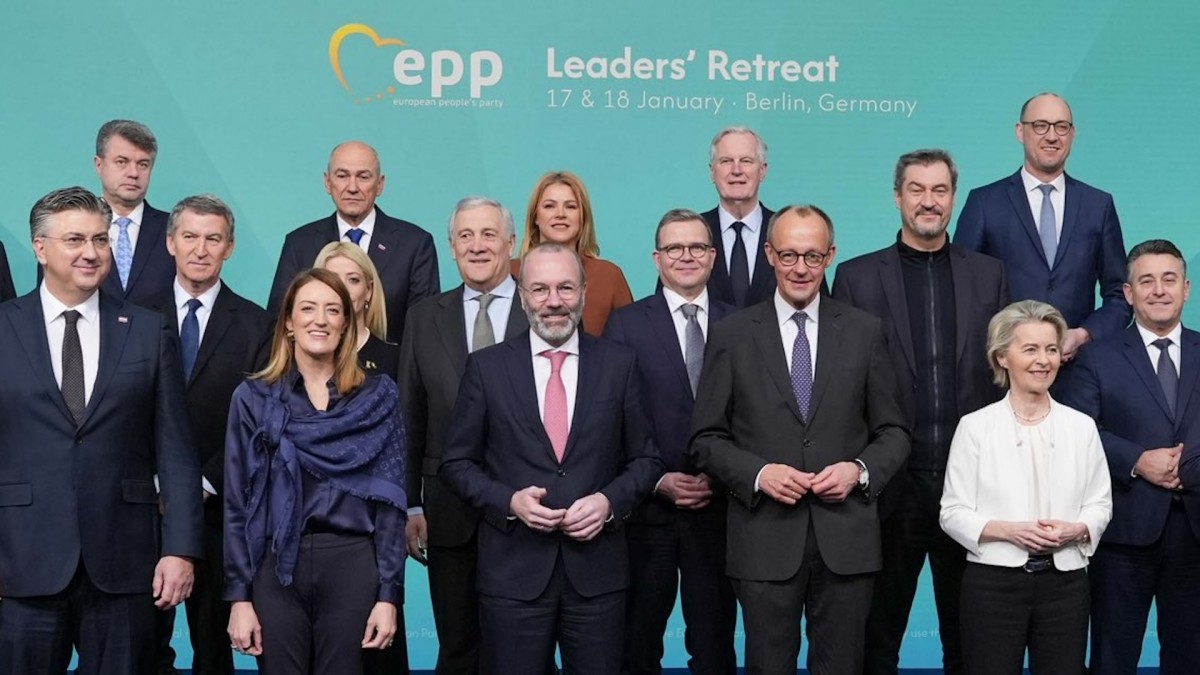
This past Friday and Saturday, senior officials of the EPP met in Berlin with the party’s national leaders, both in power and in opposition. Attendees included Weber, Von der Leyen, Núñez-Feijóo, and, notably, Friedrich Merz —most likely the next German chancellor. The Spanish conservatives managed to get a press release from that meeting to suggest that Europe is concerned about the rule of law in Spain, likening it to Hungary’s situation. This concern is unfounded, as it would appear in the annual rule of law reports issued by the European Commission if it were genuine.
“The concern about the rule of law in Spain in Europe is unfounded, as it would appear in the annual reports issued by the European Commission if it were genuine”
Weber acquiesces to the initiatives of the PP because he knows he needs the Spanish conservatives to secure his position at the May congress. If the Spaniards turn against him and align with conservative factions that are challenging his leadership—such as the Dutch, some Scandinavian, or the Greek—his position could be precarious. Weber also knows that Merz’s likely rise to power, probably in coalition with the Social Democrats, will tie his hands in Brussels. When this happens, the days of dealing with the far-right, something the PP has normalised, but the German CDU outright rejects, will be over.