
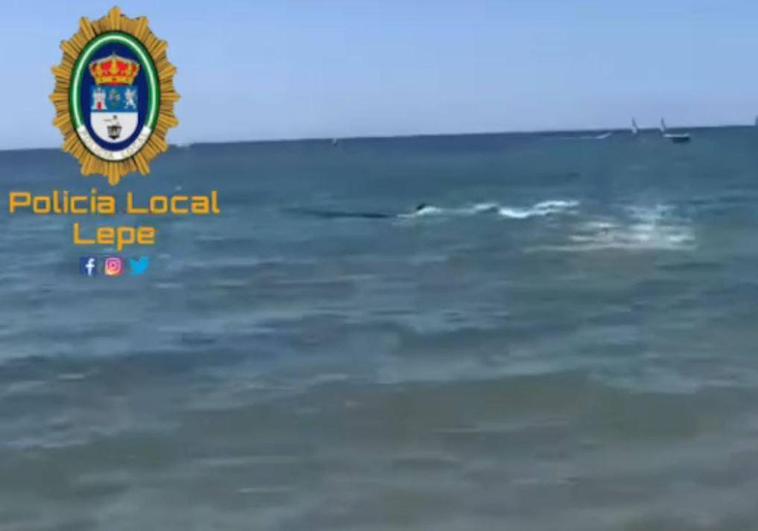
The whale was very close to the shore. Credit: Policia Local de Lepe
SCREAMS were heard from terrified beach goers at La Antilla in Huelva province on Tuesday, July 11, when a large aquatic mammal was sighted just a few metres away from the crowded shoreline and close to a breakwater.
The fast moving mammal caused chaos and confusion, especially among those having a peaceful swim in the Mediterranean sea. With the public shouting from the beach, swimmers quickly made their way back to safety.
The mammal however, seemed to be difficult to identify, until the local police force of Lepe solved the mystery in a social media post.
Before the police explanation, the video of the unknown visitor had quickly spread on the internet, and there was speculation that it could be a killer whale, a large dolphin or even a small whale.
“TRANQUILIDAD! It is not a shark, and you are not going to see Steven Spielberg with his camera on the shore. Nor is it a killer whale. What has visited us seems to be an example of ‘Ballenato Picudo de Cuvier’ (Cuvier’s beaked whale or Goose beaked whale). It boasts the record of having the deepest and longest dives among whales, but is very sensitive to sound. It is possibly confused and almost on the brink of being stranded,” stated Lepe police in a light-hearted social media post.
Inhabiting waters deeper than 300 metres deep, the beaked whale has been previously recorded at a depths of 2,992 metres, and being underwater for 222 minutes. The frequency and reasons for these extraordinary dives are unclear. Despite its deep-water habitat, it is one of the most frequently spotted beaked whales. These measurements were recorded using satellite tagging systems.
The beaked whale has a wide range and is found in many of the worlds oceans. Most of this species can be found in the eastern tropical Pacific Ocean, where there is an estimated 80,000 of the 100,000 found worldwide.