
RABAT –
Morocco and Spain are entering a new phase of cooperation after years of strained relations, officials from both countries say, as shared projects such as co-hosting the 2030 FIFA World Cup and the planned construction of a 28-kilometre undersea tunnel between Europe and Africa signal a strengthening partnership.
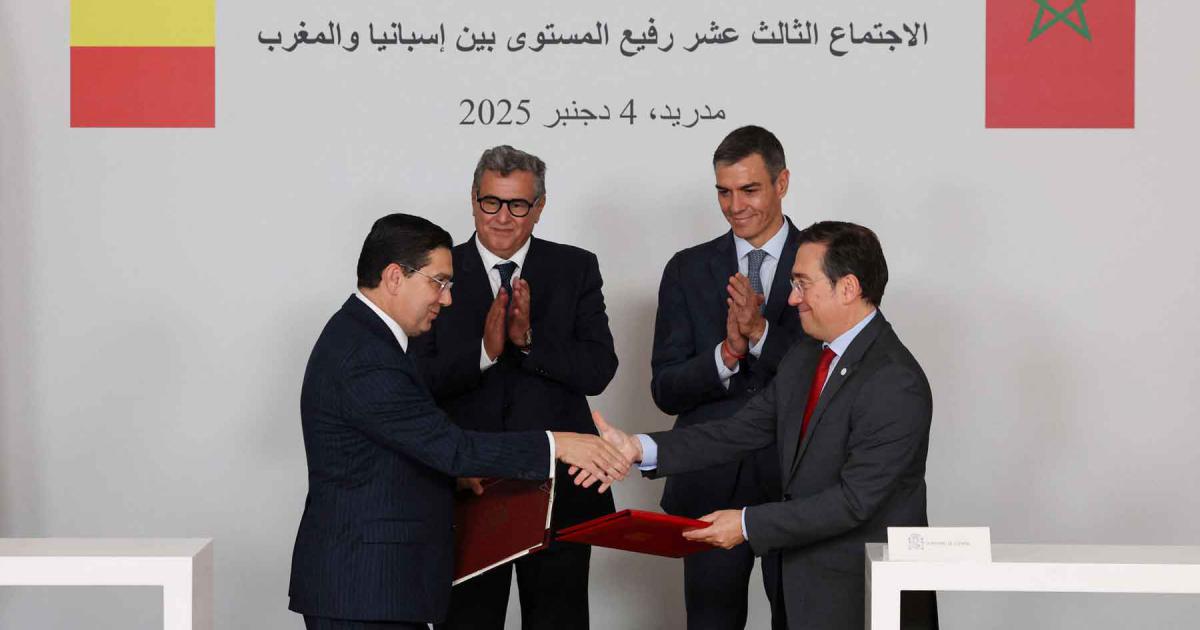
The two nations recently signed 14 agreements covering multiple sectors during the 13th high-level bilateral meeting in Madrid, reflecting a “positive trajectory” in ties that had previously been described as in a grey zone.
While Morocco’s Foreign Minister Nasser Bourita described the relationship as experiencing an “unprecedented phase,” he stressed the need for innovative solutions to outstanding issues, including maritime borders and Madrid’s management of the airspace over Western Sahara.
“This comes after the restoration of political trust and the resolution of misunderstandings, capped by Spain’s recognition of Morocco’s sovereignty over Western Sahara and support for the Moroccan autonomy initiative,” said Nabil al-Andalusi, head of the Maghreb Centre for Strategic Studies. “The signing of 14 agreements is a clear indicator of the positive trajectory of bilateral relations.”
Andalusi emphasised that the relationship has shifted from a reactive approach to crisis management to a strategic partnership encompassing vital sectors such as security, economy, energy, migration, and unprecedented political coordination. He added that “despite remaining sensitive issues with historical depth, the two countries now manage them through cumulative, peaceful settlements rather than confrontational approaches.”
The December agreements cover areas including foreign policy, justice, transport, agriculture, fisheries, education, scientific research, sports, migration and earthquake monitoring. Morocco and Spain have also launched joint initiatives in West Africa, particularly in electricity, green hydrogen and logistics, as part of efforts to deepen strategic and economic collaboration.
The improved climate follows Spain’s April 2022 endorsement of Morocco’s autonomy plan for Western Sahara, which Madrid described as the “most serious, realistic and credible basis” for resolving the protracted dispute. The move effectively ended a year-long diplomatic crisis that began after Spain hosted Polisario Front leader Brahim Ghali and established a roadmap for bilateral cooperation.
On migration, Morocco has become a key security partner, thwarting more than 34,000 irregular migration attempts from January through December 17. Overall, arrivals in Spain dropped by 40.4 percent to around 36,000 people in 2025, compared with over 60,000 in the same period in 2024, according to Spanish government data.
Airspace management over Western Sahara remains under Moroccan control, including flights between Marrakech, Laayoune and Dakhla, while discussions over maritime border demarcation in areas rich in cobalt and rare minerals are ongoing. Andalusi notes that technical arrangements have allowed Spain to gradually recognise Moroccan sovereignty over the region without provoking domestic political tensions.
On long-standing issues such as Ceuta and Melilla, Morocco is pursuing a long-term, patient approach, maintaining its claim while avoiding immediate diplomatic confrontations. Meanwhile, irregular migration has shifted from a point of contention to a framework for cooperation, bolstered by European support for development and border management.
The partnership is further symbolised by the 2030 World Cup, to be co-hosted by Morocco, Spain, and Portugal, and the ambitious undersea tunnel linking the two continents, projected to cost up to €15 billion ($17, 5 billion). These initiatives demonstrate how the two nations have moved from historic tension to a strategic, mutually beneficial partnership, underpinned by intertwined political, economic, and geopolitical interests.
Andalusi predicts that bilateral ties will remain relatively stable, noting: “Recognition of the Moroccan autonomy initiative in Western Sahara has become Spanish state policy rather than merely a government decision, which provides continuity regardless of potential political changes in Madrid.”