
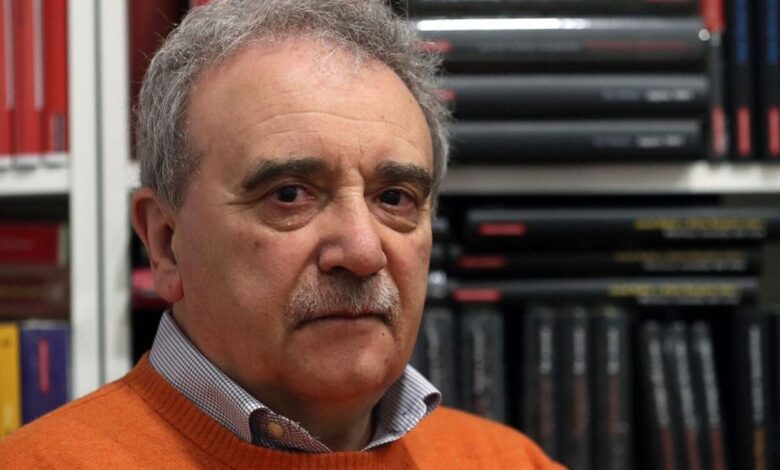
Manolo Longares (Manuel Longares) avoids grand gestures, but his perspective on Madrid is always captivating. At 82, he continues to write about the capital as if discovering it anew. His style is calm, laced with gentle irony and free of unnecessary pomp. Longares has often said that Madrid doesn’t need special adjectives: the city itself is literature, and everyone who arrives here finds themselves in the middle of a story that began long before they came.
Recently, the writer received the inaugural Sentir Madrid prize from the city council. The jury praised his ability to view Madrid through both experimentation and tradition, carrying on the legacy of Galdós and Juan Eduardo Zúñiga. According to Deputy Mayor Marta Rivera de la Cruz, Longares is an ideal laureate: his books not only describe the city, but also bring it closer, make it more understandable, and reveal its many layers.
The city through the prism of time
Longares’s childhood memories are of a postwar Madrid: cold, poor, with rundown buildings. He recalls that people then focused more on what they lacked than on what they had. These memories are free of nostalgia, but show the attentiveness to detail that would later define his prose. He was born at the intersection of Alcalá and Conde de Peñalver—on the border between the city center and the Salamanca district. This dividing line became a symbol for him: of transition, observation, and constant movement.
Studying at Colegio del Pilar felt like a struggle for survival: everything was learned by rote, no one pondered the meaning, the main thing was to keep moving forward. Longares admits that it was during this time he learned to be resilient and to maintain his curiosity about the world.
Madrid through the eyes of a writer
Longares avoids describing the famous avenues and squares. His Madrid is made up of alleyways and hidden streets where life unfolds unnoticed by most. He says the true essence of the city lies in these ‘semi-criminal’ backstreets, where everything seems accidental, but it’s exactly there that Madrid’s unique atmosphere is born.
The writer often reflects on the character of Madrid’s people. In his view, they are always in the know but rarely ask questions. Everyone is busy with their own affairs and doesn’t like idle talk, but that’s part of their naturalness. This, according to Longares, is what makes Madrid unique: no one tries to show off, everyone lives their own life.
The road to journalism
Longares came into journalism by chance, following a friend’s advice. In the early years, the work seemed pointless: routine tasks and corrections that changed little. It was only at Cambio 16 magazine that he realized journalism could be a collective endeavor, especially during Spain’s transition to democracy. In those days, the newsroom buzzed with life, debates about change were constant, and everyone felt part of something bigger.
However, Longares has always had a complicated relationship with journalism. He believes that literature and newspapers are incompatible: newspapers demand facts, while literature thrives on confusion, mistakes, and imagination. Nevertheless, it was journalism that gave him experience in communication, taught him to listen, and to notice details in conversations.
Литературные эксперименты
Longares does not hide that his books have not always been understood by readers. He calls the series ‘La vida de la letra’ (‘The Life of the Letter’) his boldest experiment. According to him, some friends even avoided meeting him after reading it—the style seemed so unusual to them. The writer is convinced that literature is work, solitude, and constant doubt. He admits that he does not always know where a text will lead and often lets his emotions guide him ahead of logic.
For Longares, it is crucial to find that one word that sets the entire story in motion. Once it is found, the text takes on a life of its own, and the author’s task is simply to follow it and then spend a long time editing.
A novel about Madrid
Longares’s most famous book is ‘Romanticismo’. It grew out of personal experience: his student years in the Salamanca district, where different generations and social classes crossed paths. The novel portrays a bourgeois family undergoing change after Franco’s death. The author shows how the fear of change and the desire to preserve the familiar way of life prove stronger than any ideology. Attention to detail, irony, and precise observation have made the novel relevant even today.
Longares notes that residents of Salamanca may seem friendly, but in reality, they always keep their distance. They might greet you, but their minds are elsewhere. According to the writer, this very trait is what preserves the spirit of Madrid—the city changes, but its essence remains the same.
New projects
Longares is currently working on a new novel, “Courtisans” (Cortesanos), set in the 18th century. The author admits to writing at night when the city falls asleep. For him, literature is a way to breathe, to find strength for a new day. The Sentir Madrid Prize will be awarded to him after the New Year holidays, once the date is coordinated with the city administration and the author himself.